English हिन्दी
Connect with us

India News

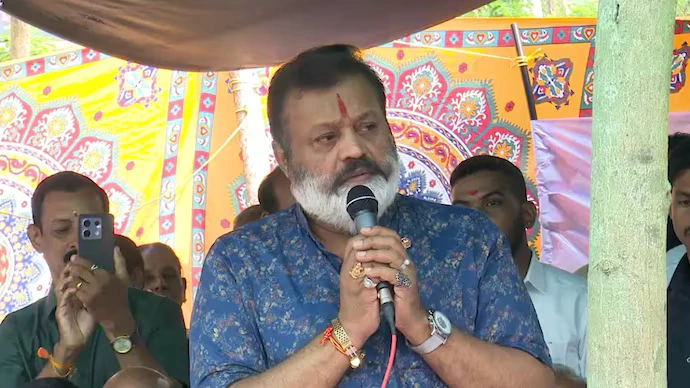
Suresh Gopi backs Waqf Bill amid land row in Kerala, calls it beneficial for Munambam residents

Union Minister Suresh Gopi supports the Waqf Bill citing benefits for Munambam residents, but lashes out at media over questions related to a recent priest attack in Jabalpur.

Published

on

Suresh Gopi

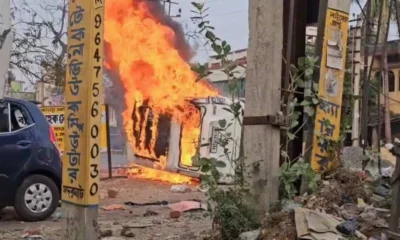
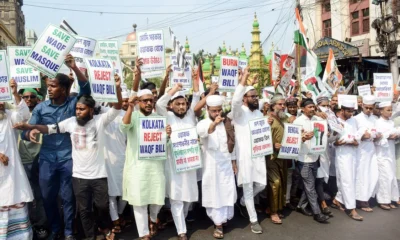
Union Minister Suresh Gopi strongly defended the Waqf (Amendment) Bill on Friday, asserting that the new legal changes would help people in Munambam, Kerala, who have been disadvantaged due to existing Waqf land claims. Speaking in Kochi, he criticised both the Congress and CPM, remarking, “Some people claimed the Waqf Bill would be thrown into the bin in the Joint Parliamentary Committee (JPC). Let’s see how it pans out.”

He insisted that the amended law would correct past injustices and benefit local residents who’ve been entangled in ownership disputes involving the Waqf Board.

Heated response on Jabalpur priest attack

Gopi, however, grew visibly agitated when questioned about the recent attack on Malayali priests in Jabalpur, Madhya Pradesh. Reacting sharply, he said, “Go ahead and do a post-mortem of my tongue, but don’t dissect my mind.” He compared the incident to past controversies involving Christian leaders in Pala, Kerala, and questioned the media’s line of inquiry, stating, “Who are you? Whom are you questioning? Be very careful while speaking.”

His remarks came as reporters pressed for a response to the assault on Christian priests and community members in Jabalpur.

George Kurien demands justice for Munambam

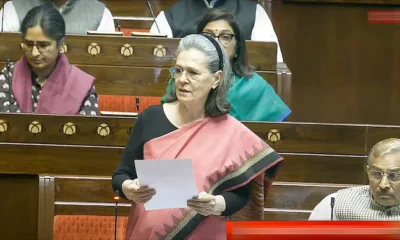
Meanwhile, Minister of State for Minority Affairs George Kurien voiced strong support for the residents of Munambam during a Rajya Sabha discussion on the Bill. He demanded that the Waqf Board produce legal documents to justify its claim over land in Munambam and asserted that ownership must be restored to rightful holders.

Kurien emphasized that “any provision of law that contradicts the Indian Constitution must be amended,” and said that the rights of all religious minorities must be protected. He also accused opposition leaders of trying to mislead the Muslim community in Kerala, whom he described as “gentle and pious.”

India News

Protesters pour in to Jantar Mantar, Centre readies for discussion in Parliament

Published

on

By

The agitation led by the Cockroach Janta Party (CJP) over alleged irregularities in the NEET-UG examination continued on Wednesday, with more people making a queue to join the demonstration at Jantar Mantar despite Delhi Metro shutting station gates, police action, ongoing negotiations with the Centre and heightened security across the capital.

Protesters regrouped at Jantar Mantar from late at night on Tuesday with CJP leaders warning that the Parliament march was “just a trailer” and that larger demonstrations would follow if the government failed to respond. The protest’s impact was also felt in Parliament, where repeated Opposition protests over the police action led to disruptions and adjournments in both the Lok Sabha and the Rajya Sabha.

Last evening, Congress leaders led by Rahul Gandhi and Priyanka Gandhi and Samajwadi Party president Akhilesh Yadav had staged a demonstration outside PM Narendra Modi’s residence. While Rahul’s protest drew kudos all around, AAP leaders mocked him for trying to hijack the movement that had been led by the CJP.  

In a related development, the Supreme Court declined an urgent hearing on a plea seeking intervention over the alleged police action against CJP protesters, directing the petitioner to follow the regular listing procedure.

Meanwhile, Delhi Police registered multiple FIRs in connection with Monday’s violence and maintained heavy deployment around Parliament House and Jantar Mantar. The Delhi Metro Rail Corporation closed 16 Metro stations across central Delhi, with trains passing through without halting. Interchange facilities were available at Rajiv Chowk, Mandi House and Central Secretariat, while commuters were advised to check official service updates. Traffic diversions and station closures disrupted travel across the city.

With protesters refusing to withdraw and the Centre signalling that dialogue will continue, the agitation remains one of the biggest political challenges confronting the government during the Monsoon Session.

The CJP agitation took on a new lease of life and urgency on Monday when thousands of CJP supporters marched to Parliament under the banner of Chalo Sansad on the opening day of the Monsoon Session. Protesters demanded the resignation of Education Minister Dharmendra Pradhan, a parliamentary debate on the alleged examination irregularities and reforms in the examination system. Delhi Police stopped the procession near Parliament, citing security concerns and the absence of permission. They then used tear gas and lathicharged the march saying some protesters attempted to cross barricades. Several demonstrators, including CJP founder Abhijeet Dipke, were briefly detained. Over 100 students were treated for injuries including fractures and pellet wounds, a similar number of police personnel were also injured thought not as severely, reports said.

The stalemate in the government position to engage with the protesters broke on Monday. Health Minister JP Nadda met a CJP delegation, which submitted a memorandum outlining its demands. Government sources said the minister urged protesters to end the agitation and assured them that their concerns would be examined. However, CJP leaders said the meeting produced no concrete outcome and vowed to continue the protest.

Activist Sonam Wangchuk, who was forcibly moved to hospital by police after his health deteriorated on his indefinite fast, remains under medical supervision with the court’s clearing his request to be moved from Safdarjung Hospital to Medanta hospital.

Continue Reading

India News

Vijay’s TVK demands scrapping NEET, seeks state control of medical education

Published

on

By

Tamil Nadu CM Vijay speaking on stage

Tamilaga Vettri Kazhagam (TVK), led by Tamil Nadu Chief Minister C. Joseph Vijay, has on Wednesday again demanded the complete abolition of the National Eligibility-cum-Entrance Test (NEET).

The party described its position as an “uncompromising and firm stand”, stating that it is not merely seeking reforms in the examination system but wants NEET scrapped entirely. The statement comes amid nationwide protests and growing concerns over alleged irregularities in the medical entrance examination.

A TVK statement said medical education should come under the full control of state governments rather than the Centre. The party demanded that education be shifted from the Concurrent List to the State List of the Constitution, allowing states to decide their own admission policies for medical colleges. As an interim measure, TVK proposed creating a Special Concurrent List that would grant states greater authority over education until constitutional changes are made.

The party criticized what it called the “One Nation, One Education” approach, arguing that a single national entrance test places students from rural areas, government schools, Tamil-medium institutions, and economically weaker sections at a disadvantage. TVK reiterated its demand that admissions to MBBS, BDS, and AYUSH courses under the state quota should be based on Class 12 examination marks instead of NEET.

TVK’s latest statement comes as students and activists across the country continue to protest over examination irregularities. The party clarified that its opposition to NEET is not limited to recent controversies but is based on its long-standing belief that states should have complete authority over medical education and admissions. It criticized political parties that promised to abolish NEET without delivering on those commitments, without naming the rival DMK.

The demand has reignited the debate over the future of NEET and the balance of power between the Centre and the states. Supporters believe scrapping the examination would provide a fair opportunity for students from different backgrounds, while opponents argue that NEET ensures a uniform standard for medical admissions across India.

At present, NEET remains a national-level entrance examination, and the Union Government has not announced any decision to abolish it. However, TVK has said it will continue to press for constitutional changes and greater state autonomy in medical education.

Continue Reading

India News

For second time, US strikes ship with Indian crew near Strait of Hormuz

Published

on

By

Strait of Hormuz

The United States Central Command (CENTCOM) has said that an oil tanker carrying Indian crew was drifting with its engine switched off near the Strait of Hormuz before it was struck by US forces.

A CENTCOM spokesperson said the vessel had stopped due to engine failure and was drifting after its crew repeatedly sought additional time to carry out repairs. US officials said the tanker was struck only after it failed to comply with directives issued by US forces enforcing a blockade on vessels allegedly transporting Iranian oil. The military said the strike was aimed at disabling the ship by targeting its engine room rather than sinking it.

The incident involved a tanker carrying Indian seafarers near the Gulf of Oman, close to the Strait of Hormuz, one of the world’s busiest maritime trade routes. The strike triggered a fire onboard, prompting rescue efforts by Omani authorities and maritime agencies. Indian authorities closely monitored the situation and coordinated with local officials regarding the welfare of the crew members.

The incident has drawn concern in India, with the government emphasising the safety of Indian nationals working aboard commercial vessels in the conflict-hit region. The Ministry of External Affairs has remained in touch with the authorities concerned as tensions between the United States and Iran continue to pose risks to international shipping.

In June, three Indian sailors were killed in a US strike on another oil tanker. The Strait of Hormuz handles a significant share of the word’s oil trade, and the latest incident has renewed concerns over the security of merchant vessels operating in the region. Maritime experts have warned that escalating hostilities could further disrupt commercial shipping and endanger civilian crews navigating one of the world’s most strategically important waterways.

Continue Reading

Trending

© Copyright 2022 APNLIVE.com