
Latest Science News
New study says haze may be contributing to warming in South Asia


[vc_row][vc_column][vc_column_text]By Dinesh C Sharma
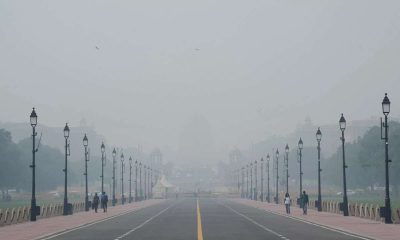
The haze over the national capital and Northwest India seen during winters is not only causing problems to people on the ground but also impacting atmospheric climate. A new study by an international group of researchers has found that the composition of a class of carbon-carrying aerosols in the haze changes as it travels from above the landmass to the oceans.
The light absorption capacity of brown carbon – a key component of the haze – decreases during transport but its bleaching half-life is 3.6 days compared to 9 to 15 hours in other regions. This means that brown carbon stays in the South Asian atmosphere for a longer duration and thereby may contribute to warming of the region, according researchers.
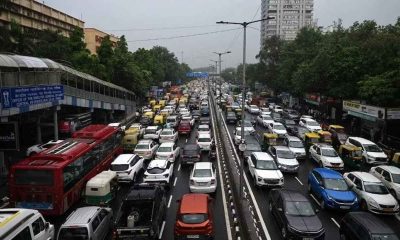
The haze, also called atmospheric brown cloud (ABC), contains several types of particles emanating from vehicular pollution, biomass burning and other sources. This layer of polluted air plays critical role in regional climate as it both absorbs and scatters incoming solar radiation.

Sanjeev Dasari, lead author of the study
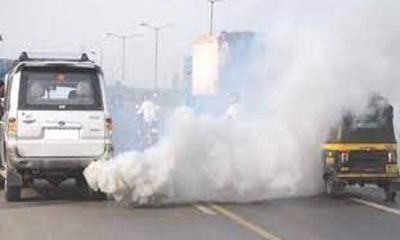
Two important light-absorbing components of ABC are black carbon and brown carbon. While black carbon mainly comes from sources like diesel combustion, brown carbon is a result of biomass burning. The new study focused on brown carbon as little was known about its light absorption capacity as it travels over the oceans.
Researchers measured air samples in Delhi, located in the midst of India-Gangetic Plains; Bhola in South Bangladesh which is at the edge of IGP; and at the Maldives Climate Observatory at Hanimaadhoo where the brown cloud reaches after long-range over-ocean transport.
It was found that the chemical composition of the aerosols changed between sites and over time. Water-soluble brown carbon concentrations were highest in Delhi, lower at the site in Bangladesh and lowest in the Maldives. Measurements of water-soluble extracts of brown carbon showed notable differences in light absorption characteristics between the three locations, with brown carbon molecules losing their warming capacity during transport, according to the study published in journal Science Advances on Thursday.
“Through measurements at three locations, we were able to determine the ability of brown carbon to absorb solar light (and thus warm the surrounding atmosphere) and how fast this ability was decreasing due to a photochemical oxidation – a process we call bleaching,” explained Prof Örjan Gustafsson (Department of Environmental Science and Analytical Chemistry, Stockholm University), senior member of the research team, in an e-mail interview with India Science Wire.
Since brown carbon in South Asia seems to have longer bleaching half-life, it has implications on warming in the region. “As of now, we cannot comment what is the ‘true’ warming capacity of brown carbon. We can, however, say that previous global modelling studies relying on ‘set’ values of brown carbon light-absorption might have wrongly estimated the warming effect,” explained Sanjeev Dasari, PhD student at Stockholm University and first author of the study, while speaking to India Science Wire.
“This study is for winter months but still has crucial information considering that the leading hypothesis for the reduction in monsoon over the past few decades has been the solar dimming by aerosols. It is clear that both climate prediction and projection models need to understand impacts of such drastic transformation of brown carbon properties,” commented Raghu Murtugudde, professor of Atmospheric and Oceanic Science and Earth System Science at the University of Maryland and a visiting professor at IIT Bombay. He was not associated with the study.
The research team included Sanjeev Dasari, August Andersson, Srinivas Bikkina, Henry Holmstrand, Krishnakant Budhavan, Örjan Gustafsson (Stockholm University); Sreedharan Sathees (Indian Institute of Science, Bangalore); Eija Asmi, Jutta Kesti, John Backman (Finnish Meteorological Institute); Abdus Salam (University of Dhaka); Deewan Singh Bisht, Suresh Tiwari (Delhi centre of Indian Institute of Tropical Meteorology); and Zahid Hameed (Maldives Meteorological Service). (India Science Wire)[/vc_column_text][/vc_column][/vc_row]









India News
PM Modi hails ISRO after successful GSLV-F17 launch, calls it proud moment
PM Modi congratulated ISRO after GSLV-F17 successfully launched EOS-05, calling the achievement a proud moment for India.


Latest Science News
Indian-origin astronaut Anil Menon begins first mission to International Space Station
Indian-origin NASA astronaut Anil Menon has launched aboard Soyuz MS-29 on his first mission to the International Space Station, where he is expected to spend around eight months conducting research.

Latest Science News
Astronaut Shubhanshu Shukla to meet PM Modi after return from historic space mission
Astronaut Shubhanshu Shukla, who recently returned from the ISS as part of the Axiom-4 mission, will meet PM Modi this evening. Parliament will also hold a special discussion on his historic journey.



Election Commission orders voter roll revision in 17 states, UTs

Delhi Police offers 11-person limit for CJP’s Connaught Place protest

Actor Imran Khan asked to leave India after CJP protest

Magnitude 7 earthquake strikes Russia’s Kamchatka Peninsula

Mallikarjun Kharge’s ‘Your Friends’ jab at Rahul Gandhi over congress exits

Abhijeet Dipke detained ahead of CJP’s national flag march in Delhi
Magnitude 7 earthquake strikes Russia’s Kamchatka Peninsula

Delhi deploys 25,000 personnel, installs CCTV cameras ahead of CJP march
Mallikarjun Kharge’s ‘Your Friends’ jab at Rahul Gandhi over congress exits
Delhi Police offers 11-person limit for CJP’s Connaught Place protest

Afghan Men Try To Hang With The Jet Engine Of The Aircraft in Kabul- Afghanistan News – Kabul News
Trending Top 10 News: 10000 Crore Fine on Flipkart, Apple to Launch Unique Feature, Hdfc Bank Job Ad

Trending Top 10 News: Nokia 6310, Apple sales, Bachpan ka Pyar Video Kid, Dainik Bhaskar IT Raid

Trending Top 10 News: Canada bans Indian flights, Rain in Delhi NCR, AIMIM Twitter hacked, Raj Kundra case

Trending Top 10 News: Shein India, Apple New Service, Pocket Oxygen, Oppo Launched New Phone
-
 India News23 hours ago
Election Commission orders voter roll revision in 17 states, UTs
-
 India News22 hours ago
Delhi Police offers 11-person limit for CJP’s Connaught Place protest
-
 India News23 hours ago
Actor Imran Khan asked to leave India after CJP protest
-
 Latest world news9 hours ago
Magnitude 7 earthquake strikes Russia’s Kamchatka Peninsula
-
 India News10 hours ago
Mallikarjun Kharge’s ‘Your Friends’ jab at Rahul Gandhi over congress exits
-
 India News10 hours ago
Delhi deploys 25,000 personnel, installs CCTV cameras ahead of CJP march
-
 India News27 mins ago
Abhijeet Dipke detained ahead of CJP’s national flag march in Delhi
