English हिन्दी
Connect with us

LATEST SPORTS NEWS

Neeraj Chopra scripts history; becomes first Indian to clinch gold medal at Diamond League 2022

Chopra made an impressive return from a groin injury that made him skip the Birmingham Commonwealth Games 2022 last month.


Published

on

Neeraj Chopra

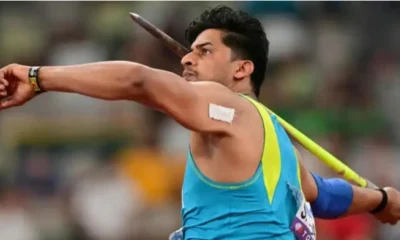
Tokyo Olympics champion Neeraj Chopra scripted history by becoming the first Indian to clinch a gold medal at the Diamond League 2022 on Friday. India’s golden boy won the Lausanne leg with a massive throw of 89.08 meters in his first attempt.

From winning gold in Tokyo Olympics, shattering his national record at Paavo Nurmi Games, and bagging gold at Kuortane Games to winning silver at World Athletics Championship 2022, there is no stopping for the 24-year-old javelin thrower.

Chopra’s massive win at the Diamond League earned him qualification for the all-important Diamond League final in Zurich next month, as well as the 2023 World Championships in Budapest, Hungary, which has a qualification mark of 85.20 meters.

Chopra made an impressive return from a groin injury that made him skip the Birmingham Commonwealth Games 2022 last month.
Read Also: IND vs PAK: Shaheen Afridi prays for Virat Kohli’s comeback, says want to see him in form again

Jakub Vadlejch, who won silver at the Tokyo Olympics, placed second with a best throw of 85.88 meters, and Curtis Thompson of the United States took third with a throw of 83.72 meters.

After a spectacular performance, Chopra said he is delighted with his result. He said 89 meters is a great performance and he is especially pleased because he achieved this feat after coming back from an injury. He further said his win was a good indicator that he has recovered well.

Adding further Chopra said, he was quite nervous as he had to skip Commonwealth Games but finishing the season on a high has given him a lot of confidence to perform stronger and better in the Zurich DL Final.

The only other Indian to place in the top three at a Diamond League Meet before Chopra was discus thrower Vikas Gowda. Gowda placed second twice in New York in 2012 and Doha in 2014, and third twice in Shanghai and Eugene in 2015.

Rajasthan University Student Union Election 2022: Candidates lay on road and ask for votes, video goes viral | WATCH

NEET UG exam 2022: NTA allows women candidates, who were forced to remove underwear at centre, to retake exam

Cricket news

Pakistan PM Shehbaz Sharif confirms boycott of India match at T20 World Cup

Pakistan Prime Minister Shehbaz Sharif has reaffirmed his country’s decision to boycott the T20 World Cup match against India, prompting concern from the ICC over selective participation.

Published

on

Pakistan Prime Minister Shehbaz Sharif on Wednesday reaffirmed his government’s decision to boycott the country’s T20 World Cup match against India, stating that Islamabad has taken a “clear stand” on the issue.

Addressing the federal cabinet in Islamabad, Sharif said Pakistan would not take the field against India for the scheduled February 15 match in Sri Lanka. He added that the decision was made after careful assessment and described it as an appropriate step.

“There should be no politics in sports,” the prime minister said, adding that the stance was final after due deliberation.

ICC flags issue of selective participation

Pakistan’s position follows an earlier statement by the government, shared on social media, indicating that the national team would not play the group-stage match against India. No specific reason was cited in that post.

Reacting to the development, the International Cricket Council (ICC) said selective participation goes against the core principles of global sporting events. In a statement, the ICC noted the Government of Pakistan’s position and said it was awaiting official communication from the Pakistan Cricket Board (PCB).

The ICC said tournaments are built on fairness, consistency, and sporting integrity, and selective participation undermines the spirit of international competition. It added that while governments have their own policy considerations, such decisions are not in the interest of the global game or fans worldwide.

The governing body urged the PCB to explore a mutually acceptable resolution that safeguards the interests of all stakeholders and ensures the successful conduct of the ICC Men’s T20 World Cup 2026.

Bangladesh replacement and wider context

The issue comes amid recent developments involving other teams. The ICC had announced last month that Scotland would replace Bangladesh in the T20 World Cup after the Bangladesh Cricket Board refused to participate as per the published schedule.

The decision followed the ICC’s rejection of Bangladesh’s request to move its matches out of India, citing the absence of any credible or verifiable security threat. Scotland, currently ranked 14th in T20 Internationals, was named as the replacement being the highest-ranked team not originally qualified.

India-Pakistan rivalry record

Pakistan and India have faced each other eight times in ICC T20 World Cups, with India holding a dominant 7-1 record. In last year’s Asia Cup, India also defeated Pakistan in a series of matches, including the final.

The T20 World Cup 2026 will be hosted by India and Sri Lanka from February 7 to March 8. Pakistan have been placed in Group A alongside India, Namibia, the Netherlands, and the United States.

Continue Reading

LATEST SPORTS NEWS

Pakistan looks to force majeure as India boycott threat looms in T20 World Cup

Pakistan’s decision not to take the field against India at the T20 World Cup could hand India two points, with ICC regulations leaving limited scope for exemptions.

Published

on

ind pak

Pakistan’s declaration that it will not take the field against India at the T20 World Cup has pushed the tournament into an unusual and sensitive situation, with ICC playing conditions clearly outlining the sporting consequences of a refusal.

Matches between India and Pakistan carry political significance, but under World Cup regulations, the procedural outcome of a team declining to play is largely unambiguous. If India arrive in Colombo as scheduled, attend training and fulfil all pre-match formalities, the onus rests entirely on Pakistan.

Should Pakistan then refuse to take the field, the fixture would be officially forfeited. India would be awarded two points, while Pakistan would receive none. The forfeiture would also negatively affect Pakistan’s net run rate, a factor that has frequently proven decisive in tightly contested World Cup group stages.

Net run rate impact could prove costly

A forfeit is not treated as a neutral outcome under ICC rules. In a competitive tournament environment, the loss of points combined with a dent to net run rate can have long-term implications, potentially influencing qualification for the semi-finals.

There is only one alternative scenario outlined under the regulations. If India do not travel to the venue, the match would be considered cancelled rather than forfeited, resulting in points being shared by both teams. However, with India expected to meet all logistical and operational requirements, that possibility currently appears unlikely.

Past precedents at ICC events

While forfeitures at World Cups are rare, they are not unprecedented. During the 1996 ODI World Cup, Australia and the West Indies declined to play matches in Sri Lanka following a bomb blast in Colombo, resulting in Sri Lanka being awarded full points.

In the 2003 ODI World Cup, England forfeited their match against Zimbabwe in Harare citing political and security concerns, while New Zealand refused to play Kenya in Nairobi due to safety considerations.

More recent ICC events have also seen withdrawals, including Zimbabwe pulling out of the 2009 T20 World Cup and New Zealand’s Under-19 team exiting the 2022 Under-19 World Cup because of COVID-19 restrictions. In such cases, the ICC has consistently prioritised the integrity of the tournament framework.

Can force majeure apply?

Pakistan’s potential reliance on a force majeure clause forms the crux of the legal debate. Force majeure traditionally applies to unforeseen and unavoidable circumstances such as natural disasters or extreme situations that make participation impossible rather than undesirable.

According to ICC sources, invoking force majeure in this case would be difficult. Such clauses are interpreted narrowly, and political objections alone do not automatically qualify unless there is a demonstrable and immediate threat to safety or feasibility. Without meeting that threshold, a refusal to play would fall outside force majeure protections.

Beyond the immediate match

The implications may extend beyond the scorecard. ICC sources indicate that severe sanctions, including the possibility of suspension, could be considered if a refusal is deemed a breach of participation obligations. Any such action would follow due process rather than being immediate, but precedent exists for firm intervention when competition rules are undermined.

For now, the impact remains primarily sporting. India stand to gain two crucial points without play, while Pakistan risk compromising both their World Cup campaign and their standing within the ICC framework.

What was expected to be the tournament’s most watched fixture could instead become its most consequential non-match, shaped not by runs or wickets but by regulations that leave little room for interpretation.

Continue Reading

Cricket news

Pakistan’s India boycott at T20 World Cup 2026 puts team at risk of ICC action

Pakistan’s boycott of its India clash at the T20 World Cup 2026 has sparked a major row, with the ICC warning of sanctions that could impact the team’s future.

Published

on

Pakistan

Pakistan’s decision to boycott its group-stage match against India at the T20 World Cup 2026 has triggered a major controversy, with the International Cricket Council (ICC) warning of possible punitive action that could impact Pakistan’s participation in global cricket.

The Pakistan cricket team is set to take part in the tournament but will not take the field against India in the February 15 match scheduled in Colombo. The move was approved by the Pakistan government and announced publicly through a social media post, which confirmed participation in the event while excluding the India fixture.

Why Pakistan decided to boycott the India match

The decision follows the ICC’s removal of Bangladesh from the T20 World Cup 2026. Bangladesh had requested a venue change for their matches citing security concerns, but the request was turned down by the ICC, eventually leading to their exclusion from the tournament. Pakistan’s government cited this development while taking the call to skip the India game.

ICC responds with strong warning

Reacting to Pakistan’s stance, the ICC said selective participation undermines the integrity and fairness of global tournaments. In its official statement, the governing body stressed that ICC events are built on sporting integrity, competitiveness and consistency, adding that such decisions are not in the interest of the global game or fans, including those in Pakistan.

The ICC also clarified that it has not yet received any formal communication from the Pakistan Cricket Board regarding the boycott decision.

Sanctions Pakistan could face

According to developments surrounding the issue, Pakistan could face a range of consequences if the boycott is enforced. These may include financial penalties, a possible ban from the current or future ICC events, and resistance from top cricketing nations in scheduling bilateral series. There is also a risk that overseas players could be barred from participating in the Pakistan Super League if sanctions escalate.

The situation remains fluid as the ICC is expected to take a final call after official communication from Pakistan’s cricket board.

Continue Reading

Trending

© Copyright 2022 APNLIVE.com