English हिन्दी
Connect with us

Top Stories

President Droupadi Murmu takes sortie on Sukhoi fighter jet in Assam | WATCH

Describing her exhilarating experience, Murmu said it is a matter of pride that India’s defense capabilities have expanded immensely to cover all the frontiers of land, air and sea.

Published

on

President Droupadi Murmu takes sortie on Sukhoi fighter jet in Assam | WATCH

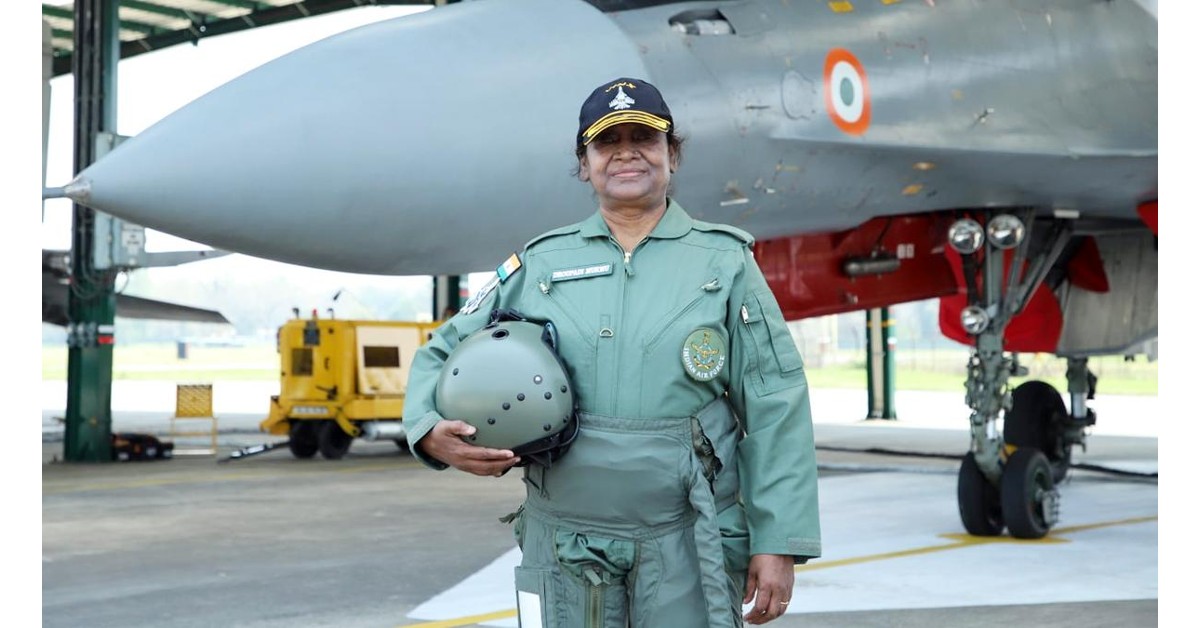
President Droupadi Murmu, who is currently on a visit to Assam, flew a sortie on the Sukhoi 30 MKI fighter aircraft at the Tezpur Air Force Station on Saturday.

Murmu is the second woman president to fly in a warplane after President Pratibha Patil who flew in the frontline fighter aircraft in 2009. Videos of Murmu flying an aircraft are going viral on social media.

The President, who serves as the Indian Armed Forces Supreme Commander, flew over the Brahmaputra and Tezpur valleys with a view of the Himalayas for around 30 minutes before landing at the air force base, according to a tweet from Rashtrapati Bhavan.  

The aircraft was flown by Gp Capt Naveen Kumar, CO of 106 Squadron. The aircraft flew at a height of about two km above sea level and at a speed of about 800 km per hour. The President was also briefed on the operational capabilities of the aircraft and the Indian Air Force (IAF).

Describing her exhilarating experience, Murmu said it is a matter of pride that India’s defense capabilities have expanded immensely to cover all the frontiers of land, air and sea. She expressed satisfaction with the operational preparedness of the IAF.
Murmu received Guard of Honor upon arrival at the Tezpur Air Force Station during her three-day visit to Assam from April 6 to 8.

The Sukhoi-30 MKI is a twin-seater multirole fighter jet developed by Russian company Sukhoi and manufactured by Indian aerospace giant Hindustan Aeronautics Limited (HAL).

President Murmu, on April 7, inaugurated the Gaj Utsav-2023 at the Kaziranga National Park in Assam to mark 30 years of Project Elephant. The event was inaugurated in the presence of Assam Governor Gulab Chand Kataria and Chief Minister Himanta Biswa Sarma.

She also attended a function to celebrate 75 years of the Gauhati High Court in Guwahati. She also flagged off the Mount Kanchenjunga Expedition-2023 in Guwahati on Friday.

India News

India clears Rs. 1.1 lakh crore defence procurement plan for radars, mine layers

India has cleared defence procurement proposals worth around Rs. 1.10 lakh crore for the Army, Navy and Air Force, including radars, mine layers, helicopters and electronic warfare systems.

Published

on

Rajnath Singh

The Defence Ministry has cleared military procurement proposals estimated at around Rs. 1.10 lakh crore for the Indian Army, Navy and Air Force, in a major push to strengthen operational capabilities and promote indigenous defence manufacturing.

The proposals were approved by the Defence Acquisition Council (DAC), headed by Defence Minister Rajnath Singh. The ministry said the DAC accorded Acceptance of Necessity (AoN) for a range of acquisitions. AoN is the first stage of the defence procurement process.

Nearly 98 per cent of the approved procurements are expected to be sourced from Indian industry, according to the Defence Ministry.

What the Army will get

The Army-related approvals include Chemical, Biological, Radiological and Nuclear (CBRN) reconnaissance vehicles, high-mobility vehicles, self-propelled mechanical mine layers, Advanced Light Helicopters (ALHs), trawl tanks and the Sarvatra bridge system.

CBRN reconnaissance vehicles will be used to detect and monitor areas contaminated by chemical, biological, radiological or nuclear agents.

The high-mobility vehicles are intended to support troop movement and logistics in difficult terrain. The trawl tanks and Sarvatra bridge system will help combat formations with mobility and crossings during military operations.

Advanced Light Helicopters will be used by both the Army and the Air Force for operations across different terrains and mission requirements.

Navy to receive Arudhra radars

For the Indian Navy, the DAC approved the procurement of Arudhra radars, along with the design, development and subsequent procurement of Marine Gas Turbines (MGTs).

The Marine Gas Turbine programme is aimed at developing a key propulsion system for warships while reducing dependence on foreign suppliers.

The Arudhra radars will replace existing air-route surveillance radars at naval air stations and are expected to strengthen the Navy’s surveillance capabilities.

Air Force gets electronic warfare systems

The Indian Air Force also received approval for projects aimed at strengthening the capabilities of its fighter aircraft, transport fleets and helicopters.

Among the approved systems is the Ground-Based Multi-Purpose Jammer (GBMPJ). The ministry said the jammer will provide electronic warfare capability against adversary radar networks.

Approval was also given for the installation of the Defence Forces Secure Access Card system.

Push for domestic defence manufacturing

The latest approvals are part of the government’s broader effort to strengthen the operational capabilities of the armed forces while promoting self-reliance in defence manufacturing.

The Defence Ministry said nearly 98 per cent of the approved procurements will be sourced from Indian industry, potentially giving further impetus to domestic defence production.

The Rs. 1.10 lakh crore figure represents the estimated value of the procurement proposals that received the DAC’s Acceptance of Necessity at this stage. It does not by itself mean that all the equipment has already been contracted or delivered.

Continue Reading

India News

Delhi hostel collapse: Rent agreement raised questions over student safety and hostel liability

The Satya Niketan hostel collapse has brought its rent agreement, building status and student safety conditions under scrutiny.

Published

on

The rent agreement of Delhi’s now-collapsed Hostel Daze has come under scrutiny after the five-storey building in Satya Niketan collapsed, killing seven residents.

According to the agreement, students were required to pay three months’ security along with one month’s advance rent. It also stated that the security deposit would not be refunded before the completion of the agreement period and that any damage to furniture or fixtures could be deducted from the deposit.

One clause in the agreement stated that the PG authorities were not responsible for casualties or risks to a student.

A separate terms-and-conditions document linked to the hostel also stated that the management would not be liable for compensation in cases involving personal injury, loss or damage to a tenant’s belongings caused by circumstances described as beyond the PG’s control, including sealing, fire, earthquakes and heavy rains.

Strict conditions for students

The agreement also laid down several conditions for tenants. Students were prohibited from putting posters or stickers on hostel walls.

It further stated that students leaving before the agreed period, including those removed for disciplinary reasons, would not receive a refund of hostel fees or security money.

The hostel management was also given the right to shift students to another room or hostel location when circumstances required it. The terms allowed immediate eviction for disciplinary issues without a refund.

Building was unauthorised, report says

The collapsed structure was a five-storey building in Satya Niketan that housed a boys’ hostel. According to a senior MCD official cited in the report, the nearly 50-year-old building stood on around 55 square yards of land in a resettlement colony where permission had been granted only for a two-storey structure.

No building plan had reportedly been approved for the structure.

The building had earlier been in a dilapidated condition. Its owner, Hari Ram Bansal, subsequently spent several months renovating it, and tenants began moving in during August 2026.

The hostel had around 30 rooms, with each room intended to accommodate two to three students. However, construction work was reportedly still underway when the building collapsed.

Labourers were working in the basement at the time of the incident. Of the 11 people rescued, two were labourers, one of whom later died.

Three arrested in Delhi hostel collapse case

Three people have been arrested in connection with the case — Hariram Bansal, his wife Urmila and their son Mahesh Bansal.

Records cited in the report show that electricity connections for the property were registered in the names of Hariram Bansal and Mahesh Bansal, while the property itself was registered in Urmila’s name.

The report also noted that the building was residential and was not intended for commercial use such as operating a paying-guest hostel.

Delhi civic body suspends five officials

The Municipal Corporation of Delhi suspended five officials a day after the tragedy.

Those suspended were Deputy Commissioner (South Zone) Rakesh Kumar, Superintending Engineer Ranvir Singh, Executive Engineer (Building) Lalit Kumar Goel, Assistant Engineer (Building) Sunil Chauhan and Junior Engineer (Building) Ashish Kumar.

Separately, the Delhi High Court ordered a high-level investigation into the collapse and observed that hostel facilities for students coming from outside Delhi were in a “pathetic condition.”

MCD order concerned neighbouring property

On September 6, the MCD had issued an order concerning the neighbouring property, number 13 in Satya Niketan, directing its owner or occupier to demolish the structure because it posed a threat to residents, visitors, passers-by and neighbouring buildings.

The collapsed building, however, was property number 14, according to an MCD statement.

Continue Reading

Latest world news

India-France ties reach new heights, says PM Modi at Paris temple event

PM Modi said India-France relations have reached new heights while highlighting strategic cooperation and cultural ties at the Paris temple inauguration.

Published

on

Prime Minister Narendra Modi on Sunday said India-France relations have reached “new heights”, highlighting the expanding strategic partnership between the two countries and their longstanding cultural connections.

Addressing the inauguration of the BAPS Swaminarayan Hindu Mandir in Paris virtually, PM Modi said India and France are moving ahead with new momentum across several areas, including technology, artificial intelligence, defence, space and climate action.

He said the India-France strategic partnership is particularly significant because it is built on longstanding cultural and political ties.

PM Modi highlights India-France strategic partnership

PM Modi said India and France are building a Special Global Strategic Partnership with French President Emmanuel Macron.

He also noted that 2026 is being celebrated as the India-France Year of Innovation, underlining the importance of innovation and cooperation between the two countries.

The prime minister said there is also growing discussion around joint venture possibilities between India and France.

He linked the relationship between the two nations not only to contemporary strategic cooperation but also to historical and cultural connections.

Paris temple seen as symbol of cultural ties

PM Modi described the newly inaugurated Swaminarayan temple in Paris as another milestone in India’s cultural relationship with France.

He said the temple is “Made in India” and “Built in France”, noting that several of its stones were carved in India before being incorporated with modern engineering in France.

According to PM Modi, the temple could become a symbol of cooperation and opportunity between the two countries and help strengthen cultural ties across Europe.

He said the values associated with Indian culture could reach people across Europe through the temple.

PM Modi recalls historical India-France connections

The prime minister also referred to the contribution of Indian soldiers in France and said their sacrifices remain remembered.

He highlighted the role of French scholars in popularising Sanskrit and referred to French writer Romain Rolland’s writings on Ramakrishna Paramahamsa and Swami Vivekananda.

PM Modi also mentioned the spiritual journey of ‘The Mother’ from Paris to the Sri Aurobindo Ashram in Puducherry, as well as Srila Prabhupada Swami’s visit to France and the subsequent development of spiritual connections through ISKCON.

He said yoga has also emerged as an important bridge between people in India and France, pointing to its popularity in France.

Temple to support service activities

PM Modi said Swaminarayan temples have traditionally served as centres of service alongside devotion.

He said he had been informed that the newly inaugurated Paris temple would also become a centre for service projects.

The prime minister expressed confidence that the temple would enrich France’s diversity while giving further momentum to cultural relations between India and France.

PM Modi also said he would try to visit the temple in the future whenever his schedule permits.

Continue Reading

Trending

© Copyright 2022 APNLIVE.com