English हिन्दी
Connect with us

Top Stories

Wanted gangster surrenders to UP police fearing encounter

According to Inspector Pal, Jabul was arrested, later produced in the court and was sent to jail.

Published

on

Wanted gangster surrenders to UP police

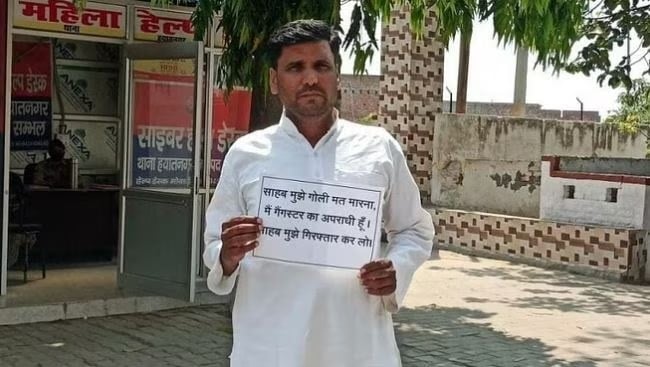
Fearing encounter, wanted gangster surrenders before the police in Uttar Pradesh pleading not to shoot him and rather arrest him.

A criminal who was wanted in Gangster Act was arrested after he himself reached the Hayatnagar police station to surrender who was frightened of encounter.

The surrendered criminal is identified as Jabul, a notorious smuggler hailing from Haibatpur in Ghaziabad, UP. A case of cow slaughter was registered against Jabul.

Jabul was on a run and the police was continuously involved in the action to nab him, police also had raided on different locations in the Sambhal district earlier for arresting Jabul.

Jabul who was in a fear of might getting encountered by the police while surrendering held a poster in his hand that pleaded not to shoot him, and he is a criminal charged with the gangster act, requested to arrest him.

Jabul surrendered at around 11 AM on Tuesday and made his request to the station in-charge Karmsingh Pal with folded hands.

Read Also: 19-year-old sends death threat to Uttar Pradesh CM Yogi Adityanath from phone he stole from girlfriend’s father

According to Inspector Pal, Jabul was arrested, later produced in the court and was sent to jail.
This comes after the recent encounter of Asad Ahmed – the son of dreaded gangster Atiq Ahmed, Asad was gunned down by the UP Special Task Force (STF) team on April 13 along with one of his aide in Jhansi.

On April 15, gangster Atiq Ahmed and his brother Asad Ahmed were also killed by three shooters posing as media personnel on camera in the police custody, while the gangster brothers were being taken for medical check-up in Prayagraj.

Uttar Pradesh Chief Minister Yogi Adityanath on the state’s assembly sending a message to all the Mafias of the said earlier made a fiery comment saying all of them will be destroyed when he said Mitti mai Milla denge.

This statement by Yogi and his actions in the recent past against the criminals in the state has put the gangster-criminals into a state of fear and are now frightened that they might get encountered.

UP man fakes his own kidnapping, murder to stop girlfriend’s wedding, arrested | WATCH

Chhattisgarh: Naxals blow up police vehicle, 10 policemen and 1 driver killed

India News

PM Modi assures no discrimination in women’s quota, delimitation debate intensifies in Parliament

PM Narendra Modi has assured that women’s reservation will be implemented without discrimination, amid a heated debate over delimitation in Parliament.

Published

on

PM modi

Prime Minister Narendra Modi has assured that there will be no discrimination in the implementation of women’s reservation, as Parliament witnessed a sharp debate over the proposed linkage between the quota and delimitation exercise.

During the ongoing special session, the government reiterated its commitment to ensuring fair representation while addressing concerns raised by opposition parties regarding the timing and structure of the legislation.

The proposed framework aims to reserve 33 percent of seats for women in the Lok Sabha and state assemblies. However, its implementation is tied to a fresh delimitation exercise, which is expected after the next census.

Opposition questions timing and intent

Opposition leaders have raised concerns that linking the women’s quota to delimitation could delay its implementation. They argue that the process of redrawing constituencies may push the actual rollout further into the future.

The issue has triggered a broader political confrontation, with multiple parties questioning whether the move could alter representation across states.

Some critics have also alleged that the delimitation exercise could disproportionately benefit certain regions based on population, a charge the government has rejected.

Government reiterates commitment to fair implementation

Responding to these concerns, the Centre has maintained that the reforms are necessary to ensure accurate and updated representation based on population data.

Leaders from the ruling side have repeatedly emphasized that the process will be carried out transparently and without bias. The assurance that there will be “no discrimination” is aimed at addressing fears among states and opposition parties.

The debate marks a key moment in Parliament, with both sides engaging in intense exchanges over one of the most significant electoral reforms in recent years.

Continue Reading

India News

No state will lose a seat, Centre assures as delimitation debate takes centre stage in Parliament

Parliament’s special session begins with key focus on implementing women’s reservation and delimitation, setting the stage for major electoral changes.

Published

on

Parliament

A special session of Parliament commenced on Thursday, with the Centre set to take up crucial legislation related to women’s reservation and delimitation of constituencies. The session, scheduled over three days, is expected to witness intense debate as the government pushes forward its legislative agenda.

At the centre of discussions is the proposal to operationalise the women’s reservation law, which seeks to allocate 33 percent of seats in the Lok Sabha and state assemblies to women. The law, passed earlier, requires enabling provisions before it can be implemented.

The rollout of the reservation is closely tied to the delimitation exercise — a process that redraws parliamentary constituencies based on updated population data. The implementation is expected only after the next census and delimitation process are completed.

The government is aiming to put in place the framework so that the reservation can be enforced in future elections, likely around 2029.

Delimitation and numbers at play

Delimitation is a key aspect of the proposed changes, as it will determine how seats are redistributed and which constituencies are reserved. The exercise is expected to reflect population shifts and may also involve an increase in the total number of Lok Sabha seats.

This linkage has made the issue politically sensitive, with several opposition parties backing women’s reservation in principle but raising concerns over how and when delimitation will be carried out.

Political reactions and expected debate

The session is likely to see sharp exchanges between the government and opposition. While there is broad agreement on increasing women’s representation, disagreements remain over the timing, process, and potential political implications of the delimitation exercise.

Some leaders have argued that delimitation could significantly alter the balance of representation among states, making it a contentious issue beyond the women’s quota itself.

The government, however, has framed the move as a step toward strengthening women’s participation in governance and ensuring more inclusive policymaking.

Continue Reading

India News

Delimitation and women’s quota bills set to be tabled in Parliament today, key numbers explained

The Centre will table key bills on women’s reservation and delimitation, proposing a major expansion of Lok Sabha and changes in seat allocation based on updated census data.

Published

on

Lok Sabha

The Centre is set to introduce a set of crucial bills in Parliament aimed at implementing women’s reservation and redrawing electoral constituencies, marking a major shift in India’s political framework.

According to details accessed from official drafts, three separate legislations are expected to be tabled during the ongoing session. These include a constitutional amendment to operationalise 33% reservation for women, a delimitation bill to redraw constituencies, and changes to laws governing Union Territories.

The move is seen as a coordinated effort to align women’s reservation with a fresh delimitation exercise based on updated population data.

How the numbers may change

One of the most significant proposals is the expansion of the Lok Sabha. The draft legislation suggests increasing the maximum strength of the House to around 815 members, with up to 35 seats allocated to Union Territories.

Currently, the Lok Sabha has 543 elected members. The increase is aimed at ensuring proportional representation after decades of population changes across states.

The proposed delimitation exercise would rely on the latest available census figures, likely the 2011 Census, replacing the long-standing reliance on 1971 data.

Women’s reservation linked to delimitation

The proposed framework makes it clear that the 33% reservation for women in Parliament and state assemblies will only be implemented after the delimitation process is completed.

The reservation is expected to apply across general, Scheduled Caste, and Scheduled Tribe seats, with constituencies being rotated periodically to ensure broader representation.

The reform is likely to come into effect ahead of the 2029 general elections, depending on the completion of the delimitation exercise.

Why delimitation is central to the plan

Delimitation has remained frozen for decades, leading to imbalances in representation due to population growth, migration, and urbanisation.

The new bill proposes setting up a Delimitation Commission, which would be tasked with redrawing constituency boundaries and reallocating seats based on updated population data.

This process is expected to significantly alter the political map of the country and could trigger debates over regional representation.

Continue Reading

Trending

© Copyright 2022 APNLIVE.com