English हिन्दी
Connect with us

Latest world news

Day-long standoff between Indian and Chinese troops in Ladakh resolved after talks

Published

on

Day-long standoff between Indian and Chinese troops in Ladakh resolved after talks

Incident comes a month ahead of Modi-Jinping summit in Mamallapuram, Tamil Nadu

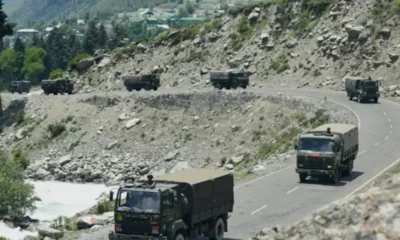
Just a month ahead of the summit meet between Prime Minister Narendra Modi and Chinese President Xi Jinping on October 11-13, Chinese troops yesterday – Wednesday, Sep 11 – stopped an Indian army patrol in Ladakh leading to heated exchanges and a standoff that lasted till evening.

The matter was finally resolved through delegation-level talks, said media reports quoting Army sources.

The incident happened at Pangong lake. China controls two-thirds of the 134km long high altitude lake extending from Tibet to Ladakh.

Indian soldiers were patrolling at the northern bank of Pangong lake on Wednesday morning when they were stopped by Chinese soldiers, according to a report in The Times of India. Soon, the standoff between the two sides started, with both calling in reinforcements and it continued till the evening, the newspaper reported.

“The matter has been de-escalated and disengaged fully after delegation-level talks yesterday. This occurs due to differing perceptions of LAC (Line of Actual Control). There are established mechanisms to resolve such occurrences,” an Army source said.

While the LAC has remained largely peaceful, there has been a pattern of stand-offs ahead of major bilateral visits between the two countries.

The present instance comes ahead of the summit meeting between Modi and Jinping at the historic coastal town of Mamallapuram on the scenic East Coast Road in Tamil Nadu. Modi will host Jinping for two days — October 11 and 13 — in Mamallapuram, according to reports.

Also Read: Delhi Police constable thrashed by bootlegger and his family, accused arrested

Last month, China, whose forces regularly intrude into Ladakh, strongly opposed India’s move to create Ladakh Union Territory. Chinese Foreign Minister Wang Yi told India’s Minister for External Affairs S Jaishankar that the Indian government’s announcement of the establishment of the Ladakh Union Territory, “which involves Chinese territory, has posed a challenge to China’s sovereignty and violated the two countries’ agreement on maintaining peace and stability in the border region”.

The India-China border dispute covers the 3,488 km LAC. China also claims Arunachal Pradesh as part of southern Tibet.

This is not the first time that a standoff has been reported between Indian and Chinese soldiers around Ladakh’s Pangong lake, a site that also draws a lot of tourists.

In August 2017, a video of a standoff between soldiers of the two sides was widely circulated on social media, showing many soldiers from the two countries punching and kicking each other and throwing stones. The incident took place on Independence Day when Chinese troops tried to enter Indian terrain along the banks of Pangong lake, but were stopped by Indian soldiers.

The two-hour-long standoff was brought under control after a drill which sees both sides holding up banners proclaiming their rights over the disputed area before stepping back to their respective positions.

Then also, Brigadier level officers met to try and find a way to bring down tensions in the region, as was done on Wednesday.

Also Read: High Court seeks DU response on rejected nominations for DUSU poll 2019

Earlier the same year, in June 2017, there was a prolonged standoff between Indian and Chinese troops at Dokalam when Indian soldiers crossed the Sikkim border to stop the construction of a Chinese road near the ‘Chicken’s Neck’, a thin strip that links India to its north-eastern states. After more than two months of soldiers from both sides staring down at each other just 150 metres apart, the standoff, described as the worst in decades, subsided with both countries accepting that they were withdrawing their troops. China, according to several reports, proceeded to build a base near the area.

Last week, India and China postponed the next round of border talks under the “special representatives” (SR) mechanism. Top officials from both countries had been expected to meet later this month in New Delhi for the 22nd round of the talks to resolve the long-standing dispute over the 3,488 km border.

The 21st round of the talks took place near the city of Chengdu in southwest China last November.

A solution to the Sino-India border dispute continues to elude the two countries after nearly 45 rounds of talks since 1960.

Latest world news

Israel-Lebanon ceasefire to begin within hours as Trump announces 10-day truce

Israel and Lebanon may begin a 10-day ceasefire within hours after a proposal announced by Donald Trump amid ongoing tensions.

Published

on

Donald Trump

A temporary halt in hostilities between Israel and Lebanon is expected to begin within hours after US President Donald Trump announced a proposed 10-day ceasefire between the two sides, amid ongoing tensions in the region.

According to his statement, the ceasefire is likely to take effect around 5 p.m. Eastern Time, although independent confirmation from both sides is still awaited.

The development follows discussions involving Israeli Prime Minister Benjamin Netanyahu and Lebanese President Joseph Aoun, with mediation efforts led by the United States.

Officials indicated that the proposed truce is aimed at creating a limited window to reduce violence and potentially pave the way for broader diplomatic engagement. The situation along the Israel-Lebanon border has remained tense in recent weeks, with escalation linked to the activities of Hezbollah.

Diplomatic efforts have intensified in recent days, with discussions facilitated by the United States, including the involvement of US Secretary of State Marco Rubio. However, details of the agreement and the extent of coordination between the parties remain unclear.

The situation remains fluid, and the success of the ceasefire will depend on adherence by all sides involved. The conflict has already led to significant humanitarian and geopolitical consequences, including displacement and disruption in affected areas.

While the proposed ceasefire is being seen as an important step toward de-escalation, broader negotiations involving regional stakeholders are expected to be necessary for any lasting resolution.

Continue Reading

Latest world news

US ends oil sanctions waiver for Iran and Russia, impact likely on India’s energy imports

The US decision to end the Iran and Russia oil waiver may impact India’s oil imports, fuel prices and global energy markets.

Published

on

US oil tanker

The United States has decided not to extend a temporary sanctions waiver that allowed limited trade in Iranian and Russian oil, marking a shift towards stricter enforcement of economic restrictions.

The waiver, introduced in March 2026, had permitted the sale of oil already loaded on ships to stabilise global supply during heightened geopolitical tensions. However, it is now set to expire around mid-April without renewal.

US officials have indicated that the move is part of a broader strategy to increase pressure on both Iran and Russia amid ongoing conflicts and geopolitical tensions.

What the waiver did and why it mattered

The short-term waiver allowed millions of barrels of oil—estimated at around 140 million barrels—to enter global markets, helping ease supply shortages and prevent sharp price spikes.

It also enabled countries like India to purchase discounted crude oil from Russia and resume limited imports from Iran after years of restrictions.

Impact on India

India, one of the world’s largest oil importers, is expected to feel the impact of the decision in several ways:

  • Reduced access to discounted oil
    India had been buying cheaper Russian crude and recently resumed Iranian imports under the waiver. Its end may limit these options.
  • Potential rise in fuel costs
    With fewer discounted supplies available, India may need to rely more on costlier sources, which could increase domestic fuel prices.
  • Supply diversification pressure
    India may need to explore alternative suppliers in the Middle East, Africa, or the US to maintain energy security.
  • Geopolitical balancing challenge
    The move adds pressure on India to align with US sanctions while managing its own economic interests.

Global energy market concerns

The end of the waiver comes at a time when global oil markets are already under stress due to conflict in West Asia and disruptions in key routes like the Strait of Hormuz.

Analysts warn that tightening sanctions could:

  • Reduce global oil supply
  • Increase price volatility
  • Intensify competition among major buyers like India and China

Bigger picture

The US decision reflects a broader shift from temporary relief measures to stricter enforcement of sanctions, even if it risks tightening global energy markets.

For India, the development highlights a recurring challenge—balancing affordable energy access with geopolitical realities.

Continue Reading

Latest world news

Sanctioned tanker fails to breach US blockade, turns back near Strait of Hormuz

A US-sanctioned tanker failed to cross the Hormuz blockade and turned back, underscoring rising tensions and disruption in global shipping routes.

Published

on

A US-sanctioned oil tanker failed to break through a newly imposed American naval blockade and was forced to turn back near the Strait of Hormuz, highlighting growing tensions in the region.

The vessel, identified as the Rich Starry, reversed its course after attempting to exit the Gulf, according to shipping data. The development comes just days after the United States enforced restrictions on ships linked to Iranian ports.

The blockade was announced by Donald Trump following the collapse of recent diplomatic talks with Iran. The move aims to restrict maritime traffic associated with Iranian trade.

Officials said that during the first 24 hours of enforcement, no vessel successfully crossed the blockade. Several ships, including the sanctioned tanker, complied with instructions from US forces and turned back toward regional waters.

The tanker is reported to be linked to a Chinese company previously sanctioned for dealing with Iran. It was carrying a cargo of methanol loaded from the United Arab Emirates at the time of the incident.

The situation underscores the rising risks in one of the world’s most critical oil transit routes. The Strait of Hormuz typically handles a significant share of global energy shipments, but traffic has sharply declined due to ongoing geopolitical tensions.

The blockade, which applies specifically to vessels travelling to or from Iranian ports, has added further uncertainty for shipping companies, insurers and global energy markets.

Continue Reading

Trending

© Copyright 2022 APNLIVE.com