English हिन्दी
Connect with us

Latest world news

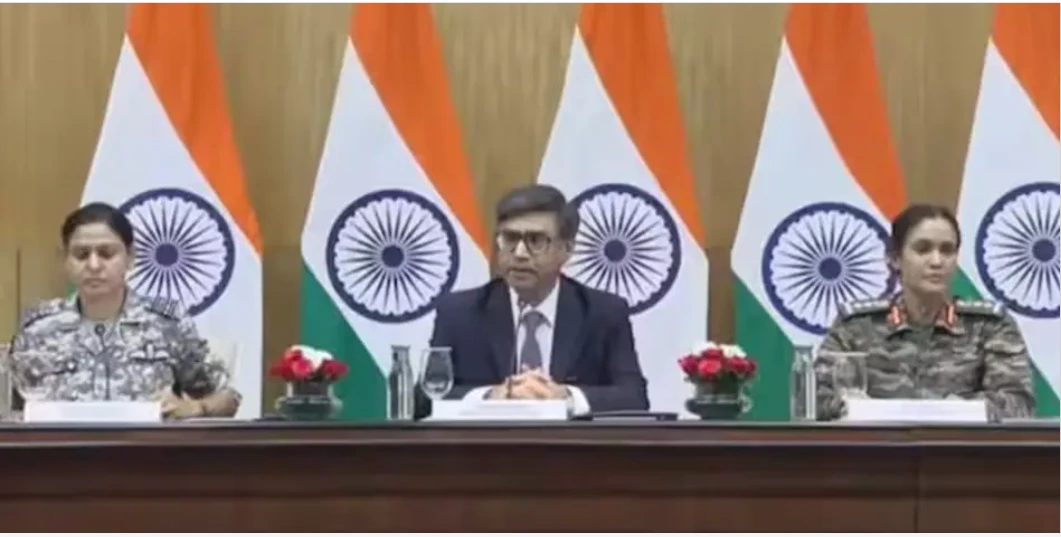
India hits back at Pakistan with precision strikes, says government in special media briefing

India has hit multiple Pakistan military bases in a precision response to cross-border drone attacks, as per the latest government briefing.

Published

on

In a bold counter-offensive following Pakistan’s drone-led aggression along the western front, India has conducted a series of precision airstrikes on several key Pakistani military installations. These include air force bases at Rafiqui, Murid, Chaklala, and Rahim Yar Khan, as confirmed during a high-level government briefing on Saturday.

Wing Commander Vyomika Singh, addressing the media alongside Foreign Secretary Vikram Misri and Colonel Sofiya Qureshi, said India’s armed forces acted in response to Pakistan’s use of unmanned combat aerial vehicles, loitering munitions, fighter jets, and long-range weapons targeting Indian military infrastructure and civilian areas.

“Pakistan carried out cowardly attacks on civilian sites including a medical centre and school premises,” Wing Commander Singh stated, highlighting the nature of the provocation.

Specific targets and India’s calibrated response

According to official sources, the Indian Air Force (IAF) employed precision air-launched munitions to strike command centres, radar stations, and weapon storage sites in Pakistan. Apart from the aforementioned air bases, Indian fighter jets also targeted Pakistani military assets in Sukkur and Chunia, a radar site in Pasrur, and the Sialkot aviation base.

Wing Commander Singh assured the public that India aimed to avoid collateral damage while responding firmly.

“All identified targets were military in nature. Precision-guided munitions ensured damage was restricted to Pakistan’s war infrastructure,” she explained.

Indian installations hit but threat neutralised

While India effectively countered the attacks, minor damage was reported at Indian Air Force bases in Udhampur, Pathankot, Adampur, and Bhuj. Most of the incoming threats, however, were neutralised mid-air, officials confirmed.

Misinformation battle: India rebuffs false claims

The Air Force officer also strongly rejected a string of misinformation being circulated by Pakistan, including false assertions about the destruction of India’s S-400 system in Adampur and alleged hits on the BrahMos base in Nagrota and airfields in Suratgarh and Sirsa.

“These are baseless narratives. Satellite imagery and timestamped visuals prove otherwise,” Singh said.

Troop movements and India’s defensive stance

India has noted an increase in Pakistani troop deployments near the Line of Control (LoC), suggesting a possible escalation in hostilities. In response, Indian forces have maintained high operational readiness.

“We reiterate our commitment to non-escalation, provided Pakistan exercises restraint,” she concluded.

Latest world news

Trump says Iran getting more serious in talks, no decision yet on major strikes

Donald Trump says Iran is becoming more serious in negotiations with the US but insists no decision has been taken on launching major military strikes against Tehran.

Published

on

Donald Trump

US President Donald Trump has said he has not yet decided whether to authorise major military strikes against Iran, stating that Tehran has become “more serious” in its negotiations with Washington even as tensions between the two countries remain high.

Speaking to reporters in the Oval Office on Friday, Trump said discussions with Iran were continuing and suggested diplomatic efforts were showing signs of progress.

“We’re talking to them right now. I think they’re getting more and more serious as the days go by,” Trump said, adding that no final decision had been taken on launching military action.

Trump says diplomacy remains an option

Trump said the United States remained prepared for military action if required but indicated that ongoing talks could still lead to an agreement.

“We’re locked and loaded and ready to go. But we’re talking to them, so I think while we’re talking, we’ll see what comes of it. I believe they’re very serious. They should be,” he said.

The US President also warned that Iran would face a “much higher level” of strikes if negotiations failed, while reiterating that preventing Tehran from developing a nuclear weapon remained his key red line.

The United States has said its military operations are aimed at preventing Iran from closing the strategically important Strait of Hormuz. Iran, meanwhile, has carried out retaliatory strikes on US bases, with four American service members reported killed.

Reports claim Trump discussed large-scale military operation

Trump’s remarks came after media reports suggested he met senior advisers to discuss the possibility of a large-scale military operation against Iran. Another report said he was considering a “massive attack”, although Trump did not confirm those reports during his interaction with journalists.

He also acknowledged that the prolonged conflict, which he had earlier expected to last only a few weeks, was approaching its fifth month and had become a political challenge ahead of the US midterm elections scheduled for November.

Trump issues warning over support for Iran

Trump also addressed reports claiming that Russia and China were providing intelligence or military support to Iran. He said both Chinese President Xi Jinping and Russian President Vladimir Putin had assured him they would not arm Tehran.

“I think they wouldn’t want to have me disappointed,” Trump said.

In a separate post on his Truth Social platform, Trump warned Moscow and Beijing against supplying weapons to Iran, saying such a move would not be in their interests.

He further stated that Xi had assured him during their meeting in Beijing in May that China would not provide weapons to Iran, while Putin had conveyed a similar position despite the ongoing war in Ukraine.

Continue Reading

India News

For second time, US strikes ship with Indian crew near Strait of Hormuz

Published

on

By

Strait of Hormuz

The United States Central Command (CENTCOM) has said that an oil tanker carrying Indian crew was drifting with its engine switched off near the Strait of Hormuz before it was struck by US forces.

A CENTCOM spokesperson said the vessel had stopped due to engine failure and was drifting after its crew repeatedly sought additional time to carry out repairs. US officials said the tanker was struck only after it failed to comply with directives issued by US forces enforcing a blockade on vessels allegedly transporting Iranian oil. The military said the strike was aimed at disabling the ship by targeting its engine room rather than sinking it.

The incident involved a tanker carrying Indian seafarers near the Gulf of Oman, close to the Strait of Hormuz, one of the world’s busiest maritime trade routes. The strike triggered a fire onboard, prompting rescue efforts by Omani authorities and maritime agencies. Indian authorities closely monitored the situation and coordinated with local officials regarding the welfare of the crew members.

The incident has drawn concern in India, with the government emphasising the safety of Indian nationals working aboard commercial vessels in the conflict-hit region. The Ministry of External Affairs has remained in touch with the authorities concerned as tensions between the United States and Iran continue to pose risks to international shipping.

In June, three Indian sailors were killed in a US strike on another oil tanker. The Strait of Hormuz handles a significant share of the word’s oil trade, and the latest incident has renewed concerns over the security of merchant vessels operating in the region. Maritime experts have warned that escalating hostilities could further disrupt commercial shipping and endanger civilian crews navigating one of the world’s most strategically important waterways.

Continue Reading

Latest world news

Trump announces phased tariff of up to 200% on generic drug imports, India may face impact

US President Donald Trump has announced a phased tariff plan on imported generic medicines, raising duties to 200% after three years, a move that could affect India’s pharmaceutical exports.

Published

on

Donald Trump

The United States has announced a phased tariff plan for imported generic medicines that could have implications for pharmaceutical exporters, including India. US President Donald Trump said the policy is intended to encourage companies to shift generic drug manufacturing to the United States by imposing steep tariffs after a two-year transition period.

The announcement is particularly important for India, one of the world’s largest suppliers of affordable generic medicines and a major exporter to the US market.

Trump outlines phased tariff plan

In a post on his Truth Social platform, President Trump said the new policy will take effect from August 1, 2026. Under the plan, imported generic medicines will continue to attract zero tariffs for the first two years.

Beginning in the third year, the tariff will increase to 100%, before rising further to 200% thereafter.

Trump said the measure is designed to encourage pharmaceutical companies to establish manufacturing facilities in the United States instead of relying on imports.

He added that companies choosing not to invest in US-based production during the transition period would face the higher tariff rates. According to Trump, the existing policy governing patented, branded and innovative medicines will remain unchanged.

Why India could be affected

India is widely regarded as the “pharmacy of the world” because of its large-scale production and export of generic medicines.

Indian generic drugs account for nearly 40% of the US generic medicine market by volume. According to a Global Trade Research Initiative (GTRI) report, India exported pharmaceutical products worth USD 9.7 billion to the United States during the 2024-25 financial year, representing around 38% of the country’s total pharmaceutical exports of USD 25.8 billion.

However, the immediate impact of the newly announced tariff policy on Indian pharmaceutical companies remains uncertain.

Existing trade agreement and industry concerns

India and the United States struck a trade pact in February that states India would receive negotiated outcomes regarding generic pharmaceuticals and pharmaceutical ingredients.

Despite that provision, previous tariff threats by Trump had already raised concerns within the pharmaceutical industry over the future of affordable medicine exports from India.

Indian pharmaceutical companies supply a wide range of generic medicines used to treat conditions including hypertension, diabetes, depression, cancer, infectious diseases and mental health disorders.

According to a Financial Post report cited in the source material, around 65% of birth control pill prescriptions in the United States during 2024 were manufactured by two India-based companies — Glenmark Pharmaceuticals Ltd. and Lupin Ltd.

Continue Reading

Trending

© Copyright 2022 APNLIVE.com