
Latest world news
Jordan and Palestine support Israeli Christians’ Church closure


The Israeli Christian leaders have received expression of support from Jordanian and Palestinian governments for shutting the doors of a historical Holy Sepulchre church in East Jerusalem in protest of “discriminatory” Israeli policies.
Roman Catholic, Armenian and Greek Orthodox leaders in Jerusalem had suddenly closed the Church of the Holy Sepulchre indefinitely on Sunday. The Christians claim that there is a “systematic campaign of abuse” directed at the community.
The Church leaders said in a statement that “These actions breach existing agreements and international obligations, which guarantee the rights and privileges of the Churches, in what seems as an attempt to weaken the Christian presence in Jerusalem.”
The Holy Sepulchre Church, one of Christianity’s holiest sites, is believed to be the site of Jesus’ crucifixion and burial attracts millions of pilgrims every year.
Jordanian government spokesman Mohammad al-Momani expressed his country’s “full solidarity” with the churches in Jerusalem. Under a 2013 agreement signed between Jordan and the Palestinian Authority, King Abdullah II is the custodian of the Muslim and Christian holy sites in Jerusalem.
The Jordanian spokesman said that Israel’s measures “violate international and humanitarian laws” and called on Israel to “immediately reverse the decisions taken against churches.”
According to reports, a bill was recently introduced in Israel’s parliament which would allow Israeli government to take over church properties leased to private companies. The Church leaders said their decision was premised on several issues, including the recent bill in the Knesset. Israeli government also plans to levy taxes on church properties, the report said.
The Church leaders said in a statement on Sunday, “These actions breach existing agreements and international obligations, which guarantee the rights and privileges of the Churches, in what seems as an attempt to weaken the Christian presence in Jerusalem.”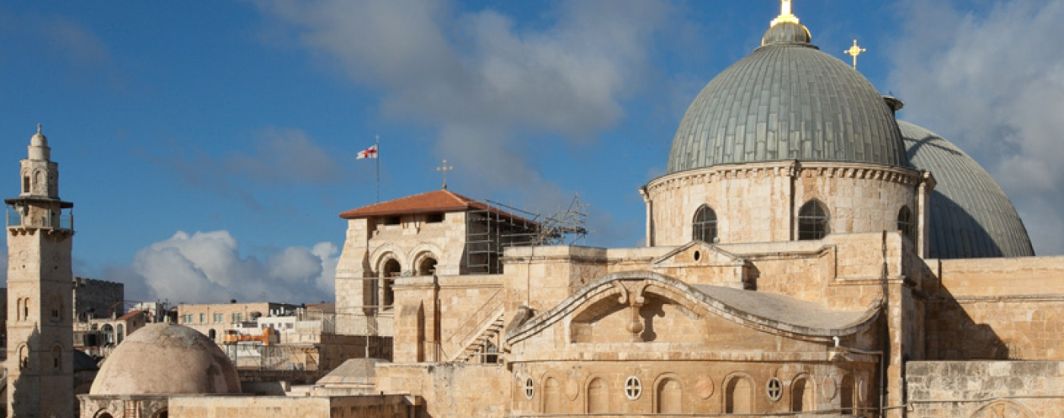
Meanwhile, Yousif al-Mahmoud, a Palestinian government spokesperson said that such steps constitute a new aggression targeting Jerusalem and the Palestinian people and their holy sites. He called on the international community to intervene to “stop Israeli practices”.
Jerusalem’s church authorities have been vocal against Greek Orthodox Church leaders who were accused of selling land to Israeli settlers in prime locations of the Old City.
In August, a Jerusalem court approved the purchase of the property by a settler group that has been working for decades to remove Palestinians from their homes and shops in the Old Jerusalem City.
Aleef Sabbagh, a member of the Central Orthodox Council said that although Palestinian Christians support any moves to deter the Israeli occupation’s encroachment on their holy sites, there needs to be more transparency within the church. He was quoted saying, “The facts about what happens behind closed doors is not made public to us. We need to make everything public, so that we can defend ourselves properly against Israel.”











Latest world news
Magnitude 7 earthquake strikes Russia’s Kamchatka Peninsula
A magnitude 7 earthquake struck Russia’s Kamchatka Peninsula region on Friday. The initial report placed the earthquake at a depth of 140 kilometres.


Latest world news
S Jaishankar says India is a natural option for Russia amid Europe tensions
External Affairs Minister S Jaishankar said India remained a natural option for Russia as Moscow increasingly turned towards Asia amid strained relations with Europe. He highlighted the continuity of India-Russia ties and their significance for the balance of power in Asia.

Latest world news
Putin praises PM Modi, says he has very good ideas on Ukraine war
Russian President Vladimir Putin has praised Prime Minister Narendra Modi for repeatedly raising the need to end the Ukraine war, describing his ideas for a settlement as “very good”.


Delhi Police offers 11-person limit for CJP’s Connaught Place protest

Actor Imran Khan asked to leave India after CJP protest

Mallikarjun Kharge’s ‘Your Friends’ jab at Rahul Gandhi over congress exits

Magnitude 7 earthquake strikes Russia’s Kamchatka Peninsula

Delhi deploys 25,000 personnel, installs CCTV cameras ahead of CJP march

Mallikarjun Kharge seeks all-party meeting with PM Modi on delimitation

Abhijeet Dipke detained ahead of CJP’s national flag march in Delhi
Magnitude 7 earthquake strikes Russia’s Kamchatka Peninsula
Delhi deploys 25,000 personnel, installs CCTV cameras ahead of CJP march
Mallikarjun Kharge’s ‘Your Friends’ jab at Rahul Gandhi over congress exits

Afghan Men Try To Hang With The Jet Engine Of The Aircraft in Kabul- Afghanistan News – Kabul News
Trending Top 10 News: 10000 Crore Fine on Flipkart, Apple to Launch Unique Feature, Hdfc Bank Job Ad

Trending Top 10 News: Nokia 6310, Apple sales, Bachpan ka Pyar Video Kid, Dainik Bhaskar IT Raid

Trending Top 10 News: Canada bans Indian flights, Rain in Delhi NCR, AIMIM Twitter hacked, Raj Kundra case

Trending Top 10 News: Shein India, Apple New Service, Pocket Oxygen, Oppo Launched New Phone
-
 India News23 hours ago
Delhi Police offers 11-person limit for CJP’s Connaught Place protest
-
 India News24 hours ago
Actor Imran Khan asked to leave India after CJP protest
-
 India News11 hours ago
Mallikarjun Kharge’s ‘Your Friends’ jab at Rahul Gandhi over congress exits
-
 Latest world news11 hours ago
Magnitude 7 earthquake strikes Russia’s Kamchatka Peninsula
-
 India News11 hours ago
Delhi deploys 25,000 personnel, installs CCTV cameras ahead of CJP march
-
 India News2 hours ago
Abhijeet Dipke detained ahead of CJP’s national flag march in Delhi
-
 India News34 mins ago
Mallikarjun Kharge seeks all-party meeting with PM Modi on delimitation
