English हिन्दी
Connect with us

Latest world news

Kim Jong: Nuclear launch button always on his desk

Published

on

North Korean President Kim Jong Un

Declares completion of nuclear program in 2017 

In a major shocking message for US President Donald Trump, North Korean President Kim Jong Un has asserted his power and warned that his country’s nuclear program  has competed in 2017 and Washington cannot dare to attack. He said that nuclear launch button is “always on his desk”. North Korean leader chose national New Year’s address to declare his country’s nuclear capability.

According to CNN translation of his speech, Kim Jong Un said, “The entire mainland of the US is within the range of our nuclear weapons and the nuclear button is always on the desk of my office. They should accurately be aware that this is not a threat but a reality.”

“No matter how much America wants to attack us with their military might and nuclear power, they know that now we possess such great nuclear power and therefore they will not dare,” Kim said, adding that his country’s greatest achievement of 2017 was the “historic accomplishment of completing our nuclear capabilities.”

He further said, “[The North] can cope with any kind of nuclear threats from the US and has a strong nuclear deterrence that is able to prevent the US from playing with fire.”

However, he declared that North Korea was “a responsible nuclear nation that loves peace” and that “the US cannot wage a war” against it, adding, “As long as there’s no aggression against us, we do not intend to use nuclear powers.”

Meanwhile, North Korea’s state-run news agency KCNA released a report on Saturday promising that the country would remain committed to its nuclear development in 2018.

“Do not expect any change in its policy. Its entity as an invincible power can neither be undermined nor be stamped out. The DPRK, as a responsible nuclear weapons state, will lead the trend of history to the only road of independence and justice, weathering all tempests on this planet,” the report said.

Tension between US and North Korea has been on the rise after Pyongyang conducted its largest nuclear test in September and tested repeatedly its powerful Inter Continental Ballistic Missile (ICBM).

US President Donald Trump has issued several warnings to North Korea with a response “with fire and fury” causing destruction “world has never seen”. He had also undertaken a long trip to several of its allies including South Korea and Japan.

At one point Trump had referred to Jong-un as “rocket man” while Jong had called Trump as a “mentally deranged dotard.”  However, Donald Trump has not yet responded to the Kim Jong Un’s announcement of becoming a nuclear capable state.

Latest world news

India calls US religious freedom body biased over RSS sanctions demand

India has criticised USCIRF as biased and lacking credibility after the US body urged sanctions against RSS members ahead of Mohan Bhagwat’s New York visit.

Published

on

India has criticised the United States Commission on International Religious Freedom (USCIRF) after the US body called for sanctions against members of the Rashtriya Swayamsevak Sangh (RSS) ahead of RSS chief Mohan Bhagwat’s scheduled visit to the United States.

External Affairs Ministry spokesperson Randhir Jaiswal described USCIRF as a “biased organisation” and said it lacked credibility.

“It is a biased organisation. I would say that we should keep away from such organisations as they have their own agenda and lack any credibility,” Jaiswal said.

He also accused the body of making “disparaging and inflammatory remarks” about India and said the USCIRF was unlikely to engage with the country’s “pluralistic framework” or acknowledge the harmonious coexistence of its diverse communities.

USCIRF seeks sanctions against RSS members

USCIRF chair Asif Mahmood opposed Mohan Bhagwat’s upcoming visit to the US and called on the American government to impose sanctions against the RSS. Bhagwat is scheduled to visit New York on August 29.

The US body also urged Washington not to extend diplomatic courtesies to RSS leaders. It described the RSS as an “umbrella organisation” and alleged that its sub-groups had “perpetrated attacks on religious minorities”.

USCIRF said the US government should instead focus on imposing sanctions on RSS members found responsible for freedom of religious belief violations.

USCIRF’s earlier criticism of India

In its annual report released in March, USCIRF criticised India over alleged violations of religious freedom and recommended targeted sanctions against individuals and entities, including the RSS and Research and Analysis Wing.

The commission also recommended designating India as a “country of particular concern”.

USCIRF is an independent, bipartisan US federal government agency that makes policy recommendations to the US President, Secretary of State and Congress and tracks their implementation.

Hindu advocacy group criticises USCIRF

US-based Hindu advocacy group HinduPACT also condemned USCIRF members’ public opposition to Bhagwat’s New York visit.

Ajay Shah, founder and chair of HinduPACT, accused the commission of having “disgraced its mandate” and alleged that its chair’s remarks reflected an anti-Hindu narrative.

Shah also criticised groups including CAIR, IAMC and HfHR, alleging that they had portrayed Hindu self-assertion as extremism.

Continue Reading

Latest world news

PM Modi meets Japanese Defence Minister, pushes India-Japan security ties

PM Modi met Japanese Defence Minister Shinjiro Koizumi in New Delhi and discussed strengthening India-Japan defence and security cooperation.

Published

on

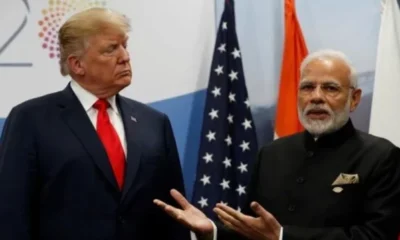
Prime Minister Narendra Modi on Thursday, August 20, met Japanese Defence Minister Shinjiro Koizumi in New Delhi and discussed ways to further strengthen defence and security cooperation between India and Japan.

During the meeting, Modi outlined his vision for strengthening the India-Japan Special Strategic and Global Partnership and highlighted the importance of closer defence and security ties in promoting peace, stability and prosperity in the Indo-Pacific and beyond.

PM Modi recalls India-Japan summit discussions

During his meeting with Koizumi, Modi recalled his detailed discussions with Japanese Prime Minister Sanae Takaichi during her visit to India for the 16th India-Japan Annual Summit in July 2026.

The prime minister also appreciated the steady momentum in defence cooperation between the two countries.

According to a statement from the Prime Minister’s Office, Koizumi, who is on an official visit to India, called on Modi on Thursday.

Focus on defence cooperation and Make in India

Modi also highlighted opportunities for Japanese companies and startups to partner with Indian firms in the defence sector.

The discussions included possibilities for co-development and co-production under the Make in India initiative, according to the statement.

Later, Modi said in a post on X that he had an “excellent conversation” with Koizumi on deepening defence and security ties between India and Japan.

He said the Special Strategic and Global Partnership between the two countries is an important anchor for peace, stability and prosperity in the Indo-Pacific and beyond.

Japan reaffirms commitment to deeper ties

Koizumi briefed Modi on the progress of bilateral defence cooperation during the meeting.

The Japanese Defence Minister also reaffirmed Japan’s continued commitment to deepening ties with India, the Prime Minister’s Office said.

Continue Reading

Latest world news

Trump warns Iran’s trading partners of economic action: India’s exports to take a hit?

Trump’s warning against countries supporting Iran could create payment, shipping and logistics challenges for Indian exporters.

Published

on

Donald Trump

US President Donald Trump has warned countries, financial institutions and businesses against providing Iran with what he called an “economic lifeline”, saying those that continue supporting Tehran could face “TREMENDOUS” economic consequences.

Trump’s warning comes as the United States steps up economic pressure on Iran. For India, the development could have implications for exporters, particularly those shipping agricultural products, food items and pharmaceuticals to the Iranian market.

India’s trade with Iran has already declined sharply over the years. However, Indian exporters continue to maintain a trade surplus with Tehran, making the potential impact of tighter US sanctions an issue to watch.

What did Trump say about Iran?

Trump has announced what he described as the “most crushing economic operation” against Iran and said the US would pursue economic warfare and isolation against Tehran.

His warning extends beyond Iran itself. Trump said countries, financial institutions and businesses that provide Tehran with financial or commercial support could face severe consequences.

The activities cited in his warning include oil smuggling, cash transfers, currency swap lines, exchange houses, ship registries and front companies.

“This will be an ECONOMIC D-DAY, and we need all of our Allies to stand with the United States of America to isolate, and defeat, the Iran threat,” Trump said.

He also warned that countries allowing their financial institutions, businesses, airports or government entities to support Iran could face “TREMENDOUS Economic Consequences”.

How much does India trade with Iran?

India remains an important trading partner of Iran, although bilateral trade has fallen significantly from previous levels.

According to data from the Indian Embassy in Tehran cited in the report, India’s exports to Iran stood at $1.25 billion in 2025-26, while imports from Iran were around $370 million. This gave India a trade surplus of approximately $880 million.

The scale of bilateral trade is considerably smaller than it was several years ago.

In 2018-19, India-Iran trade was worth $17.03 billion. India’s imports from Iran stood at $13.53 billion that year, while exports were $3.51 billion.

By 2024-25, total bilateral trade had fallen to $1.68 billion.

This sharp decline means India’s overall economic exposure to Iran is now relatively limited compared with the size of the Indian economy. However, businesses that continue to depend on the Iranian market could still face difficulties if US sanctions and enforcement are tightened.

What does India export to Iran?

India’s trade relationship with Iran extends beyond energy.

Major Indian exports to Iran include:

  • Basmati rice
  • Tea
  • Sugar
  • Fresh fruits
  • Drugs and pharmaceuticals
  • Spices
  • Cereals and other food products

Iran also exports products including pistachios, dates, apples and kiwis to India.

Any disruption to this trade could therefore affect businesses involved in agricultural products, food items and pharmaceuticals.

Why could Trump’s warning affect Indian exporters?

The immediate risk is not necessarily that India’s entire trade with Iran will stop.

Instead, Indian exporters could face greater difficulties with payments, shipping and logistics if the US expands sanctions or increases enforcement against businesses and financial institutions dealing with Tehran.

Shipping disruptions and higher freight costs could add to the pressure. The Strait of Hormuz remains a key pressure point, while vessel rerouting, elevated freight rates and tighter container availability can increase the cost and complexity of international trade.

For exporters with direct exposure to Iran, such disruptions could make shipments more expensive and payments more complicated.

India’s exports are finding other markets

India’s broader export performance provides some cushion against a potential slowdown in trade with Iran.

India’s merchandise exports reached a record $44.24 billion in July, representing a 19.6 per cent increase from a year earlier, according to the figures cited in the report.

Engineering goods exports rose 17.7 per cent to $12.24 billion, while electronics exports jumped 57.4 per cent to around $5.9 billion.

Exports to the Middle East also increased 8.6 per cent to $5.7 billion.

India has also been expanding its trade across several other markets. In July, exports to China increased 64.57 per cent year-on-year to $2.2 billion, while shipments to Singapore rose 83.7 per cent to $1.6 billion.

Exports to the US increased 12.85 per cent to $9.02 billion.

The diversification of India’s export markets could help businesses reduce their dependence on individual markets if geopolitical tensions disrupt trade with Iran.

Will Trump’s Iran warning hurt India?

Trump’s warning could affect Indian exporters doing business with Iran through higher shipping costs, payment complications and weaker demand if economic pressure on Tehran intensifies.

The impact is likely to be more significant for businesses with direct exposure to the Iranian market than for the Indian economy as a whole.

India-Iran trade has already contracted substantially from its earlier levels. With Indian exporters increasingly accessing markets across regions including ASEAN, Africa, South Asia and North-East Asia, India may be better placed to absorb the impact of any further disruption in Iran trade.

Continue Reading

Trending

© Copyright 2022 APNLIVE.com