
Latest world news
Lebanon: Hariri defers his resignation after reaching Beirut


[vc_row][vc_column][vc_column_text]Promises to work with President Michel Aoun
In a major turn-around development, Lebanese PM Saad al-Hariri has deferred his resignation, which he had suddenly announced in Saudi Arabia on November 4, and has promised to work with the country’s president, Michel Aoun.
According to Aljazeera, he declared his intention in a live telecast from country’s presidential palace on Wednesday after reaching Beirut. He returned from Paris on Tuesday evening.
Hariri said, “Today, I presented my resignation to the president and he urged me to hold onto it for more dialogue about its reasons and its political underpinnings … and I accepted.”
He further said, “I will do so in hopes that it will renew talks to strengthen our unity and resolve internal conflicts we have and how they reflect in our relations with our Arab brothers.”
While announcing his resignation while in Riyadh, he had criticised Iran for its intervention in Lebanese internal affairs and alleged Hezbollah for actively involved in the regional conflicts. He had also expressed danger of a plot for his assassination.
“At this time, Lebanon needs exceptional efforts from everyone in the face of upcoming challenges … I look forward today to a real partnership with all of the political parties to put Lebanon’s interest on top of anything else,” he said.
The report says that Hariri addressed the nation after holding a private meeting with President Michel Aoun in Beirut. Both leaders were seen in the celebrations commemorating country’s 74th Independence Day.
Hariri’s returned to Lebanon after two weeks of uncertainty which was erupted after his shock resignation on November 4, in a televised speech from Riyadh. Later, after Riyadh developed some understanding with Paris for extending “invitation” to Hariri, he travelled to France.
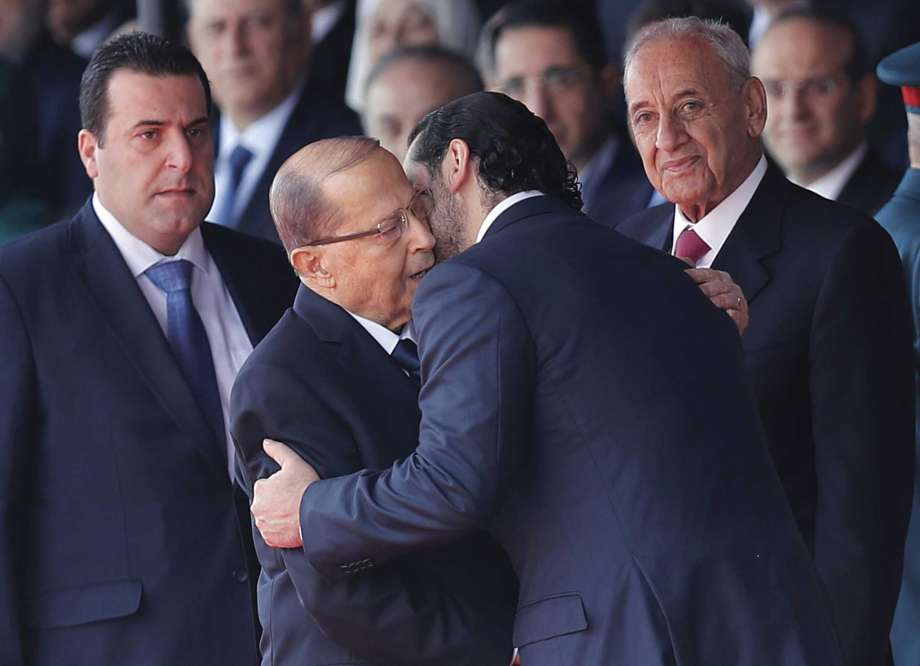
Hariri’s sudden resignation caused uncertainty in the politically fragile country. It was understood that Saudi Crown Prince Mohammed bin Salman had forced him to resign to create political vacuum in the country. Hariri was summoned through a telephonic call from Riyadh on November 3 and his mobile was ransacked while reached Riyadh on November 4. Nobody from royal family came to receive him at the airport.
Hariri’s children were left behind in Saudi Arabia while Hariri travelled to France.
Hariri later tweeted: “Our beloved nation requires at this precise moment in its life exceptional effort from everyone, in order to protect it as it faces danger and challenges. These efforts start with an adherence to a policy of neutrality with regards to everything that hurts internal stability and our brotherly relations with the Arabs.”
Observers believe that Saudi Arabia ha been supportive of Saad Hariri as it was with his father Rafik in its bid to grow its influence in Lebanon. It is also understood that US, Israel and Saudi Arabia were against growing Iranian influence in the region especially in Lebanon because of substantive presence of Hezbollah.[/vc_column_text][/vc_column][/vc_row]







Latest world news
Magnitude 7 earthquake strikes Russia’s Kamchatka Peninsula
A magnitude 7 earthquake struck Russia’s Kamchatka Peninsula region on Friday. The initial report placed the earthquake at a depth of 140 kilometres.


Latest world news
S Jaishankar says India is a natural option for Russia amid Europe tensions
External Affairs Minister S Jaishankar said India remained a natural option for Russia as Moscow increasingly turned towards Asia amid strained relations with Europe. He highlighted the continuity of India-Russia ties and their significance for the balance of power in Asia.

Latest world news
Putin praises PM Modi, says he has very good ideas on Ukraine war
Russian President Vladimir Putin has praised Prime Minister Narendra Modi for repeatedly raising the need to end the Ukraine war, describing his ideas for a settlement as “very good”.


India-US trade deal first phase finalised, drafting underway

Election Commission orders voter roll revision in 17 states, UTs

Actor Imran Khan asked to leave India after CJP protest

Delhi Police offers 11-person limit for CJP’s Connaught Place protest

Mallikarjun Kharge’s ‘Your Friends’ jab at Rahul Gandhi over congress exits

Magnitude 7 earthquake strikes Russia’s Kamchatka Peninsula

Delhi deploys 25,000 personnel, installs CCTV cameras ahead of CJP march
Mallikarjun Kharge’s ‘Your Friends’ jab at Rahul Gandhi over congress exits
Delhi Police offers 11-person limit for CJP’s Connaught Place protest
Actor Imran Khan asked to leave India after CJP protest

Afghan Men Try To Hang With The Jet Engine Of The Aircraft in Kabul- Afghanistan News – Kabul News
Trending Top 10 News: 10000 Crore Fine on Flipkart, Apple to Launch Unique Feature, Hdfc Bank Job Ad

Trending Top 10 News: Nokia 6310, Apple sales, Bachpan ka Pyar Video Kid, Dainik Bhaskar IT Raid

Trending Top 10 News: Canada bans Indian flights, Rain in Delhi NCR, AIMIM Twitter hacked, Raj Kundra case

Trending Top 10 News: Shein India, Apple New Service, Pocket Oxygen, Oppo Launched New Phone
-
 India News21 hours ago
India-US trade deal first phase finalised, drafting underway
-
 India News18 hours ago
Election Commission orders voter roll revision in 17 states, UTs
-
 India News18 hours ago
Actor Imran Khan asked to leave India after CJP protest
-
 India News17 hours ago
Delhi Police offers 11-person limit for CJP’s Connaught Place protest
-
 India News5 hours ago
Mallikarjun Kharge’s ‘Your Friends’ jab at Rahul Gandhi over congress exits
-
 India News5 hours ago
Delhi deploys 25,000 personnel, installs CCTV cameras ahead of CJP march
-
 Latest world news5 hours ago
Magnitude 7 earthquake strikes Russia’s Kamchatka Peninsula
