
Latest world news
Nanotech can make biopesticides more effective


[vc_row][vc_column][vc_column_text]By Sunderarajan Padmanabhan
The use of eco-friendly biocontrol agents as an alternative to chemical pesticides is prevalent in some farming communities. A group of scientists have now shown that it is possible to substantially enhance efficacy of such biocontrol agents by converting them into nanoparticles.
Researchers at the University of Agricultural Sciences at Raichur in Karnataka have developed a new technique to do so. They have converted secretion of a bacterium, Photorhabdusluminescens, into nanoparticles and found that its efficacy improved significantly. The bacterium is used as a biocontrol agent against a wide range of crop pests like mite, aphid, and mealy bug. The nano form of biocontrol agent has been tested against two sucking pests of cotton — Tetranychusmacfarlanei, a species of mite and Aphis gossypii, a species of aphid.
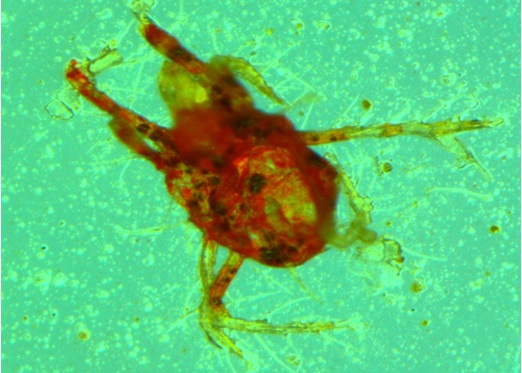
The fight is on: A mite killed by the new nano-particulated solution.
Reporting their findings in a recent issue of scientific journal Current Science, the researchers noted, “High mortality coupled with quick action emphasises the potential of nanotechnology in enhancing the pathogenicity of a microbial pesticide.” It was found that very low concentration of nano-particulated secretion could kill pests as against unprocessed secretion. This means farmers would be required to use very small quantities of biopesticide in its nano form.
Cellular secretions of the bacterium Photorhabdusluminescens have been used as pesticide against a wide range of insects. The bacterium lives within the body of a nematode called Heterorhabditis in a symbiotic relationship with the nematode. It secretes an array of toxins and enzymes.The secretions have a wide range of insecticidal actions against both sucking and chewing anthropod pests of agricultural crops. Farmers spray solutions of the bacteria on crops but it is not as efficacious as synthetic chemicals.
Scientists converted bacterial secretions into nanoparticles using a multi-stage process involving culturing, centrifuge, ultrasonic assisted atomizing and hot air-assisted vacuum process. The resultant product is dry powder.
“We have proved that it is possible to substantially enhance the efficacy of biopesticides. We need to conduct more studies to figure what is the best form in which it could be delivered to the users: whether it should be as a powder or a solution or in some other form,” said A Prabhuraj, one of the scientists involved in the study.
The research team included Ramesh A Kulkarni, J Ashoka and SG Hanchinal of the Department of Agricultural Entomology and SharanagoudaHiregoudar of the Department of Processing and Food Technology at the Raichur University. (India Science Wire)[/vc_column_text][/vc_column][/vc_row]





Latest world news
Magnitude 7 earthquake strikes Russia’s Kamchatka Peninsula
A magnitude 7 earthquake struck Russia’s Kamchatka Peninsula region on Friday. The initial report placed the earthquake at a depth of 140 kilometres.


Latest world news
S Jaishankar says India is a natural option for Russia amid Europe tensions
External Affairs Minister S Jaishankar said India remained a natural option for Russia as Moscow increasingly turned towards Asia amid strained relations with Europe. He highlighted the continuity of India-Russia ties and their significance for the balance of power in Asia.

Latest world news
Putin praises PM Modi, says he has very good ideas on Ukraine war
Russian President Vladimir Putin has praised Prime Minister Narendra Modi for repeatedly raising the need to end the Ukraine war, describing his ideas for a settlement as “very good”.


India-US trade deal first phase finalised, drafting underway

Election Commission orders voter roll revision in 17 states, UTs

Actor Imran Khan asked to leave India after CJP protest

Delhi Police offers 11-person limit for CJP’s Connaught Place protest

Mallikarjun Kharge’s ‘Your Friends’ jab at Rahul Gandhi over congress exits

Magnitude 7 earthquake strikes Russia’s Kamchatka Peninsula

Delhi deploys 25,000 personnel, installs CCTV cameras ahead of CJP march
Mallikarjun Kharge’s ‘Your Friends’ jab at Rahul Gandhi over congress exits
Delhi Police offers 11-person limit for CJP’s Connaught Place protest
Actor Imran Khan asked to leave India after CJP protest

Afghan Men Try To Hang With The Jet Engine Of The Aircraft in Kabul- Afghanistan News – Kabul News
Trending Top 10 News: 10000 Crore Fine on Flipkart, Apple to Launch Unique Feature, Hdfc Bank Job Ad

Trending Top 10 News: Nokia 6310, Apple sales, Bachpan ka Pyar Video Kid, Dainik Bhaskar IT Raid

Trending Top 10 News: Canada bans Indian flights, Rain in Delhi NCR, AIMIM Twitter hacked, Raj Kundra case

Trending Top 10 News: Shein India, Apple New Service, Pocket Oxygen, Oppo Launched New Phone
-
 India News23 hours ago
India-US trade deal first phase finalised, drafting underway
-
 India News21 hours ago
Election Commission orders voter roll revision in 17 states, UTs
-
 India News20 hours ago
Actor Imran Khan asked to leave India after CJP protest
-
 India News19 hours ago
Delhi Police offers 11-person limit for CJP’s Connaught Place protest
-
 India News8 hours ago
Mallikarjun Kharge’s ‘Your Friends’ jab at Rahul Gandhi over congress exits
-
 India News7 hours ago
Delhi deploys 25,000 personnel, installs CCTV cameras ahead of CJP march
-
 Latest world news7 hours ago
Magnitude 7 earthquake strikes Russia’s Kamchatka Peninsula
