
Latest world news
Pakistan Lodge Complaint at WB against India’s violating IWT


Amidst cancellation of bilateral foreign minister level meeting by India, Pakistan’s Foreign Minister Shah Mahmood Qureshi, on Monday, met with World Bank President Jim Yong Kim and requested for empanelment of Court of Arbitration over alleged illegal construction of dams by India on western rivers.
According to Dawn report, the focus of the meeting was on implementing the World Bank’s role as the administrator of the Indus Waters Treaty (IWT). Qureshi asked the WB chief to “empanel the Court of Arbitration over [the] illegal construction of dams by India on western rivers”.
According to the state broadcaster Pakistan Radio, foreign minister told the WB president that India’s construction of the Kishanganga and Ratle dams represents a violation of the IWT.
Read More: Pakistan reaches to World Bank against India on Kishanganga dam
Briefing the media persons after his meeting, Qureshi said that while speaking to WB President Jim Yong Kim he had asked that Pakistan’s request pertaining to Annexure G, Paragraph 11 of the IWT should be focused on.
He said that Pakistan and India were unable to resolve the issue bilaterally and the World Bank president had promised to make one more attempt. “I heard his point of view and he has promised that he will make one more attempt [at this issue],” Qureshi said.
 Pakistan’s foreign minister said that new government “views this as a humanitarian issue with the lives and livelihoods of millions at stake.”
He “emphasised” that the “procedural delay” in Pakistan’s request to the WB had resulted in completion of the Kishanganga project while construction was underway on Ratle dam.
Read More: India, Pakistan Agree For Mutual Inspection of Indus Basin
In April, the WB had received Pakistan’s complaint on the completion of the Kishanganga hydropower plant by India and confirmed that it was working with Islamabad and New Delhi for an amicable resolution.
Pakistan complained that India had violated a World Bank-mandated pause, placed in 2016, by completing the controversial Kishanganga project.
The report said Qureshi indicated that the WB was in the “process of finalising a fresh initiative” for which it would soon approach India and Pakistan with details.
Meanwhile another report from Islamabad says that opposition members in country’s senate raised questions on the dialogue offered by PM Imran Khan to India at a time when “Indian forces had intensified brutalities in …Kashmir.”
 In another development, World Bank, in its report “A Glass Half Full: The Promise of Regional Trade in South Asia” said on Monday that trade between India and Pakistan is mare $2 billion whereas this could reach to $37 bn if all trade barriers are removed.






Latest world news
S Jaishankar says India is a natural option for Russia amid Europe tensions
External Affairs Minister S Jaishankar said India remained a natural option for Russia as Moscow increasingly turned towards Asia amid strained relations with Europe. He highlighted the continuity of India-Russia ties and their significance for the balance of power in Asia.


Latest world news
Putin praises PM Modi, says he has very good ideas on Ukraine war
Russian President Vladimir Putin has praised Prime Minister Narendra Modi for repeatedly raising the need to end the Ukraine war, describing his ideas for a settlement as “very good”.

Latest world news
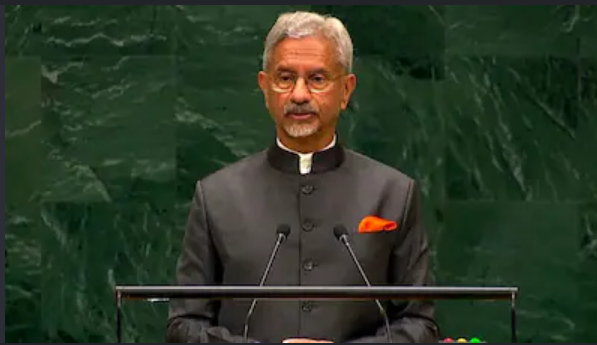
S Jaishankar calls Pakistan a “serial practitioner of terrorism” at UN
S Jaishankar criticised Pakistan at the UN General Assembly, referring to a “serial practitioner of terrorism” and warning against attempts to normalise terrorism.

Dhruv Rathee gets fresh summons in 2018 BJP IT cell video case

Nobody can browbeat judiciary, Chief Justice warns over Rahul Gandhi’s march

India-US trade deal first phase finalised, drafting underway

Election Commission orders voter roll revision in 17 states, UTs

Actor Imran Khan asked to leave India after CJP protest

Delhi Police offers 11-person limit for CJP’s Connaught Place protest
Actor Imran Khan asked to leave India after CJP protest
Election Commission orders voter roll revision in 17 states, UTs
India-US trade deal first phase finalised, drafting underway
Nobody can browbeat judiciary, Chief Justice warns over Rahul Gandhi’s march

Afghan Men Try To Hang With The Jet Engine Of The Aircraft in Kabul- Afghanistan News – Kabul News
Trending Top 10 News: 10000 Crore Fine on Flipkart, Apple to Launch Unique Feature, Hdfc Bank Job Ad

Trending Top 10 News: Nokia 6310, Apple sales, Bachpan ka Pyar Video Kid, Dainik Bhaskar IT Raid

Trending Top 10 News: Canada bans Indian flights, Rain in Delhi NCR, AIMIM Twitter hacked, Raj Kundra case

Trending Top 10 News: Shein India, Apple New Service, Pocket Oxygen, Oppo Launched New Phone
-
 India News20 hours ago
Dhruv Rathee gets fresh summons in 2018 BJP IT cell video case
-
 India News17 hours ago
Nobody can browbeat judiciary, Chief Justice warns over Rahul Gandhi’s march
-
 India News12 hours ago
India-US trade deal first phase finalised, drafting underway
-
 India News10 hours ago
Election Commission orders voter roll revision in 17 states, UTs
-
 India News10 hours ago
Actor Imran Khan asked to leave India after CJP protest
-
 India News8 hours ago
Delhi Police offers 11-person limit for CJP’s Connaught Place protest
