
Latest world news
Saudi-led aggression: 5000 families displaced in Hudaidah


Yemen witnessed unprecedented war
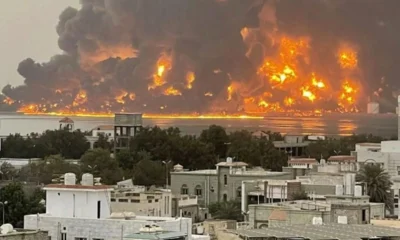
The ongoing Saudi-led fresh aggression against Yemen’s Hudaidah port city has caused major internal displacement of war stricken citizens in the most impoverished country in the region. The UN says that nearly 5,000 families have been displaced due to unprecedented attacks by Saudi-led coalition and militia loyal to the former President Abdrabbuh Mansur Hadi since June 13.
The UN Office for the Coordination of Humanitarian Affairs said, in a statement on Sunday that 4,458 households have been displaced from their homes in Hudaidah since June 1. At least 36 displaced families had already lost their entire livelihood as their crops were damaged in airstrikes.
After nearly a month of sporadic clashes with Houthi Ansarullah fighters, the Saudi-led coalition along with the militia loyal to former President Abdrabbuh Mansur Hadi, who is currently based in Riyadh in Hudaidah, launched a major assault on Wednesday to take the Houthi-held port, a densely-populated and the most vital city.
The Houthi movement has been running state affairs in the absence of an effective administration during the past three years. Their administration also lack recognition by UN and other world bodies. The Houthis have been supporting Yemeni army having allegiance with them in defending the country against Saudi led coalition forces.
The terminology used by Houthi administration and Saudi-led coalition generally creates confusion among the readers outside the region. Saudi media call ousted President Hadi as the head of Yemen government having no practical control on most of the country’s territory.

Meanwhile UAE’s Minister of State for Foreign Affairs Anwar Gargash, while briefing members of international diplomatic corps based in Abu Dhabi, has said on Sunday that the efforts to “liberate” Hudaidah is aimed at forcing Houthi militias to the negotiating table.
He wrote on his twitter on Sunday, “This operation is intentionally calibrated to help UN Special Envoy Martin Griffiths in his difficult task to persuade the Houthis to unconditionally withdraw from Hodeida.We are at a turning point, because as long as the Houthis hold Hodeida, they will continue to impede the political process. We firmly believe that the liberation of Hodeida will pull the Houthis back to the negotiating table.”
However, on Monday, Gargash said, “It was just a matter of time” before the complete liberation of Yemen’s port city of Hudaidah. “The Arab coalition is militarily advancing with caution, to avoid civilians in Hudaidah. All routes leading to the port are planted with Houthi mines. We appreciates France’s announcement that it will help de-mining efforts in the city, he said.
He was also quoted saying, “The liberation of Hudaidah is key to liberating Sanaa. We have opened the road from Hudaidah to Sanaa (the capital) for Houthi militias to exit without resistance.”

Meanwhile, Beirut based Al-Manar, quoting a Houthi Ansarullah official Mohammad Al-Bakhiti has reported that the Saudi and Emirati aggression on Hudaidah is resulting only in failure. He dismissed all reports claiming that the Saudi led forces have taken control of the Hudaidah airport and claimed that the aggression powers sustain heavy losses. He said, “Aggression forces have never secured any achievement in Hudaidah, morale of Yemeni Army, popular committees high.”
Al-Manar further said that the forces loyal to Houthi were reportedly still in control of the airport of Hudaidah, noting that Saudi-led media reports on capturing airport aimed at diverting attention from the huge losses inflicted upon Saudi-led ground troops and mercenaries in several fronts across the port city. Media in Iran and its ally countries call forces loyal to Hadi as “mercenaries” while Saudi lead coalition call them Yemeni army.
The invasion of Hudaydah has already triggered fears of a fresh humanitarian crisis in a country where more than 22 million people are in need of aid, including 8.4 million who are at risk of starvation, according to UN figures.







Latest world news
S Jaishankar says India is a natural option for Russia amid Europe tensions
External Affairs Minister S Jaishankar said India remained a natural option for Russia as Moscow increasingly turned towards Asia amid strained relations with Europe. He highlighted the continuity of India-Russia ties and their significance for the balance of power in Asia.


Latest world news
Putin praises PM Modi, says he has very good ideas on Ukraine war
Russian President Vladimir Putin has praised Prime Minister Narendra Modi for repeatedly raising the need to end the Ukraine war, describing his ideas for a settlement as “very good”.

Latest world news
S Jaishankar calls Pakistan a “serial practitioner of terrorism” at UN
S Jaishankar criticised Pakistan at the UN General Assembly, referring to a “serial practitioner of terrorism” and warning against attempts to normalise terrorism.


Rahul Gandhi hosts high tea for INDIA bloc after Gyanesh Kumar protests

L Murugan quits Union ministry to strengthen BJP in Tamil Nadu

Amit Shah attacks Rahul Gandhi over Congress poll losses, questions SIR row

BJP focuses on religion as opposition pushes BDM strategy in UP

CJP leaders Saurav Das, Ashutosh Ranka, Ajinkya Shinde sent to 5-day judicial custody

PM Modi speaks to Mark Carney as India and Canada push to strengthen ties

S Jaishankar says India is a natural option for Russia amid Europe tensions
CJP leaders Saurav Das, Ashutosh Ranka, Ajinkya Shinde sent to 5-day judicial custody
BJP focuses on religion as opposition pushes BDM strategy in UP
L Murugan quits Union ministry to strengthen BJP in Tamil Nadu

Afghan Men Try To Hang With The Jet Engine Of The Aircraft in Kabul- Afghanistan News – Kabul News
Trending Top 10 News: 10000 Crore Fine on Flipkart, Apple to Launch Unique Feature, Hdfc Bank Job Ad

Trending Top 10 News: Nokia 6310, Apple sales, Bachpan ka Pyar Video Kid, Dainik Bhaskar IT Raid

Trending Top 10 News: Canada bans Indian flights, Rain in Delhi NCR, AIMIM Twitter hacked, Raj Kundra case

Trending Top 10 News: Shein India, Apple New Service, Pocket Oxygen, Oppo Launched New Phone
-
 India News17 hours ago
Rahul Gandhi hosts high tea for INDIA bloc after Gyanesh Kumar protests
-
 India News16 hours ago
L Murugan quits Union ministry to strengthen BJP in Tamil Nadu
-
 India News16 hours ago
Amit Shah attacks Rahul Gandhi over Congress poll losses, questions SIR row
-
 India News15 hours ago
BJP focuses on religion as opposition pushes BDM strategy in UP
-
 India News4 hours ago
CJP leaders Saurav Das, Ashutosh Ranka, Ajinkya Shinde sent to 5-day judicial custody
-
 Latest world news4 hours ago
S Jaishankar says India is a natural option for Russia amid Europe tensions
-
 India News4 hours ago
PM Modi speaks to Mark Carney as India and Canada push to strengthen ties
