English हिन्दी
Connect with us

Latest world news

Syria: Conflicting reports of Chemical weapons used in Douma

Published

on

Syria: Conflicting reports of Chemical weapons used in Douma

[vc_row][vc_column][vc_column_text]Russia and Syria denies using chemical weapons while US-Israel-Saudi media drums against Assad regime

The ongoing struggle in Syria is once again marked with allegations and denials of using chemical weapons during operations in the rebel held Douma area in Eastern Ghouta on Saturday. The US-Israel-Saudi Arabian media alleged for the chemical weapon attack on civilians while Syria and Russia have officially denied the allegations.

CNN quoted several Syrian activist groups that toxic gas inside barrel bombs were dropped by helicopters over Douma causing people to suffocate and choke leaving dozens of civilians dead and scores wounded.

However, Syrian state news agency SANA cited an “official source” who denied the allegation, saying reports were a “blatant attempt to hinder the army’s advance” into what it described as a “collapsing terrorist” stronghold.

Read More: Russia, Turkey and Iran support Syrian sovereignty, integrity

The agency further said that the Syrian Arab Army “does not need to use any chemical materials as claimed by terrorists’ media affiliates.”

Meanwhile, Russia’s Defense Ministry has refuted reports on Sunday that the Syrian forces have used chemical weapons in Douma in Eastern Ghouta.

According to TASS news agency, Major General Yuri Yevtushenko, the head of the Russian Center for Reconciliation of the Warring Sides in Syria said that the allegations that a chlorine barrel bomb had been dropped in Douma by the Syrian armed forces were the work of the so-called independent non-governmental organizations, including the White Helmets, which is widely known for its fake news.

Syria: Conflicting reports of Chemical weapons used in DoumaHe further said “We strongly reject this information and confirm readiness after Douma is liberated from militants to send Russian specialists in radiation, chemical and biological protection to collect data to confirm that these statements are fabricated.”

The allegations of Syrian forces using chemical weapons have come to light after Damascus has recently claimed of discovering Daesh (IS) terrorist-run factory of making chemical weapons in Eastern Ghouta.

Read More: Syria: Chemical weapon factory unearthed in Eastern Ghouta

The Russian official noted that the West used the allegations of chemical attacks to disrupt an operation beginning on Sunday on evacuating from Douma irreconcilable militants of the Jaish al-Islam group. On Saturday, news broke that they resumed fighting against the government forces.

Meanwhile SANA reports on Sunday morning that the terrorists of the so-called “Jaish al-Islam” seek negotiations with the Syrian state and said that the negotiations would begin within two hours.

The agency further said that the request from terrorists came after “the painful blows” they received due to the decisive military operation on their positions and hotbeds in Douma.

Syrian government has agreed to negotiate due to its “keenness to protect civilians and liberate the abductees” despite having doubts about their seriousness, the agency added.

Read More: Syrian forces clear 90 per cent of Eastern Ghouta

However, the slant of coverage in American-Israeli-Saudi media houses was quite provocative. CNN’s headline reads “Dozens dead in possible gas attack in Syria: regime denies allegation”. Haaretz, a leading Israeli newspaper’s headline was “Scores of Syrians killed in Suspected Chemical Attack by Assad Forces” while Saudi Arabia’s Alarabiya.net was headlined “Horrific pictures show ‘entire families’ gassed to death in Syria’s Douma” while Qatar based Al-Jazeera network’s story say “Syria Chemical attack kills ‘70’.[/vc_column_text][/vc_column][/vc_row]
Latest world news

US hits Iranian missile sites and mine-laying boats near Strait of Hormuz amid peace talks

US Central Command executed targeted strikes against Iranian missile launch sites and mine-laying vessels near Bandar Abbas, testing a fragile ceasefire even as high-stakes diplomatic talks continue in the region.

Published

on

In a major development testing a fragile regional ceasefire, the United States military carried out targeted strikes in southern Iran on Monday. The operation hit missile launch sites and vessels allegedly attempting to lay mines near the crucial Strait of Hormuz, according to statements from the US Central Command (CENTCOM).

The military action took place near Bandar Abbas, a prominent southern port city hosting a primary Iranian naval base. Media reporting indicated that explosions were heard across multiple coastal locations, including Sirik and Jask.

Focus on ‘Self-Defense’ Amid Active Ceasefire

A spokesperson for CENTCOM, Capt. Tim Hawkins, confirmed that the engagement was defensive in nature. “US forces conducted self-defense strikes in southern Iran today to protect our troops from threats posed by Iranian forces,” Hawkins stated. He noted that the operational targets included active missile launch sites alongside Iranian boats attempting to emplace naval mines. Despite the escalation, CENTCOM emphasized that it continues to exercise restraint under the parameters of the ongoing ceasefire brokered in early April.

According to media reports, the tactical response was triggered when two Islamic Revolution Guard Corps (IRGC) boats were detected laying mines in the strategic shipping lane. Additionally, a surface-to-air missile site reportedly targeted American warplanes, prompting US forces to neutralize both the vessels and the missile installations. Media channels citing local updates indicated that four individuals were killed in the strikes, though the complete casualty figures remain unverified.

Diplomatic Dialogue Continues in Parallel

The strikes coincide with a critical phase of diplomatic negotiations aimed at extending the current truce. Top Iranian negotiators traveled to Qatar early this week to discuss a potential 60-day extension of the ceasefire, alongside provisions to keep the Strait of Hormuz fully operational for global trade.

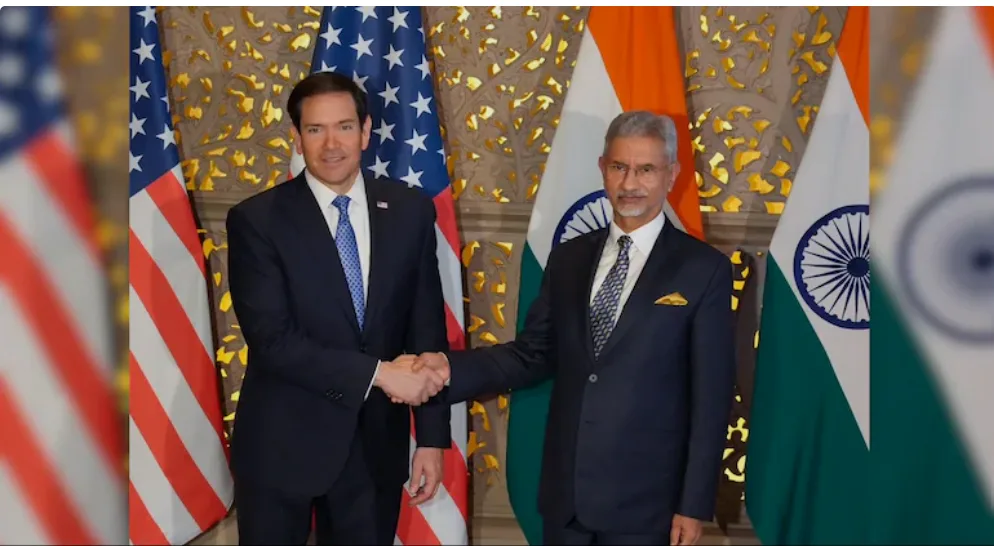
US officials maintain that the military action does not signal an end to the active truce. A senior administration source clarified that the specific operations are “over for now”. US Secretary of State Marco Rubio, speaking from India, affirmed that diplomatic channels remain open and active. Rubio stated that intensive language discussions regarding the initial documents are ongoing, reiterating that the opening of the strategic strait remains a core objective.

Meanwhile, political leaders in Washington have separately reiterated demands for the secured disposal or international transfer of enriched uranium stockpiles as part of any comprehensive long-term agreement.

Continue Reading

Latest world news

US announces new America First visa schedule to boost business ties with India

During his official state visit to New Delhi, US Secretary of State Marco Rubio announced a new America First visa schedule designed to prioritise business professionals and boost bilateral trade efficiency.

Published

on

In a significant development aimed at strengthening bilateral cooperation, the United States has introduced a new “America First” visa schedule. The policy update was announced by US Secretary of State Marco Rubio during his official four-day visit to India. The new schedule is specifically designed to prioritise business professionals who play a key role in fortifying trade and strategic connections between the two nations.

Speaking about the initiative in the national capital, the top US diplomat clarified that the updated framework will not only assist visa applicants but will also significantly enhance operational productivity for the diplomatic mission. “We’re introducing a new America First visa schedule that prioritises business professionals that strengthen these ties,” Rubio stated. He added that the arrangement will enable the system to process applications with greater accuracy, speed, and efficiency.

Focus on Indo-Pacific and regional security

The announcement coincided with high-level discussions between the visiting diplomat and Prime Minister Narendra Modi. The meeting, which lasted for over an hour, covered critical areas of bilateral interest, including trade, energy security, strategic technologies, defence cooperation, and the ongoing West Asia crisis. During the interaction, Rubio extended an official invitation from US President Donald Trump for PM Modi to visit the White House in the near future.

The US Secretary of State described the partnership between New Delhi and Washington as a foundational cornerstone of America’s overarching strategy for the Indo-Pacific region. Highlighting India’s central role, Rubio noted that his very first official engagement upon taking office was a meeting of the Quadrilateral Security Dialogue (Quad), emphasizing that hosting the upcoming foreign ministers’ meeting in India acts as a tangible sign of the deep commitment to this framework.

Clarification on immigration rules

Addressing separate concerns regarding recent shifts in American immigration policies, the top diplomat provided a crucial clarification regarding the new guidelines for permanent residency. Media reports had previously highlighted anxieties surrounding a newly instituted rule that requires many legal immigrants to exit the US and apply for green cards from their home countries.

Rubio explicitly stated to the media that these measures are universal regulatory updates rather than policy shifts targeted at any specific nation. He reassured that the rule is applicable globally to all international applicants and is not directed exclusively at Indian citizens.

The visit marks Rubio’s first official trip to India since assuming office. His comprehensive itinerary began in Kolkata and includes a scheduled bilateral dialogue with External Affairs Minister S Jaishankar, alongside participation in the Quad Foreign Ministers’ meeting alongside international counterparts.

Continue Reading

Latest world news

High stakes for India-US ties as top American diplomat arrives for critical bilateral talks

US Secretary of State Marco Rubio has arrived in India for a vital four-day tour aimed at reinforcing bilateral cooperation amid global energy challenges, tariff disputes, and shifting regional security dynamics.

Published

on

US Secretary of State Marco Rubio has landed in Kolkata to begin an extensive four-day diplomatic tour of India, marking his first official visit to the country since assuming office. The visit arrives at a crucial juncture for bilateral relations, with both nations navigating complex global alignments, ongoing geopolitical conflicts, and shifting economic dynamics.

Upon arriving in Kolkata, the top diplomat broke a 14-year hiatus since a US secretary of state last traveled to the eastern metropolis. Accompanied by his wife, Jeanette D. Rubio, and the US Ambassador to India, Sergio Gor, the delegation commenced the tour by visiting the Missionaries of Charity headquarters, the historical Mother House founded by Mother Teresa.

Strategic energy shifts and regional security on the table

The four-day visit carries elevated strategic significance as the two major global partners look to address critical geopolitical challenges. Headlining the bilateral talks are the economic ripples of the US-Iran war, particularly its immediate fallout on international energy security and commercial trade routes.

The energy partnership remains a key focal point. While India continues to procure substantial volumes of discounted Russian crude oil to stabilize its domestic market, Washington is actively attempting to diversify New Delhi’s energy footprint by expanding American liquefied natural gas (LNG) and crude exports to the South Asian nation. Additionally, the leadership will deliberate on resolving recent trade frictions arising from tariffs imposed by the US on Indian goods.

Strengthening the bilateral roadmap

Prior to starting his engagements, the Secretary of State underlined the strength of the relationship, characterizing India as an invaluable partner and ally with whom Washington shares a robust and extensive collaborative framework. The visit serves as a top-level initiative to stabilize and accelerate the momentum of the bilateral partnership, backed by the personal investment of both US President Donald Trump and Prime Minister Narendra Modi.

The diplomat’s packed itinerary includes a high-profile meeting with Prime Minister Narendra Modi, followed by extensive bilateral discussions with External Affairs Minister S. Jaishankar. Furthermore, the tour will culminate in New Delhi, where the Secretary of State will join regional partners for a meeting of the Quad foreign ministers. Cultural stops in Agra and Jaipur are also scheduled during the four-day visit.

Continue Reading

Trending

© Copyright 2022 APNLIVE.com