
Latest world news
Pakistan asks US to resume balancing role in South Asia


Islamabad unhappy over New Delhi’s growing ties with Washington
Continuing its anti-India tirade Pakistan has been trying to curtail India’s growing influence. In the latest development Pakistan has asked the United States administration to resume its balancing role it played in South Asia before starting to build a strategic partnership with India.
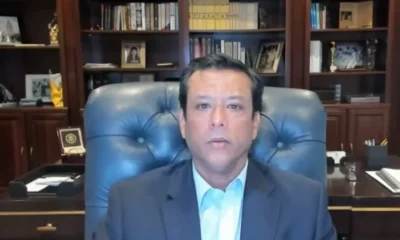
According to Dawn correspondent Anwar Iqbal in Washington, Aizaz Ahmed Chaudhary, Pakistan’s Ambassador to US, while briefing US and Pakistani journalists on Friday said, “We are saying to the US administration that the United States always brought a balance in SA [South Asia], but this recent tilt has created an imbalance.”
 He further said, “This tilt has also emboldened the Indian government to go for a heavy-handed approach, which is the most manifest in occupied Kashmir.”
Pakistan government and media call Jammu and Kashmir as occupied Kashmir while call Pakistan Occupied Kashmir (PoK) as Aazad Kashmir. However, India call all Jammu and Kashmir, including under Pakistan occupied and China occupied Kashmir as its integral part.
Ambassador Aizaz Ahmad Chaudhry addressing Pakistani, American & International media representatives highlighting the latest developments in Indian Occupied Kashmir on the occasion of #Kashmir Solidarity Day held at the Embassy of Pakistan pic.twitter.com/WfR5diRNeu
— Pakistan Embassy, DC (@PakEmbassyDC) April 6, 2018
India did not participate in One Belt One Road Summit in China last year because the China-Pakistan Economic Corridor (CPEC), part of the giant project, passes through the occupied Jammu and Kashmir region.
Chaudhary further said, “The policy of Hindutva will not bode well for either India or the region but what happens in India is for them to worry about, not for us. Peace in South Asia is better served if the United States assumes the role of a balanced power-player.”
Pakistan’s Ambassador distributed a so-called “fact-sheet” among the media persons claiming that Indian forces had killed 20 innocent Kashmir in the last few days. It described the uprising in India-held Kashmir as a legitimate struggle for the realisation of their right of self-determination, not terrorism.
Pakistan has been constantly supporting separatists in Jammu and Kashmir. Dialogue between India and Pakistan has been suspended for last few years, especially after 26/11 Mumbai terror attacks in November 2008 killing 116 people and wounding 308 others. Pakistan was also involved in Pathankot terror attack on Indian Air Force base in January 2016 and heavily armed militants attack on security forces in September 2016 in Uri. This attack was reported as “the deadliest attack on security forces in Kashmir in two decades”.
Amb Aizaz received a representative delegation of Kashmiri Americans @PakEmbassyDC & reiterated Govt of Pak’s demand that India must immediately halt its campaign of torture against civilians & allow int’l human rights organizations access to IOK 2 determine extent of brutalities pic.twitter.com/ew7g1x7AIT
— Pakistan Embassy, DC (@PakEmbassyDC) April 7, 2018







Latest world news
Magnitude 7 earthquake strikes Russia’s Kamchatka Peninsula
A magnitude 7 earthquake struck Russia’s Kamchatka Peninsula region on Friday. The initial report placed the earthquake at a depth of 140 kilometres.


Latest world news
S Jaishankar says India is a natural option for Russia amid Europe tensions
External Affairs Minister S Jaishankar said India remained a natural option for Russia as Moscow increasingly turned towards Asia amid strained relations with Europe. He highlighted the continuity of India-Russia ties and their significance for the balance of power in Asia.

Latest world news
Putin praises PM Modi, says he has very good ideas on Ukraine war
Russian President Vladimir Putin has praised Prime Minister Narendra Modi for repeatedly raising the need to end the Ukraine war, describing his ideas for a settlement as “very good”.


India-US trade deal first phase finalised, drafting underway

Election Commission orders voter roll revision in 17 states, UTs

Delhi Police offers 11-person limit for CJP’s Connaught Place protest

Actor Imran Khan asked to leave India after CJP protest

Mallikarjun Kharge’s ‘Your Friends’ jab at Rahul Gandhi over congress exits

Magnitude 7 earthquake strikes Russia’s Kamchatka Peninsula

Delhi deploys 25,000 personnel, installs CCTV cameras ahead of CJP march
Mallikarjun Kharge’s ‘Your Friends’ jab at Rahul Gandhi over congress exits
Delhi Police offers 11-person limit for CJP’s Connaught Place protest
Actor Imran Khan asked to leave India after CJP protest

Afghan Men Try To Hang With The Jet Engine Of The Aircraft in Kabul- Afghanistan News – Kabul News
Trending Top 10 News: 10000 Crore Fine on Flipkart, Apple to Launch Unique Feature, Hdfc Bank Job Ad

Trending Top 10 News: Nokia 6310, Apple sales, Bachpan ka Pyar Video Kid, Dainik Bhaskar IT Raid

Trending Top 10 News: Canada bans Indian flights, Rain in Delhi NCR, AIMIM Twitter hacked, Raj Kundra case

Trending Top 10 News: Shein India, Apple New Service, Pocket Oxygen, Oppo Launched New Phone
-
 India News24 hours ago
India-US trade deal first phase finalised, drafting underway
-
 India News22 hours ago
Election Commission orders voter roll revision in 17 states, UTs
-
 India News20 hours ago
Delhi Police offers 11-person limit for CJP’s Connaught Place protest
-
 India News21 hours ago
Actor Imran Khan asked to leave India after CJP protest
-
 India News8 hours ago
Mallikarjun Kharge’s ‘Your Friends’ jab at Rahul Gandhi over congress exits
-
 India News8 hours ago
Delhi deploys 25,000 personnel, installs CCTV cameras ahead of CJP march
-
 Latest world news8 hours ago
Magnitude 7 earthquake strikes Russia’s Kamchatka Peninsula
