
Latest world news
Yemen’s Houthi attack Saudi Arabia’s Capital airport


[vc_row][vc_column][vc_column_text]Riyadh claims of intercepting missile before reaching target
Saudi Arabia has claimed to have intercepted and destroyed a ballistic missile near Riyadh’s King Khaled international airport on Saturday. It was verified by Yemen’s Houthi forces with their claimed of firing a long range ballistic missile travelling more than 800 km over the border with Saudi Arabia.
The military alliance led by Saudi Arabia has been pounding Yemen since March 2015 in an attempt to crush the popular Houthi Ansarullah movement and reinstate its ally former president Abd Rabbuh Mansur Hadi in that country.
Aljazeera quoted a Houthi spokesman that they launched a Burkan 2H missile, a scud type missile with a range of more than 800 km towards Riyadh late on Saturday.
Saudi lead coalition spokesman claimed that air defence intercepted the missile, bringing it down to the north of the airport. He said, “Shattered fragments from the intercepted missile landed in an uninhabited area of the airport and there were no injuries.”
The Houthi spokesman extended their threat to hit other capitals in the region who were part of the Saudi led coalition. He said, “The capital cities of countries that continually shell us, targeting innocent civilians, will not be spared from our missiles.”
The Saudi lead intervention in Yemen includes UAE, Bahrain, Kuwait, Qatar, Egypt, Jordan, Morocco, Senegal and Sudan. The coalition is supported by US, UK, Canada and Trukey.
On the other side, Yemen’s Revolutionary Committee is supported by Yemen Army (pro-Saleh Abdullah (former President) and Houthis), Yemen Republican Guard, Yemen Air Force and Shia Ahrar al-Najran Movement. Houthis are allegedly being supported by Iran and Hezbollah.
Meanwhile, Yemen’s official Saba news agency has reported that the missile force of the army and popular forces have claimed that the “ballistic missile hit the target accurately.”
Moreover, a military official told the news agency on Saturday that the popular forces targeted gatherings of Saudi mercenaries’ sites in some places in Asir province killing and injuring dozens of them.
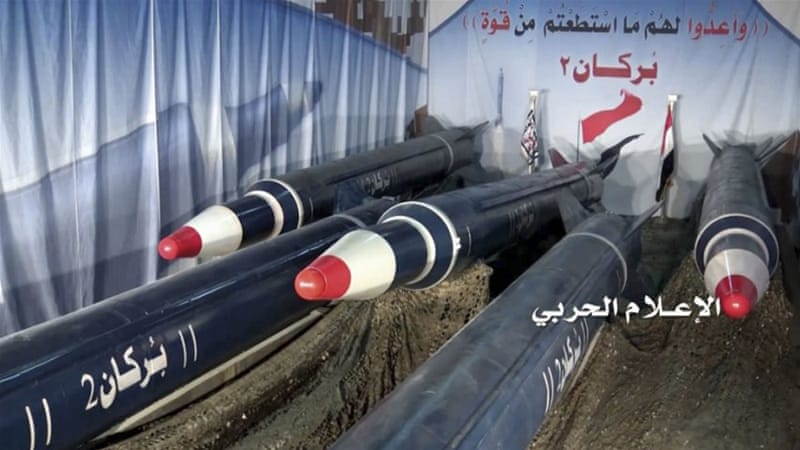
A Houthi spokesman Colonel Aziz Rashed has reportedly told Tehran based Press TV on Sunday morning, “Our Yemeni forces succeeded in launching a missile, a Borkan H2 long distance missile, at the King Khalid international airport in north eastern Riyadh which was in response to the massacres committed by the US-Saudi coalition in Yemen.”
He further said, “This comes in order to even out power between the coalition and Yemen, who have been attempting to fight more than one country in the past three years.”
Videos on social media showed smoke rising from an area near Riyadh’s King Khalid International Airport.
Following Saturday night Houthi missile attack, Saudi warplanes engaged in airstrikes on Yemen, hitting targets in Sana’a and Sa’ada provinces. The targets included Defence Ministry, Interior Ministry and the national Security Council buildings.
On the other side, Saudi state news channel Al Ekhbariya said, “The missile was of limited size (and) no injuries or damage” were reported. It further said that the missile was destroyed near Riyadh’s King Khaled international airport, which was functioning normally.
Meanwhile Saudi Press Agency (SPA) reported on Saturday that Saudi-led military coalition has claimed that an air strike that hit a market in Yemen’s northern Sa’ada province was a legitimate military target.
On Wednesday an air strike carried out by the Saudi led coalition killed 26 people at a hotel and an adjoining market, where the Houthi fighters gather.
Till date more than 12,000 people have been killed in more than two and half years destroying infrastructure including hospitals, schools and factories.
Recently Saudi Arabia’s Crown Prince Muhammed bin Salman had vowed not to allow Yemen’s Houthi Ansarullah movement to emerge as another Hezbollah in the region.[/vc_column_text][/vc_column][/vc_row]







Latest world news
Magnitude 7 earthquake strikes Russia’s Kamchatka Peninsula
A magnitude 7 earthquake struck Russia’s Kamchatka Peninsula region on Friday. The initial report placed the earthquake at a depth of 140 kilometres.


Latest world news
S Jaishankar says India is a natural option for Russia amid Europe tensions
External Affairs Minister S Jaishankar said India remained a natural option for Russia as Moscow increasingly turned towards Asia amid strained relations with Europe. He highlighted the continuity of India-Russia ties and their significance for the balance of power in Asia.

Latest world news
Putin praises PM Modi, says he has very good ideas on Ukraine war
Russian President Vladimir Putin has praised Prime Minister Narendra Modi for repeatedly raising the need to end the Ukraine war, describing his ideas for a settlement as “very good”.


Mallikarjun Kharge’s ‘Your Friends’ jab at Rahul Gandhi over congress exits

Magnitude 7 earthquake strikes Russia’s Kamchatka Peninsula

Delhi deploys 25,000 personnel, installs CCTV cameras ahead of CJP march

Abhijeet Dipke detained ahead of CJP’s national flag march in Delhi

Mallikarjun Kharge seeks all-party meeting with PM Modi on delimitation

Centre sends 3 letters to Punjab government after anti-drug activist’s killing
Mallikarjun Kharge seeks all-party meeting with PM Modi on delimitation
Abhijeet Dipke detained ahead of CJP’s national flag march in Delhi
Magnitude 7 earthquake strikes Russia’s Kamchatka Peninsula
Delhi deploys 25,000 personnel, installs CCTV cameras ahead of CJP march

Afghan Men Try To Hang With The Jet Engine Of The Aircraft in Kabul- Afghanistan News – Kabul News
Trending Top 10 News: 10000 Crore Fine on Flipkart, Apple to Launch Unique Feature, Hdfc Bank Job Ad

Trending Top 10 News: Nokia 6310, Apple sales, Bachpan ka Pyar Video Kid, Dainik Bhaskar IT Raid

Trending Top 10 News: Canada bans Indian flights, Rain in Delhi NCR, AIMIM Twitter hacked, Raj Kundra case

Trending Top 10 News: Shein India, Apple New Service, Pocket Oxygen, Oppo Launched New Phone
-
 India News13 hours ago
Mallikarjun Kharge’s ‘Your Friends’ jab at Rahul Gandhi over congress exits
-
 Latest world news12 hours ago
Magnitude 7 earthquake strikes Russia’s Kamchatka Peninsula
-
 India News12 hours ago
Delhi deploys 25,000 personnel, installs CCTV cameras ahead of CJP march
-
 India News3 hours ago
Abhijeet Dipke detained ahead of CJP’s national flag march in Delhi
-
 India News2 hours ago
Mallikarjun Kharge seeks all-party meeting with PM Modi on delimitation
-
 India News1 hour ago
Centre sends 3 letters to Punjab government after anti-drug activist’s killing
