English हिन्दी
Connect with us

Latest world news

Saudi Arabia extends ultimatum, Qatar remains reluctant

Published

on

Saudi Arabia extends ultimatum, Qatar remains reluctant

[vc_row][vc_column][vc_column_text]Internal Crisis forces Saudis to punish Doha

By Abu Turab

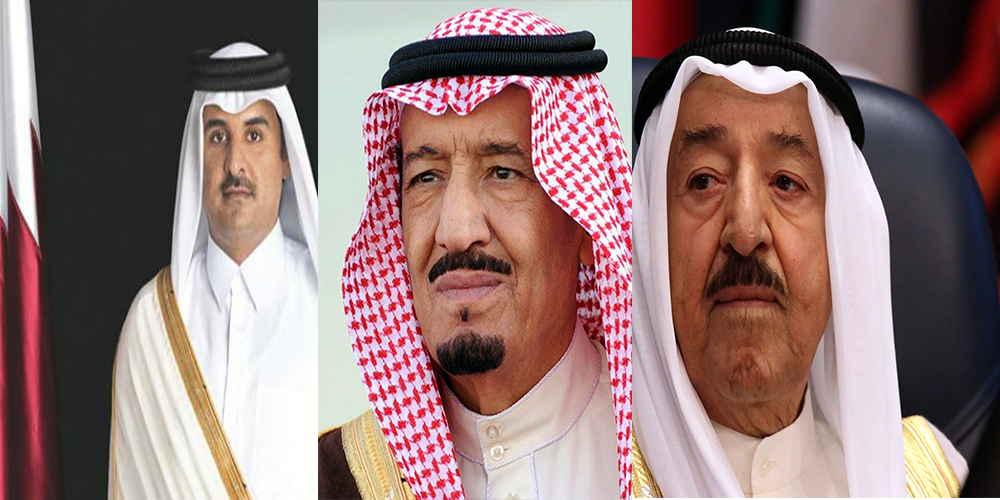
The US supported Kuwait’s mediation for resolving crisis between Saudi Arabia plus three allies and Qatar seems to be working. On Kuwait’s Emir Sheikh Sabah al-Sabah’s request, Saudi Arabia, UAE, Bahrain and Egypt, on Sunday morning, agreed to extend their 10 day ultimatum by another 48 hours. The ultimatum expired Sunday midnight.

The joint statement was released through SPA the official news agency of Saudi Arabia while KUNA the Kuwait’s official news agency claimed that Emir received a response from Qatar regarding 13 point demands presented by Saudi led block of Arab countries.

The foreign ministers of Saudi Arabia-led group of four countries will review Qatar’s response in a meeting scheduled to be held in Cairo on Wednesday. Egypt’s Foreign Ministry spokesman Ahmed Abu Zeid, was quoted as saying, “At the invitation of  foreign Minister Sameh Shoukry, there will be a quartet meeting of the foreign ministers of Egypt, Saudi Arabia, the UAE and Bahrain in Cairo on Wednesday July 5 to follow up on the developing situation regarding relations with Qatar.”

Saudi Arabia and its allies severed diplomatic ties with Qatar on June 5, sparking worst diplomatic crisis in decades. Qatari citizens were ordered to leave these countries and various steps were taken against Qatari companies and financial institutions. All land and air links were also severed.

On June 22, Saudi Arabia led block of Arab countries presented a list of 13 demands and gave Qatar ten days to comply.

Meanwhile Qatar’s Foreign Minister Sheikh Mohammed bin Abdulrahman Al-Thani, while speaking to journalist on Saturday in Rome said, “The list of demands is made to be rejected. The state of Qatar …is rejecting it as a principle. We are willing to engage in providing the proper conditions for further dialogue.”

Meanwhile QNA, the official Qatari News Agency, has reported that Foreign Minister will inform the ruler of Kuwait of Qatar’s response on Monday.

However, the US administration headed by Donald Trump, who initially justified Saudi led bloc action against Qatar, has been giving varying responses. A Department of State official said on Sunday that US encourages “all parties to exercise restraint to allow for productive diplomatic discussions. We are not going to get ahead of those discussions. We fully support Kuwait mediation”.

Earlier this week, Secretary of State Rex Tillerson insisted that Qatar’s neighbors provide a list of demands that was “reasonable and actionable”. He had also called for compromise and hosted senior Gulf officials, but efforts were undermined by President Trump who apparently supported Riyadh’s position.

Saudi Arabia had demanded Qatar to shut down Al Jazeera network, close Turkish military base and scale down ties with Iran. Qatar was also asked to cut ties with Muslim Brotherhood and other groups including Hezbollah, al-Qaeda and IS.

The Saudi Arabia led block also asked Qatar to stop all means of funding for individuals, groups or organizations that have been designated as terrorists by Saudi Arabia, UAE, Egypt, Bahrain, US and other countries.

Qatar must also refuse to naturalize citizens from the four countries and “revoke Qatari citizenship for existing nationals where such citizenship violates those countries’ laws”. Qatar should also hand over “terrorist figures”, fugitives and wanted individuals from Saudi Arabia led bloc to their countries of origin, freeze their assets and provide any desired information about their residency, movements and finances. They also asked Qatar to cease contact with the political opposition in these countries.

Demand of severing ties with Iran was explained in detail. Doha was asked to shut down  its diplomatic posts in Iran, expel any members of Iran’s Revolutionary Guards and conduct trade and commerce in accordance with the US and international sanctions in manner that does not “jeopardize the security” of the GCC member countries.

The desired media clampdown was not targeted at Al-Jazeera only. Al Jazeera’s affiliates and other news outlets including Arabi21, Rassd, Al-Araby Al-Jadeed and Middle East Eye were also asked to be close down.

Doha was also asked to “align Qatar’s military, political, social and economic policies with other Gulf and Arab countries, as well as on economic matters, as per 2014 agreement reached with Saudi Arabia”.

Another demand, which could have been quite costly for Qatar, says to “pay reparations and compensation for loss of lives and other financial losses caused by Qatar’s policies in the recent years. The sum will be determined in coordination with Qatar”.

They asked Qatar to agree to all demands within ten days of list being submitted, or the list will become invalid. Qatar must consent to monthly compliance audits in the first year after agreeing, followed by quarterly audits in the second year and annual audits in the following ten years.

The situation may deteriorate in case of Qatar’s non-compliance. UAE Ambassador to Russia Omar Ghobash, during an interview last week said that Qatar could face fresh sanctions by Gulf States asking their trading partners to choose between them or with Doha. Commercial bankers in the region believe that Saudi, Emirati and Bahraini banks might receive official guidance to pull deposits and interbank loans from Qatar.

However UAE’s Minister of State for Foreign Affairs Anwar Gargash has played down the chances of escalation saying “the alternative is not escalation but parting ways” from the six-member GCC.

On the other hand Qatar’s Foreign Minister Sheikh Mohammad bin Abdulrahman Al-Thani , while speaking in Washington last week, said the GCC was set up to guard against external threats. “When the threat is coming from inside the GCC, there is a suspicion about the sustainability of the organization.”

Following the severing of diplomatic ties by Saudi led bloc and delinking ground and air routes with Qatar, Iran and Turkey have started supplying food items, water and other necessities and welcomed Qatar Airways to use their skies.

In one of his tweets, Saudi Arabia’s representative in UN Abdullah bin-Yahya al-Moallemi said: “Qatar had insisted on shaking the security of the kingdom of Saudi Arabia and interfering in the affairs of countries in the region.”

Saudi Arabian forces have been assisting Bahrain in controlling opposition protests demanding their basic rights. Riyadh is also heading a coalition with started war against Yemen, currently under Houthis control. Qatar was also alleged by Riyadh to have ties with Yemen’s Ansarullah, the militia force of the Houthis fighting against Saudi hegemonic war. The ousted President Mansour al-Hadi led government in exile is based in Riyadh for more than a year.

Kuwait, working for mediating in the crisis and Oman have not followed Saudi Arabia’s diktat for severing relations with Qatar. Among the GCC countries, Oman and Kuwait have better ties with Tehran than other GCC member countries. Diplomatic ties between Saudi Arabia and Iran were severed after violent protest at Saudi embassy in Tehran in the aftermath of stampede tragedy in Mina, during Haj 2015. Some 465 Iranians were among those killed out of more than 1400 casualties. However Saudi Arabia admitted the death of 769 only. Others remain missing till date. More than 100 Indians were killed while 280 remained missing.[/vc_column_text][/vc_column][/vc_row]

Latest world news

Lashkar commander admits Hamas links, raises alarm over expanding terror nexus

A senior Lashkar-e-Taiba commander’s admission of meetings with Hamas leaders has intensified concerns over growing coordination between terror groups operating across regions.

Published

on

Lashkar Commander

A senior commander of Pakistan-based Lashkar-e-Taiba has publicly acknowledged links with Hamas and confirmed meetings with its top leadership, triggering fresh concerns among security agencies about an emerging alliance between globally designated terrorist organisations.

In a recent video accessed by media, Faisal Nadeem, a senior figure associated with the Pakistan Markazi Muslim League, widely regarded as Lashkar’s political front, said he met senior Hamas leaders in Doha, Qatar, in 2024. Nadeem operates in Pakistan’s Sindh province and claimed that Saifullah Kasuri, alleged by Indian agencies to be involved in the Pahalgam terror attack in Jammu and Kashmir, accompanied him during the visit.

According to Nadeem’s statement, the delegation met senior Hamas leader Khaled Mashal, a disclosure that intelligence officials view as direct evidence of coordination between terror networks operating across South Asia and the Middle East. Security analysts say the admission points to a growing effort to share operational experience, logistics and propaganda strategies.

The confession follows earlier reports of a meeting between a senior Hamas commander and a Lashkar leader in Pakistan’s Gujranwala during a public event organised by the same political outfit. An undated video that surfaced recently showed both leaders sharing the stage, with officials noting that the public nature of the interaction reflected increasing confidence and deepening ties between the groups.

Investigators have pointed out that the Hamas representative attended the event as a chief guest, while the Lashkar leader appeared under the cover of a political role. Security officials have also flagged multiple visits by Hamas operatives to Pakistan since October 2023, indicating sustained engagement.

Counter-terrorism experts note that both Hamas and Lashkar-e-Taiba are designated terrorist organisations by the United States and several other countries. Any coordination between them, they warn, could have serious implications for regional and international security.

Indian intelligence agencies are closely monitoring developments related to the Hamas-Lashkar engagement. Officials said the emerging evidence may be raised at international platforms, including financial watchdogs and counter-terror forums, as authorities assess potential legal and diplomatic responses.

Analysts tracking the evolving situation say the growing trail of videos and public statements points to a broader ideological and operational alignment, marking a concerning shift in the global terror network landscape.

Continue Reading

Latest world news

India-EU free trade pact set to lower prices of luxury cars, wines and medicines

The India-EU free trade pact is set to cut import duties on luxury cars, wines and medicines, while opening European markets for Indian exports.

Published

on

India European Deal

After nearly two decades of negotiations, India and the European Union have sealed a Free Trade Agreement that is expected to significantly reduce prices of several European products in India while expanding export opportunities for Indian manufacturers.

Described by European Commission President Ursula von der Leyen as the “mother of all trade deals”, the pact aims to deepen economic cooperation by easing tariffs and improving market access on both sides.

Luxury cars likely to become more affordable

One of the most noticeable impacts of the agreement will be in the premium automobile segment. Imported European cars such as Mercedes, BMW and Audi currently face import duties exceeding 100 per cent in India.

Under the new agreement, vehicles priced above 15,000 euros (around Rs 16 lakh) will see duties reduced to 40 per cent initially, with a further cut to 10 per cent planned over time. This is expected to bring down prices by several lakh rupees.

The concessions will operate under a quota system to safeguard India’s domestic automobile industry. Officials clarified that smaller, mass-market cars — which dominate India’s auto sector — will not be directly exported by European manufacturers, though local manufacturing remains an option.

Imported wines and spirits to get cheaper gradually

European wines from countries such as France, Italy and Spain are also set to become more affordable. India currently levies an import duty of 150 per cent on wines. Under the pact, this will be reduced to 20 per cent, though the change will be phased in over five to ten years to limit disruption to domestic producers.

The agreement is expected to reduce prices of premium spirits such as cognac, high-end gins and vodkas. However, wines priced below 2.5 euros will not receive duty concessions, a move aimed at protecting Indian manufacturers. Indian wines, meanwhile, will gain improved access to European markets.

Cheaper medicines and medical equipment

The trade deal is expected to benefit India’s healthcare sector by lowering the cost of imported medicines, particularly for cancer and other critical illnesses. Advanced medical equipment sourced from Europe is also likely to become cheaper.

At the same time, pharmaceuticals manufactured in India will gain access to all 27 EU member countries, strengthening India’s position as a global supplier of affordable medicines.

Electronics, steel and chemicals to benefit

The agreement removes tariffs on aircraft spare parts, mobile phone components and other high-tech electronic items imported from Europe. This could reduce manufacturing costs for electronic devices in India, potentially benefiting consumers.

Additionally, proposals for zero tariffs on iron, steel and chemical products may lower raw material costs for industries such as construction, with possible downstream benefits for homebuyers and infrastructure projects.

Overall, the India-EU Free Trade Agreement is being seen as a major boost for Indian exports, particularly in sectors such as garments, leather and jewellery, while offering Indian consumers access to more competitively priced European goods.

Continue Reading

Latest world news

India plans sharp cut in car import tariffs under proposed EU trade pact

India is planning a sharp reduction in car import tariffs as part of a proposed free trade agreement with the European Union, potentially opening up its auto market to European brands.

Published

on

India is planning a significant reduction in import tariffs on cars from the European Union as part of a proposed free trade agreement, according to sources familiar with the discussions. The move could mark the biggest opening yet of India’s tightly protected automobile market.

Under the plan, import duties on a limited number of cars priced above 15,000 euros are set to be reduced to 40% from the current levels that go as high as 110%. Over time, these duties could be lowered further to 10%, the sources said.

The decision is expected to benefit European automakers including Volkswagen, Renault and Stellantis, along with luxury manufacturers Mercedes-Benz and BMW, which have long raised concerns over high import taxes in India.

Trade pact announcement expected soon

India and the European Union are expected to announce the conclusion of negotiations for the long-pending free trade agreement as early as Tuesday. The pact has already been described by officials as a landmark deal, with final details to be worked out and ratified subsequently.

The agreement could significantly expand bilateral trade and provide relief to Indian exporters of products such as textiles and jewellery, which have been impacted by steep tariffs in recent months.

Limited quota, phased reduction

Sources indicated that India has proposed an immediate tariff cut for around 200,000 combustion-engine cars annually. While the quota could still see last-minute changes, it represents the most aggressive step yet by New Delhi to open up its auto sector.

Battery electric vehicles will not be included in the duty reductions for the first five years. This exemption is aimed at safeguarding investments made by domestic manufacturers such as Tata Motors and Mahindra & Mahindra in the developing EV segment. After the five-year period, EVs are expected to follow a similar tariff-cut path.

European brands see growth opportunity

India is currently the world’s third-largest car market after the United States and China, with annual sales of about 4.4 million units. However, European carmakers hold less than a 4% share of the market, which is dominated by Japanese and Indian manufacturers.

Lower import taxes could allow global brands to introduce a wider range of models at more competitive prices and assess consumer demand before committing to additional local manufacturing.

With the Indian car market projected to grow to 6 million units annually by 2030, several European automakers are already planning new investments, seeing India as a key growth destination beyond their traditional markets.

Continue Reading

Trending

© Copyright 2022 APNLIVE.com