English हिन्दी
Connect with us

Latest Politics News

Nitish Wins Vote: Trust doubtful

Published

on

Nitish Kumar won the trust vote

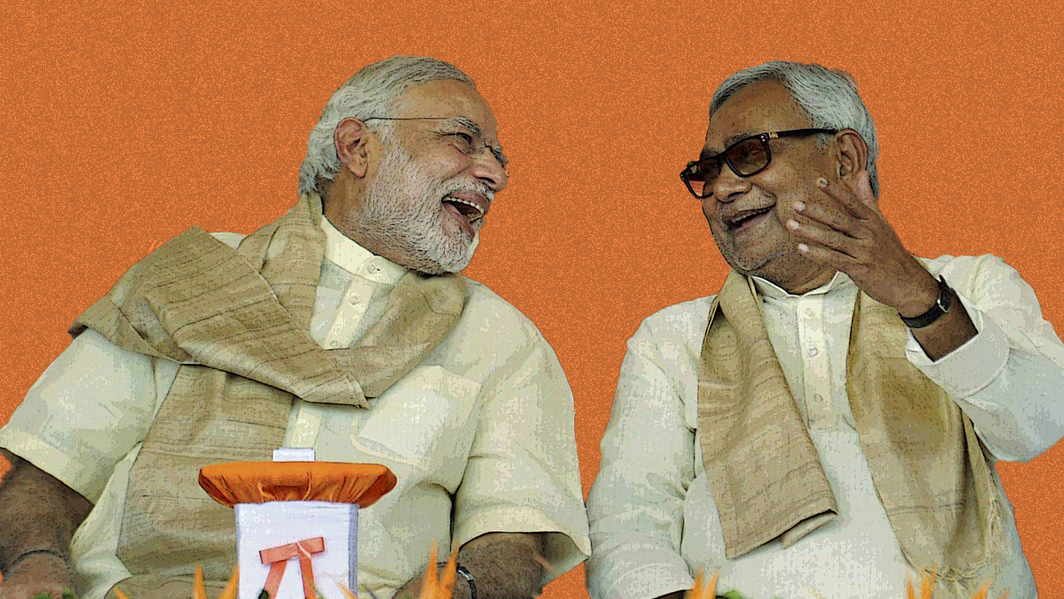
[vc_row][vc_column][vc_column_text]Winning the trust vote with a comfortable margin, Nitish Kumar started his second term as chief minister in the same State Assembly on Friday. This is the fifth time the 66-year-old has become CM in his 40 years of life in active politics.

The newly sworn-in CM won the trust vote on Friday in the Bihar Assembly with 131 votes in favour of the JD(U)-BJP alliance; 108 MLAs voted against the motion. The NDA had earlier submitted a list of 132 MLAs to the governor. These include 71 of JD(U), BJP 53, RLSP 2, LJP 2, HAM 1 and 3 Independents. In the rival camp, the RJD has 80 MLAs, the Congress 27 and the CPI-ML has three.

Four legislators did not vote, two on technical grounds and one calling sick. Two of the four independent legislators voted for Kumar in the House of 243.

There was no cross-voting, the Speaker Vijay Kumar Choudhary’s rejection of RJD and Congress’ demand for a secret ballot ensuring that voting was strictly on party lines. A lobby division method was opted for. Legislators went of the House and came back one by one and signed a register indicating their vote, for or against the motion.

A political survivor who has managed to stay in office by tying up with whichever party seems to be carrying the day, somewhat like the other Bihar politician and Union Consumer Affairs Minister Ram Vilas Paswan, Kumar insisted while seeking the trust vote that he changed sides for “sewa” (service) and not “mewa” (fruits of power).

“To be in power devolves great responsibility to govern, not earn. Yeh sewa ka Avsar hai, na ki mewa ka (It is an opportunity to serve, not profit,” he said before seeking the trust vote.

Two days ago, he had dumped coalition partners, the RJD and Congress. “I faced lot of resistance trying to run the government in the best interest of people of Bihar and preserve the mahagathbandhan, but failed due to RJD’s attitude,” said Kumar.

He chose to quit over his deputy chief minister and RJD chief Lalu Prasad’s son Tejashwi Yadav neither resigning nor explaining to the people the corruption charges against him being investigated by the CBI.

Less than two years ago, Kumar had ignored several cases of corruption against Prasad. However, Kumar probably realised that Lalu Prasad was grooming his son for post of CM and his position at the top was doubtful in future in the alliance even as, for him, it was leading to diminishing returns for him. He used the excuse of allegations of corruption against Yadav’s son, Tejashwi Yadav, to break the Grand Alliance. Kumar’s decision was likely made keeping the 2020 Bihar Assembly elections in mind.

Former ally BJP, with which he ran a previous coalition government till 2013, immediately offered him support and he was sworn in again as CM with BJP leader Sushil Kumar Modi as his new deputy on Thursday. Governor Keshari Nath Tripathi ased him to prove his majority on the floor of the House within two days, a condition that was met today.

His action dealt a blow to the strength and unity of Opposition, while giving further boost to the image of BJP as a fast-acting, decisive party under the strong and popular leadership of Prime Minister Narendra Modi. The Congress came out as a floundering party with an incapable leadership.

Modi congratulated Kumar immediately after the trust vote. “I am happy that the CM did not give in and took a step”, Modi said, referring to the corruption charges. Taking a dig at Tejashwi, Modi said, “Today Tejashwi did not say a single word on corruption in the assembly. People of Bihar want to know how has he earned so much money at an age of 28 years?”

About Mahagathbandhan, he said, “If they had votes, they should have proven it in the Assembly. It has been proved that the JD(U)-BJP alliance has full majority. Unnatural alliance died naturally. Within months, the alliance has split.”

Sushil Kumar Modi, the deputy chief minister who replaced Tejashwi, said, “I thank the Congress and the RJD for not asking Tejashwi to resign. Had that happened, I would not have been on the right side.”

“If the RJD insists that the mandate was not followed, it should introspect, whether it was for the likes of Mohammad Shahabuddin and Rajballabh Yadav? It is better now, that the government is in right hands,” he said, referring to two controversial aides of Lalu Prasad.

“The new government will register fresh milestones in successful governance, which was lacking in the last regime due to RJD’s intransigence,” he added.

Before the vote, Opposition leader and former deputy chief minister, Tejashwi Yadav, made an emotional speech, dismissing corruption charges against him were cooked up.

“Is there any charge against me in the last 20 months of impropriety during my tenure in office?… If it was about corruption, the JD(U) should not have allied with my father, who was facing cases; yet it happened,” he said.

“There is just an FIR, not a proved case; so where was the question of my resignation?” he added referring to the controversy over his refusal to quit that led to Kumar pulling of the grand alliance. “The chief minister never ever asked for my resignation either,” he said.

“I am young. Only 28. It was my success, which unnerved the JD(U), which plotted for my removal,” he said, adding that Kumar was aware of his “honesty”, said Tejashwi.[/vc_column_text][/vc_column][/vc_row]

India News

Abhishek Banerjee says will not bow to BJP after nearly 11 hours of ED questioning

After spending nearly 11 hours before the Enforcement Directorate, TMC leader Abhishek Banerjee said he would not bow to the BJP and accused the ruling party of using investigative agencies for political purposes.

Published

on

Abhishek Banerjee

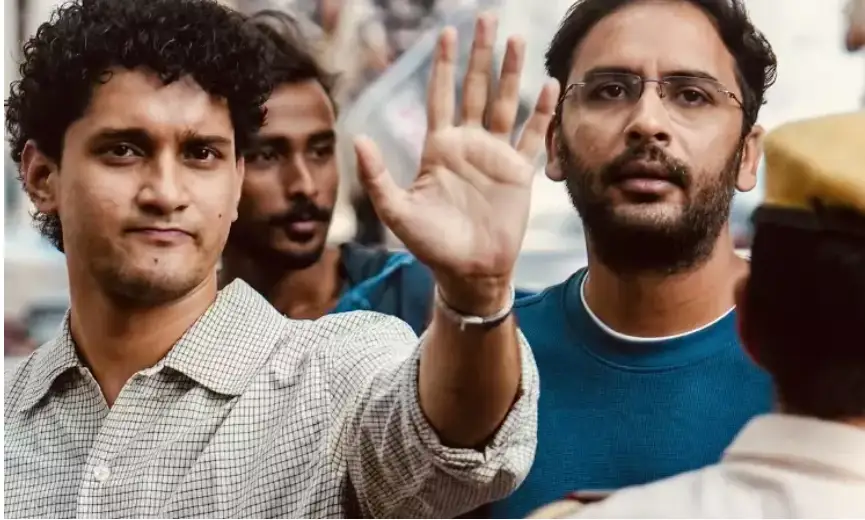
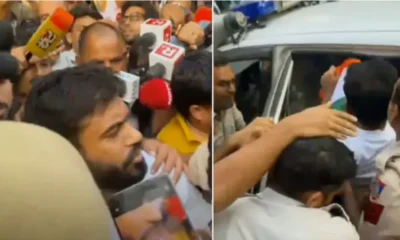
Trinamool Congress leader and Diamond Harbour MP Abhishek Banerjee on Tuesday said he would not bow to the BJP after spending nearly 11 hours being questioned by the Enforcement Directorate (ED) in connection with an ongoing investigation.

Speaking after the questioning, Banerjee alleged that central agencies were being used to target opposition leaders and asserted that he would continue his political fight despite what he described as sustained pressure.

The TMC leader has repeatedly maintained that investigations involving him are politically motivated, a charge he has made on several previous occasions while appearing before central agencies.

His appearance before the ED comes amid a period of heightened political activity and multiple investigations involving leaders in West Bengal. Recent days have also seen Banerjee face summons and questioning in separate matters by state investigative agencies.

After leaving the ED office, Banerjee reiterated that he would not be intimidated and said he remained committed to his political responsibilities. He also accused the BJP of attempting to weaken opposition parties through investigative action, an allegation that the BJP has rejected in the past.

The Enforcement Directorate has not publicly commented on Banerjee’s remarks. The investigation related to the questioning remains ongoing.

Continue Reading

India News

DMK attacks Rahul Gandhi, accuses him of weakening opposition unity

DMK has intensified its criticism of Rahul Gandhi, alleging that the Congress leader’s actions have weakened opposition unity and strained relations within the INDIA bloc.

Published

on

Rahul-Gandhi

The war of words between the DMK and Congress has intensified, with the DMK launching a strong attack on Leader of Opposition Rahul Gandhi and accusing him of contributing to divisions within the opposition alliance. The criticism comes amid strained ties between the two parties following their political split in Tamil Nadu.

According to the DMK, Rahul Gandhi’s political approach has weakened unity among opposition parties. The party’s IT wing mocked the Congress leader on social media, while an editorial published in the DMK’s official mouthpiece Murasoli questioned his recent remarks on opposition solidarity.

DMK questions Rahul Gandhi’s remarks on opposition unity

In its editorial, Murasoli argued that Rahul Gandhi was speaking about opposition unity despite, according to the DMK, contributing to disagreements among alliance partners in several states. The publication cited criticism directed at Congress by various opposition parties and suggested that the party’s actions had often created tensions within the INDIA bloc.

The editorial also referred to past political disputes involving Congress and Left parties, particularly in Kerala, claiming such episodes had raised concerns among opposition allies about Congress’s approach toward its partners.

Tamil Nadu political fallout adds to tensions

The attack comes after a major political realignment in Tamil Nadu. Following the 2026 Assembly elections, Congress ended its alliance with the DMK and joined the government led by Vijay’s Tamilaga Vettri Kazhagam (TVK). The move left the DMK in the opposition and significantly altered the political equation between the two former allies.

The DMK has alleged that Congress benefited from the alliance during the election and later abandoned its partner. The party’s editorial questioned whether assurances from Congress leadership would be trusted by alliance partners after the developments in Tamil Nadu.

Congress rejects allegations

Congress has not issued a detailed official response to the editorial, but party sources have rejected the allegations. According to the party, its decisions in Tamil Nadu were made in line with the mandate delivered by voters and were not intended to undermine either the DMK or the broader opposition alliance.

The latest exchange highlights growing strains between two key opposition parties even as leaders continue to stress cooperation on national issues. Just days earlier, Rahul Gandhi had said that the DMK remained aligned with the opposition on defending the “idea of India” despite political differences.

Continue Reading

India News

Congress, SP send mixed signals on AIMIM’s role ahead of 2027 Uttar Pradesh polls

Congress and Samajwadi Party leaders have responded differently to questions about AIMIM’s role ahead of the 2027 Uttar Pradesh Assembly elections, highlighting ongoing discussions over opposition strategy.

Published

on

Differing responses from Congress and Samajwadi Party leaders have highlighted varying approaches within the Opposition camp regarding the possible role of the All India Majlis-e-Ittehadul Muslimeen (AIMIM) in the run-up to the 2027 Uttar Pradesh Assembly elections.

The discussion gained momentum after AIMIM chief Asaduddin Owaisi launched his party’s campaign preparations for the 2027 elections from Bahraich and reiterated that his party is open to alliances, provided it is treated with respect and as an equal partner.

Different responses from Congress and SP

Reacting to questions about a possible understanding with AIMIM, Congress leader Imran Masood said any decision on alliances would be taken by the party leadership. He also stressed that there could be no compromise with communalism.

On the other hand, Samajwadi Party leader Ram Gopal Yadav adopted a more accommodating tone, stating that anyone capable of defeating the BJP would be welcome. His remarks were viewed as leaving the door open to broader anti-BJP political cooperation.

The differing responses have drawn attention as Opposition parties continue to assess their electoral strategies ahead of the 2027 Uttar Pradesh Assembly elections.

AIMIM steps up preparations

AIMIM has begun expanding its campaign activity in Uttar Pradesh, with Owaisi launching the party’s preparations from Bahraich. The Hyderabad MP has indicated that AIMIM is willing to consider alliances but has maintained that any partnership must be based on mutual respect and equality.

The party is also working to strengthen its organisational presence in the state as it seeks a larger role in Uttar Pradesh politics ahead of the next Assembly election.

No formal alliance announced

Despite the ongoing discussion, no formal alliance or seat-sharing arrangement involving AIMIM and major Opposition parties has been announced so far.

With more than a year remaining before the 2027 Uttar Pradesh Assembly elections, political equations are expected to evolve as parties finalise their strategies and alliance plans.

Continue Reading

Trending

© Copyright 2022 APNLIVE.com