
Latest world news
Another North Korean Missile Lands beyond Japan

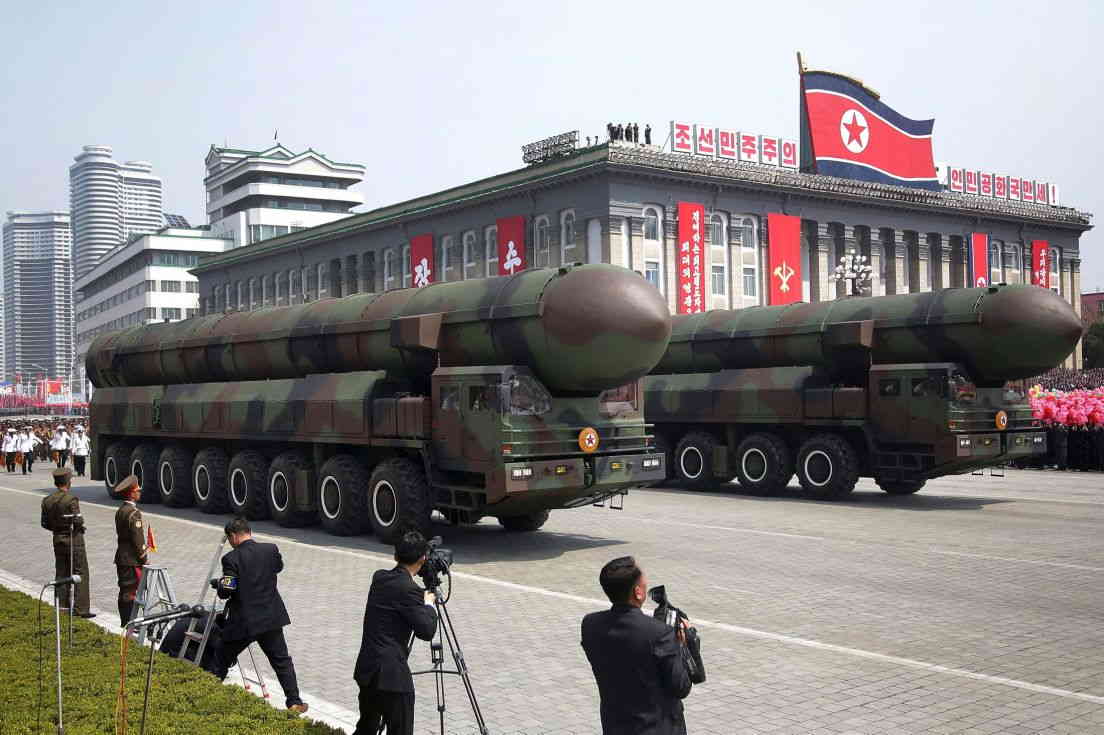
[vc_row][vc_column][vc_column_text]Covers longer distance than US Guam territory
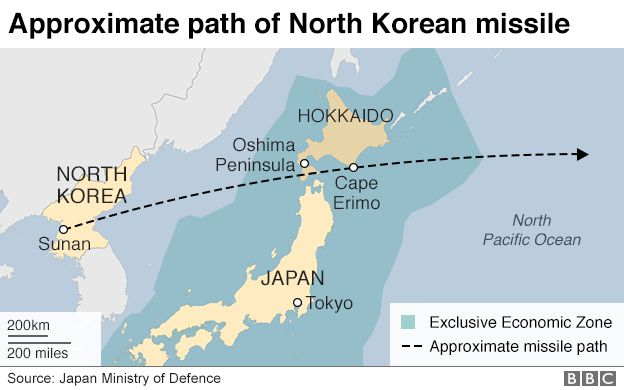
Continuing its defiant moves, North Korea fired another missile that flew over Japan’s northern Hokkaido Island and landed some 2000 km beyond into Pacific Ocean early Friday morning. This was the second such missile test flying over Japan’s territory in less than 20 days.
The missile covered a distance of 3,700 km while Guam, an unincorporated US territory housing Anderson Air Force base lies at just 3,400 km from North Korean coast. Pyongyang had earlier threatened to fire 30-40 km short of Guam.
Reuters reports from Tokyo that warning announcements about the missile blared around 7 a.m. in the parts of northern Japan, while residents received alerts on their mobile phones or saw warnings on TV asking them to seek refuge.
This was announced by Japanese Cabinet Secretary Yoshihide Suga. However, North Korea’s official news agency KCNA Watch has not announced the fresh missile test over Japan so far.
Earlier on August 29, North Korea had fired a missile flying over Japan causing nervousness in Hokkaido residents, who woke up with siren sound and warning messages on their mobiles. People were advised to evacuate and take shelter in basements of sturdy buildings.
North Korea’s State agency Korea-Pacific Peace Committee (KAPPC) on Wednesday had threatened to use nuclear weapons to “sink” Japan and reduce US to “ashes and darkness”.
Japanese Prime Minister Shinzo Abe, who concluded his two day India visit on Thursday, told reporters in Tokyo, “The international community needs to come together and send a clear message to North Korea that it is threatening world peace with its actions.” He described the Pyongyang’s missile launch as “unacceptable”.
The US military sources said soon after the launch that it had detected a single intermediate range ballistic missile. However they say that “the missile did not pose a threat to South Korea or the US Pacific territory of Guam.”
The missile reached an altitude of about 770 km and flew for about 19 minute over a distance of about 3,700 km.
David Wright, the Co-Director and senior scientist at Union Of Concerned Scientists (UCS), a US based advocacy organisation, wrote in his blog, “The range of this test was significant since North Korea demonstrated that it could reach Guam with this missile, although the payload the missile was carrying is not known. Guam lies 3,400 km from North Korea, and Pyongyang has talked about it as a target because of the presence of US forces at Anderson Air Force Base.”
Meanwhile, Rex Tillerson, the US Secretary of State has called for “new measures” against Pyongyang and said the “continued provocations only deepen North Korea’s diplomatic and economic isolation”. He reiterated Washington’s commitments to defend its allies.
The spokesman of South Korean President Moon Jae-in has said that dialogue with North was impossible at the point. The President has asked his officials to analyse and prepare for possible new North Korean threats, including electro-magnetic pulse and biochemical attacks, a spokesman added.
 Earlier on August 17, President Moon Jae-in had argued to prevent war saying “I will prevent war at all cost. So I want all South Koreans to believe with confidence that there will be no war. All South Koreans have worked so hard to rebuild the country from the ruins of the Korean War.”
The South Korean leader had also asserted, “No one can make a decision on military action on the Korean peninsula without our agreement.” Earlier US officials had expressed their reluctance saying that Trump will have final word on the question.
The United Nations Security Council, which has held several emergency meetings on North Korean defiant moves in the recent past, will meet once again at 1500 hrs (New York time) on Friday (00.30 hrs Saturday IST).
The meeting is being held at the request of US and Japan; just days after Security Council unanimously stepped up sanctions against North Korea over its September 3 nuclear test. The recent anti-North Korea UNSC sanctions resolution has banned Pyongyang’s textile exports and capped import of crude oil.
During last few months North Korea has launched several missiles under the leadership of Kim Jong Un for accelerating weapons program. Pyongyang claims that the tests were aimed to achieve ability to target US with a powerful nuclear tipped missile.
In July this year, North Korea conducted two long range Inter-continental Ballistic Missile (ICBM) tests capable of reaching some parts of US mainland. On September 3, Pyongyang had successfully tested a hydrogen bomb, capable to be used with ICBM, the largest nuclear test in the recent history.[/vc_column_text][/vc_column][/vc_row]








Latest world news
Magnitude 7 earthquake strikes Russia’s Kamchatka Peninsula
A magnitude 7 earthquake struck Russia’s Kamchatka Peninsula region on Friday. The initial report placed the earthquake at a depth of 140 kilometres.


Latest world news
S Jaishankar says India is a natural option for Russia amid Europe tensions
External Affairs Minister S Jaishankar said India remained a natural option for Russia as Moscow increasingly turned towards Asia amid strained relations with Europe. He highlighted the continuity of India-Russia ties and their significance for the balance of power in Asia.

Latest world news
Putin praises PM Modi, says he has very good ideas on Ukraine war
Russian President Vladimir Putin has praised Prime Minister Narendra Modi for repeatedly raising the need to end the Ukraine war, describing his ideas for a settlement as “very good”.


Magnitude 7 earthquake strikes Russia’s Kamchatka Peninsula

Mallikarjun Kharge’s ‘Your Friends’ jab at Rahul Gandhi over congress exits

Delhi deploys 25,000 personnel, installs CCTV cameras ahead of CJP march

Abhijeet Dipke detained ahead of CJP’s national flag march in Delhi

Mallikarjun Kharge seeks all-party meeting with PM Modi on delimitation

Centre sends 3 letters to Punjab government after anti-drug activist’s killing
Mallikarjun Kharge seeks all-party meeting with PM Modi on delimitation
Abhijeet Dipke detained ahead of CJP’s national flag march in Delhi
Magnitude 7 earthquake strikes Russia’s Kamchatka Peninsula
Delhi deploys 25,000 personnel, installs CCTV cameras ahead of CJP march

Afghan Men Try To Hang With The Jet Engine Of The Aircraft in Kabul- Afghanistan News – Kabul News
Trending Top 10 News: 10000 Crore Fine on Flipkart, Apple to Launch Unique Feature, Hdfc Bank Job Ad

Trending Top 10 News: Nokia 6310, Apple sales, Bachpan ka Pyar Video Kid, Dainik Bhaskar IT Raid

Trending Top 10 News: Canada bans Indian flights, Rain in Delhi NCR, AIMIM Twitter hacked, Raj Kundra case

Trending Top 10 News: Shein India, Apple New Service, Pocket Oxygen, Oppo Launched New Phone
-
 Latest world news13 hours ago
Magnitude 7 earthquake strikes Russia’s Kamchatka Peninsula
-
 India News13 hours ago
Mallikarjun Kharge’s ‘Your Friends’ jab at Rahul Gandhi over congress exits
-
 India News13 hours ago
Delhi deploys 25,000 personnel, installs CCTV cameras ahead of CJP march
-
 India News4 hours ago
Abhijeet Dipke detained ahead of CJP’s national flag march in Delhi
-
 India News3 hours ago
Mallikarjun Kharge seeks all-party meeting with PM Modi on delimitation
-
 India News2 hours ago
Centre sends 3 letters to Punjab government after anti-drug activist’s killing
