English हिन्दी
Connect with us

Latest world news

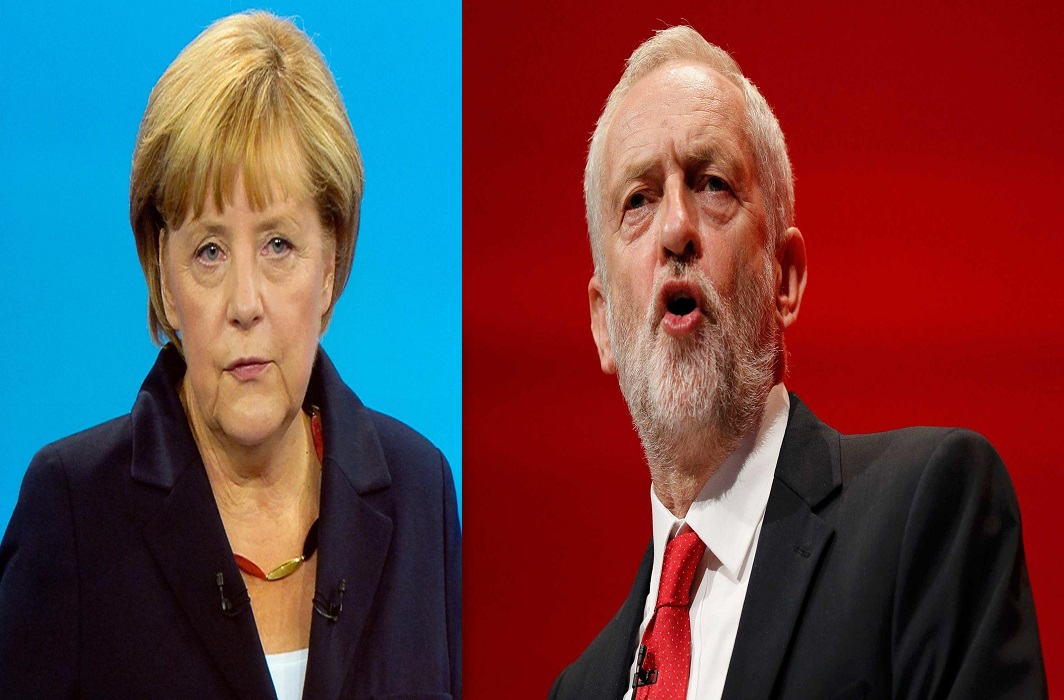
Merkel and Corbyn: There’s Room for Decency in Public Life

Published

on

~By Saeed Naqvi

Two developments in Europe this week have brought cheer. First, Angela Merkel has held onto her job (even though only by the skin of her teeth). Secondly, the very citadel of western capitalism, The Economist, has editorially welcomed Jeremy Corbyn, a socialist in the Michael Foot mould, as Britain’s next Prime Minister, whenever elections take place. There is a stamp size photograph of Corbyn standing at 10 Downing Street, without a neck tie, of course.

 It is maliciously reported that smoke billowed out of Lord Peter Mandelson’s ears after he read the editorial while holidaying on an oligarch’s yacht. Tony Blair’s favourite sidekick and one of the architects of the now defunct New Labour, had sworn in 2015, that he would work hard to “undermine Corbyn”.

It is not that The Economist has suddenly turned pink. It is doing the best it can to cope with altered circumstances: if you can’t beat them, join them.

The trophy for prescience must go to Chris Mullin, writer and former Labour MP. In 2015, Mullin wrote an imaginary piece in The Guardian under the heading:

“All hail the Bearded One! The first 100 days of Jeremy Corbyn as Prime Minister”.

 “To general astonishment, among the early visitors to Downing Street is a grim-faced Rupert Murdoch. He is closeted with the new prime minister for more than an hour, at the end of which the following announcement is made.”

“First, that the Broadcasting Acts are amended, requiring Sky to compete on a level playing field with the main terrestrial TV channels. And secondly, that he relinquishes control of all his British newspapers which will, in future, be managed by a trust in which no single shareholder will have a controlling interest. Mr. Murdoch has accepted these conditions. Our discussions were amicable.”

While Corbyn is still in the realm of speculation, the historic German elections have stirred up the heart of Europe. From the wreckage around her, emerges Angela Merkel as a fourth term German Chancellor, testimony to the compelling power of decency in public life. If she were not a hardnosed politician also she would not be where she is – a titanic figure in world affairs. But a premium she places on moral and ethical values in decision making, shines through. This fourth term is her trophy on that count.

Daughter of a vicar in East Germany, her background has been something of an asset for her. It is the abiding Christian in her, in the highest sense of the term, that enabled her to rise above the din and keep compassion as an ingredient in her decision to accord hospitality to hapless Arab and North Africa migrants – totally against the prevailing political current.

She is too intuitive not to have known that she would be made to pay a price for her decision. As a consequence, the Bundestag will have for the first the ultra right wing AFD (Alternative for Germany) with 94 seats, making it the country’s third largest party much of it at Merkel’s cost. Marine Le Pen in France or Geet Wilder in the Netherlands also represent narrow, anti immigrant Xenophobia. In Germany the AFD resonates more frightfully. It stirs images of Nazism. But it would be a mistake to paint all the one million voters who moved away from the ruling Christian Democrats, with the same brush.

Let me add in parenthesis: voters moved away from CDU and its Bavarian partner, CSU, but, please note, much the largest number of the vote did not shift. They stayed with Angela Merkel. It must be put down to Merkel magic that in a House of 709, she still has 246 seats despite her immigration policy. But she is still 109 short of a majority. “One thing is clear” she announced with good natured mischief in her eyes. “They can’t form a government without us.”

 By the same token, she cannot form a government without them. The Social Democrats who were with her in a grand coalition in the outgoing government, have been decimated. They have decided to sit in the opposition.

If Merkel lost 8.5% of her vote because of her calculated decency, Martin Schulz of SPD is kicking himself for having lost 5.2% of his vote for the sin of looking like CDU’s B team. The fate of the Spanish Socialist party leader Pedro Sanchez must have haunted him. After two deadlocked elections, Sanchez was persuaded to abstain from a vote, enabling the Peoples Party Prime Minister Mariano Rajoy to sail through. Sanchez now looks a cipher in public life. Schulz wishes to escape that fate. There is accidental altruism in his decision too. By choosing to be in the opposition with 153 seats, he has effectively blocked AFD from taking the pulpit as leader of the opposition.

All of Merkel’s negotiating skills will be brought into play to forge what in German parlance is called a “Jamaica” coalition – black, yellow and Green representing the colours of CDU, FDP and Green. The combination happens to be the colour of the Jamaican flag.

How will Merkel reconcile her gentler, market approach to the Liberal, FDP leader, Christian Lindner’s unbridled capitalism?

Will there be difficulty striking a rapport with the Green’s Katrin Goring-Eckardt on environmental issues? Merkel did not hesitate calling off nuclear energy for Germany quite instinctively as soon as she witnessed Japan’s Fukushima disaster.

She will also work very hard to retrieve the million or so voters who drifted away from her because of her being “soft” on immigration. A hunch on Merkel is that she will not compromise on her core beliefs. One such belief concerns immigration. Refugees fleeing from the post 9/11 West Asian wars strike a very Christian chord with her.

Being practical, she will not accelerate migration; she will facilitate migrant leaders, NGOs, in establishing model migrant settlements. Unnecessary gestures unpopular with the electorate, will be discarded. She has already spoken with her usual honesty that talks with Turkey should be suspended on European entry. Where is the point in sustaining a dialogue with Turkey when nobody in Europe is willing to give up the medieval aversion to the “Turk”. Decades ago, French President Giscard d’Estaing declared with stunning candour: “European civilization is Christian civilization”. In it there was no room for a Muslim Turkey. Those were days when Turkey’s case could be supported because it still donned the secular cloak of Ataturk. Now Europe considers such support untenable: Turkey is quite transparently, Muslim Brotherhood.

Latest world news

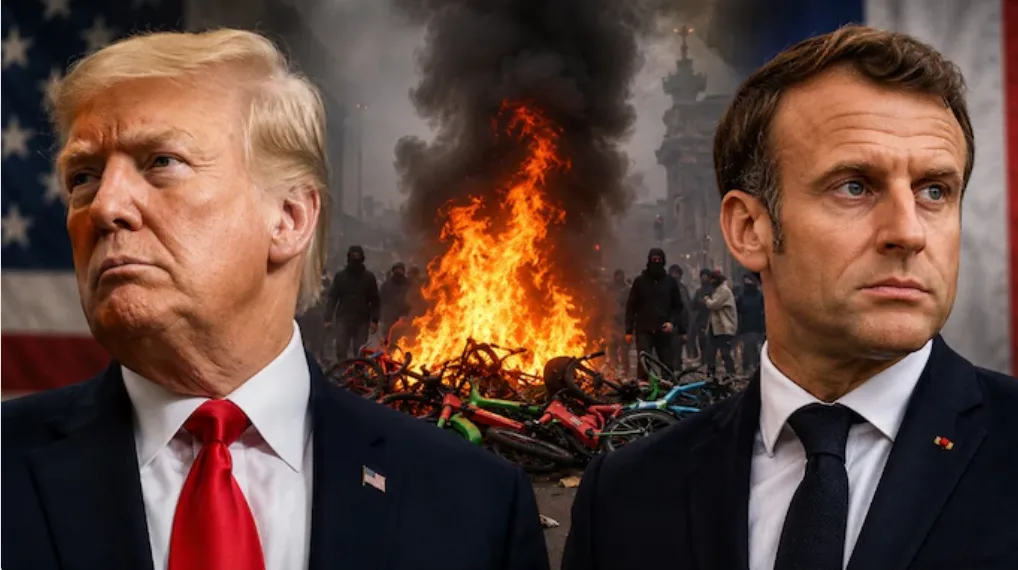
PM Modi, Xi Jinping among global leaders Donald Trump says he admires most

Donald Trump named Narendra Modi and Xi Jinping among the world leaders he admires most, praising Modi’s negotiating skills and describing Xi as “all business”.

Published

on

Donald Trump statement

US President Donald Trump has named Prime Minister Narendra Modi and Chinese President Xi Jinping among the world leaders he admires most, offering praise for both leaders during a recent interview.

Asked which global leaders he respects and admires, Trump pointed to Modi and Xi. He described the Indian Prime Minister as “a very tough cookie” and praised his negotiating abilities, while characterising the Chinese President as someone who is “all business.”

Speaking about Modi, Trump said the Indian leader is a strong negotiator who is difficult to outmanoeuvre in discussions.Trump’s remarks came shortly after his meeting with PM Modi on the sidelines of the G7 Summit in France. 

Trump also spoke positively about Xi Jinping, highlighting his focused approach to leadership. Despite differences between Washington and Beijing on several issues, Trump indicated that he maintains respect for Xi’s abilities and leadership style.

The comments reflect Trump’s emphasis on dealing directly with influential world leaders and his tendency to evaluate leaders based on their negotiating skills, leadership qualities and effectiveness on the global stage.

Continue Reading

Latest world news

Times Square shooting sparks panic in New York, one injured

A shooting in New York’s Times Square left one person injured and caused panic among tourists and commuters before police detained a suspect.

Published

on

A shooting in New York City’s Times Square caused panic among hundreds of people on Thursday after gunfire erupted in the crowded entertainment and tourist district. Authorities said one person was injured in the incident, while police quickly detained a suspect and began an investigation.

Videos shared on social media showed people running through the streets and seeking cover as the sound of gunshots echoed through the area. The incident unfolded in one of Manhattan’s busiest locations, which is usually packed with tourists, office workers and commuters.

According to officials, emergency responders reached the scene shortly after the shooting was reported. The injured person was taken to a nearby hospital for treatment. Authorities have not immediately released details about the victim’s condition.

Police officers already deployed in the area moved swiftly to secure the location and apprehend a suspect. Investigators are examining the circumstances that led to the shooting and are working to determine whether any other individuals were involved.

Initial reports suggested that the gunfire may have followed an altercation, though officials have not confirmed a motive. The investigation remains ongoing, and authorities are reviewing evidence and witness accounts from the scene.

The shooting drew attention because of its location in Times Square, one of New York City’s most visited landmarks. Despite the brief period of chaos, law enforcement officers were able to restore order and secure the area.

Officials have urged anyone with information about the incident to come forward as investigators continue to piece together the events that led to the shooting.

Continue Reading

Latest world news

US-Iran deal text released: Strait of Hormuz reopening, $300 billion fund and no-nuclear pledge among key provisions

The newly released US-Iran agreement includes provisions for reopening the Strait of Hormuz, launching a proposed $300 billion reconstruction fund and advancing negotiations on Iran’s nuclear programme.

Published

on

The memorandum of understanding sets out a roadmap for restoring maritime trade, advancing nuclear negotiations and supporting Iran’s economic recovery through a proposed reconstruction fund.

The United States has released the text of a memorandum of understanding (MoU) with Iran, laying out the framework for ending months of conflict and opening the door to broader negotiations on Tehran’s nuclear programme and economic future. The agreement includes commitments on reopening the Strait of Hormuz, a pledge from Iran not to pursue nuclear weapons, and the creation of a proposed $300 billion reconstruction and development fund.

According to the released text, Iran has agreed to ensure the restoration of commercial shipping through the Strait of Hormuz, one of the world’s most important energy transit routes. The US, in turn, has committed to lifting its naval blockade and refraining from imposing new sanctions during a 60-day negotiation period aimed at reaching a broader and more comprehensive agreement.

Hormuz reopening central to agreement

A major component of the deal focuses on restoring maritime traffic in the Persian Gulf and Gulf of Oman. The memorandum calls for the reopening of the Strait of Hormuz to safe commercial navigation, a move expected to ease concerns in global energy markets after months of disruption.

The agreement also outlines cooperation between both sides to reduce tensions in the region and maintain freedom of navigation through the strategic waterway.

Iran reiterates no-nuclear weapons commitment

The released document states that Iran has reaffirmed its commitment not to develop or acquire nuclear weapons. It also provides for cooperation with the International Atomic Energy Agency (IAEA) and further discussions on the future of Iran’s enriched uranium stockpiles as part of upcoming negotiations.

While the MoU establishes broad principles, several key nuclear issues are expected to be addressed during the 60-day negotiation process that follows the signing of the framework agreement.

$300 billion reconstruction fund proposed

One of the most significant economic elements of the agreement is a proposed $300 billion Reconstruction and Development Fund intended to support Iran’s recovery and investment needs. US officials have said the fund would be financed by private-sector investors and international partners rather than American taxpayers.

Officials have also stressed that access to the fund and broader economic benefits would depend on Iran meeting its commitments under the agreement, including compliance with nuclear-related obligations.

Next phase of negotiations

The memorandum establishes a 60-day period for negotiations on a final agreement covering sanctions, nuclear issues and broader regional security concerns. Both countries have pledged to avoid escalation during this period while working toward a longer-term settlement.

The deal is being viewed as an important step toward reducing tensions in the Middle East, though significant negotiations remain before a permanent agreement can be reached.

Continue Reading

Trending

© Copyright 2022 APNLIVE.com