English हिन्दी
Connect with us

Latest world news

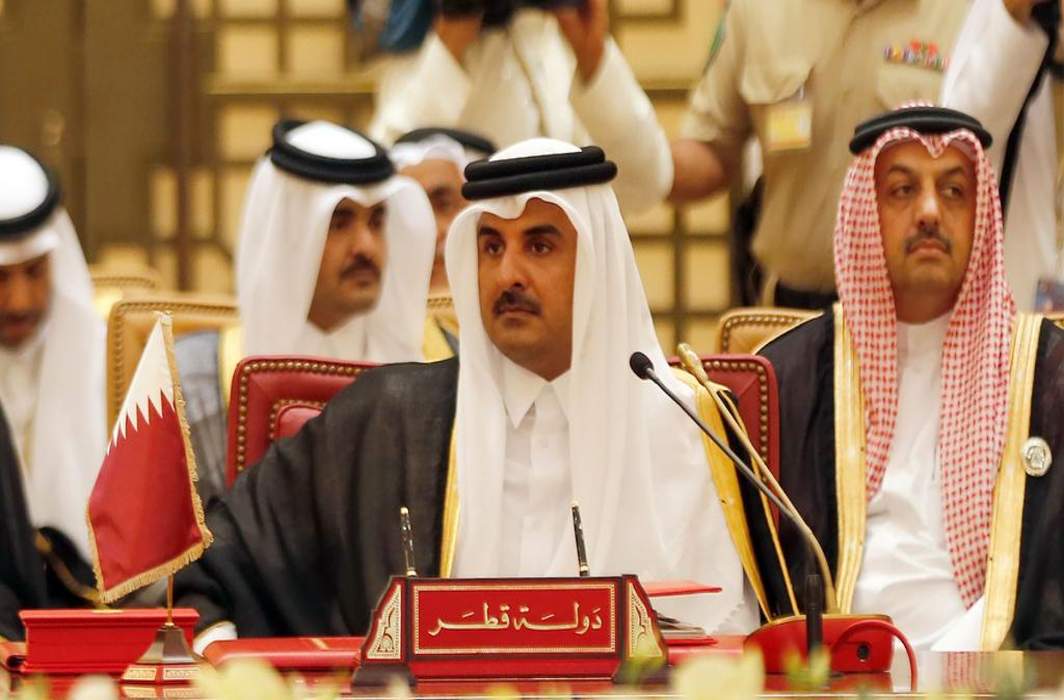
Qatar Emir to attend GCC summit in Kuwait this week

Published

on

Qatar Emir to attend GCC summit in Kuwait this week
May lead to crisis resolution if Saudi Arabia participates

The diplomatic thaw in Middle East seems to be in the offing. Having faced six months of blockade by Saudi led quartet Qatari Emir Sheikh Tamim bin Hamad Al Thani will attend 38th  Gulf Cooperation Council (GCC) summit in Kuwait later this week.

Qatar’s foreign minister Sheikh Mohammed bin Abdulrahman Al Thani announced on Sunday that Emir has accepted Kuwait’s invitation to attend the two-day summit beginning on Tuesday.

According to Doha based Aljazeera, the foreign minister said, “I will attend the ministerial council tomorrow and the emir will attend the summit.” He was speaking at a forum.  “It is important that the GCC system remains alive,” he said.

The emir of Kuwait Sheikh Sabah Al Ahmad Al Sabah was the first Arab leader who tried to mediate for resolving Qatar crisis involving diplomatic impasse.

Last week, Kuwait had invited all six GCC member states. It is still not clear if all other leaders would attend the summit.

The GCC, established in 1981, the early years of Iraq-Iran war (1980-88), is a political and economic alliance of Bahrain, Kuwait, Oman, Qatar, Saudi Arabia and the United Arab Emirates (UAE). The recent Qatar crisis has created ruptures with a debate if GCC will survive due to ongoing tension in the region.

On June 5 this year, Saudi Arabia, Bahrain, UAE and Egypt had suddenly severed diplomatic, air, sea and land route ties with Qatar. They accused Qatar of supporting “terrorism”, maintaining cordial relations with Iran and meddling in the internal affairs of their countries.

Qatar strongly denied all allegations. Doha maintains there is no legitimate justification for the blockade calling it “a violation of its sovereignty”.

Saudi Arabia had also appealed to “all brotherly nations” to join the blockading countries. Kuwait and Oman did not join the quartet. Instead Kuwait, with US support, tried to mediate for resolving the crisis.

In the third week of June, Saudi Arabia led quartet put forwarded 13-point charter of demands asking Qatar, among others, to cut its ties with Iran, close down new Turkish army base in its territory and shut its Aljazeera news network.

In August, Qatari foreign minister visited Tehran and both countries decided to send their ambassadors to each other’s capitals. Qatar had called its Ambassador along with Saudi Arabia after violent protest against Saudi Embassy in Tehran in January 2016 after Mina tragedy during Hajj.

In October, Kuwait’s emir warned of the potential collapse of the Gulf Cooperation Council if the crisis continues.

He was quoted saying, “Contrary to our wishes and hopes, the Gulf crisis has the potential of escalating; therefore, all of us must be fully aware of its potential consequences.” “Any escalation will bring with it an outright call for regional and international intervention, which will destroy the security of the Gulf and its people.”

At the end of October, Qatar’s Emir sheikh Tamim bin Hamad, during an interview with US based CBS News, had accused Saudi Arabia of seeking “regime change” in his country. He had also asserted that he will not bow to pressure and country’s independence and sovereignty is a “red line”.

Bahrain, which is enjoying Saudi army’s support in suppressing its pro-democratic opposition since 2011, had indicated in late October that its king Hamad bin Issa Al-Khalifa will not attend GCC summit if attended by Qatar unless Doha “correct its approach”.

Meanwhile, Marwan Kabalan, director of policy analysis at the Doha Institute has told Al Jazeera about the imminent danger of a GCC collapse.

He said, “The emir of Kuwait knows very well that if the crisis runs for long, we’re going to see two blocks within the GCC. One is led by Saudi Arabia, the Emirates and Bahrain, and the other will actually have Qatar, Oman and to a lesser extent, probably Kuwait. So we’ll be having then two GCCs, rather than one.”

“Qatar has made it clear many times, by the emir of Qatar and by other Qatari officials, that they cannot accept a total surrender. They want a negotiation. They want mutual concessions by all sides, actually, to solve the crisis,” added Kabalan.

The GCC is the only pan-Arab alliance active with its leaders meeting twice a year. In December the leaders meet in the member states (in rotation) and once in Riyadh, the headquarters of the body.

The official Saudi Press Agency (SPA), does not carry any information on who will, if any, will represent Saudi Arabia in the GCC summit in Kuwait till 11.30 Monday morning (local time). Kuwaiti News Agency (KUNA) also  does not carry any news story telling the names of countries participating in the pre-summit ministerial meeting on Monday.

However, most of the Arab news websites carried story about participation of Qatar’s Emir in the summit.

However, Gulf News reports that GCC summit’s fate and level of representation will most likely depend on the outcome of the foreign ministers’ meeting on Monday.

Latest world news

Israel-Lebanon ceasefire to begin within hours as Trump announces 10-day truce

Israel and Lebanon may begin a 10-day ceasefire within hours after a proposal announced by Donald Trump amid ongoing tensions.

Published

on

Donald Trump

A temporary halt in hostilities between Israel and Lebanon is expected to begin within hours after US President Donald Trump announced a proposed 10-day ceasefire between the two sides, amid ongoing tensions in the region.

According to his statement, the ceasefire is likely to take effect around 5 p.m. Eastern Time, although independent confirmation from both sides is still awaited.

The development follows discussions involving Israeli Prime Minister Benjamin Netanyahu and Lebanese President Joseph Aoun, with mediation efforts led by the United States.

Officials indicated that the proposed truce is aimed at creating a limited window to reduce violence and potentially pave the way for broader diplomatic engagement. The situation along the Israel-Lebanon border has remained tense in recent weeks, with escalation linked to the activities of Hezbollah.

Diplomatic efforts have intensified in recent days, with discussions facilitated by the United States, including the involvement of US Secretary of State Marco Rubio. However, details of the agreement and the extent of coordination between the parties remain unclear.

The situation remains fluid, and the success of the ceasefire will depend on adherence by all sides involved. The conflict has already led to significant humanitarian and geopolitical consequences, including displacement and disruption in affected areas.

While the proposed ceasefire is being seen as an important step toward de-escalation, broader negotiations involving regional stakeholders are expected to be necessary for any lasting resolution.

Continue Reading

Latest world news

US ends oil sanctions waiver for Iran and Russia, impact likely on India’s energy imports

The US decision to end the Iran and Russia oil waiver may impact India’s oil imports, fuel prices and global energy markets.

Published

on

US oil tanker

The United States has decided not to extend a temporary sanctions waiver that allowed limited trade in Iranian and Russian oil, marking a shift towards stricter enforcement of economic restrictions.

The waiver, introduced in March 2026, had permitted the sale of oil already loaded on ships to stabilise global supply during heightened geopolitical tensions. However, it is now set to expire around mid-April without renewal.

US officials have indicated that the move is part of a broader strategy to increase pressure on both Iran and Russia amid ongoing conflicts and geopolitical tensions.

What the waiver did and why it mattered

The short-term waiver allowed millions of barrels of oil—estimated at around 140 million barrels—to enter global markets, helping ease supply shortages and prevent sharp price spikes.

It also enabled countries like India to purchase discounted crude oil from Russia and resume limited imports from Iran after years of restrictions.

Impact on India

India, one of the world’s largest oil importers, is expected to feel the impact of the decision in several ways:

  • Reduced access to discounted oil
    India had been buying cheaper Russian crude and recently resumed Iranian imports under the waiver. Its end may limit these options.
  • Potential rise in fuel costs
    With fewer discounted supplies available, India may need to rely more on costlier sources, which could increase domestic fuel prices.
  • Supply diversification pressure
    India may need to explore alternative suppliers in the Middle East, Africa, or the US to maintain energy security.
  • Geopolitical balancing challenge
    The move adds pressure on India to align with US sanctions while managing its own economic interests.

Global energy market concerns

The end of the waiver comes at a time when global oil markets are already under stress due to conflict in West Asia and disruptions in key routes like the Strait of Hormuz.

Analysts warn that tightening sanctions could:

  • Reduce global oil supply
  • Increase price volatility
  • Intensify competition among major buyers like India and China

Bigger picture

The US decision reflects a broader shift from temporary relief measures to stricter enforcement of sanctions, even if it risks tightening global energy markets.

For India, the development highlights a recurring challenge—balancing affordable energy access with geopolitical realities.

Continue Reading

Latest world news

Sanctioned tanker fails to breach US blockade, turns back near Strait of Hormuz

A US-sanctioned tanker failed to cross the Hormuz blockade and turned back, underscoring rising tensions and disruption in global shipping routes.

Published

on

A US-sanctioned oil tanker failed to break through a newly imposed American naval blockade and was forced to turn back near the Strait of Hormuz, highlighting growing tensions in the region.

The vessel, identified as the Rich Starry, reversed its course after attempting to exit the Gulf, according to shipping data. The development comes just days after the United States enforced restrictions on ships linked to Iranian ports.

The blockade was announced by Donald Trump following the collapse of recent diplomatic talks with Iran. The move aims to restrict maritime traffic associated with Iranian trade.

Officials said that during the first 24 hours of enforcement, no vessel successfully crossed the blockade. Several ships, including the sanctioned tanker, complied with instructions from US forces and turned back toward regional waters.

The tanker is reported to be linked to a Chinese company previously sanctioned for dealing with Iran. It was carrying a cargo of methanol loaded from the United Arab Emirates at the time of the incident.

The situation underscores the rising risks in one of the world’s most critical oil transit routes. The Strait of Hormuz typically handles a significant share of global energy shipments, but traffic has sharply declined due to ongoing geopolitical tensions.

The blockade, which applies specifically to vessels travelling to or from Iranian ports, has added further uncertainty for shipping companies, insurers and global energy markets.

Continue Reading

Trending

© Copyright 2022 APNLIVE.com