English हिन्दी
Connect with us

Top Stories

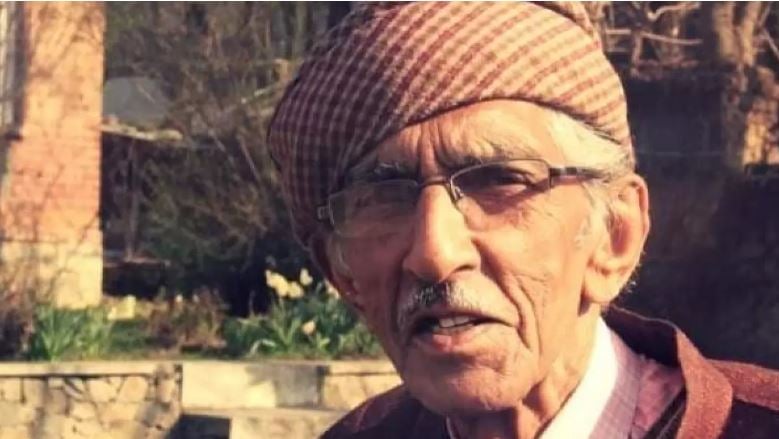
Kashmir’s first Jnanpith awardee Rehman Rahi passes away at 98

Kashmir’s renowned poet and first Jnanpith awardee Professor Rehman Rahi died in the early hours of Monday. As per the details shared by the family, the famous poet took his last breath at his residence in the Nowshera area.

Published

on

Rehman Rahi

Kashmir’s renowned poet and first Jnanpith awardee Professor Rehman Rahi died in the early hours of Monday. As per the details shared by the family, the famous poet took his last breath at his residence in the Nowshera area. He was 98 years old. His last rites will be performed at the shrine of Khwaja Habibullah Nowshehri (RA).

Many political leaders express grief over the sad news on social media platforms. Reacting about the same, former Jammu and Kashmir Chief Minister Omar Abdullah said that he is deeply saddened by the demise of legendary Kashmiri poet and lyricist Rahman Rahi sahib. He said that the artist will be remembered for his outstanding work forever. In addition, he said that with his memorable and progressive poetry, he has left an indelible mark on the hearts of people. Today, the literary world of Kashmir has suffered a great loss. His death marks an end of an era, Omar Abdullah added.

Read Also: Mahindra launches 2023 Thar with RWD at Rs 9.99 Lakh, here’s what firm included this year!

President of the Halqua-e-Adab Sonawari (HAS), Shakir Shafi also expressed condolence to the family and calls the event a massive loss to the Kashmiri language and literature,

Know everything about Rehman Rahi

Born in Srinagar in 1925, Prof Rahi was originally known as Abdur Rehman Mir who has always been very fascinated by poetry. He started his career in 1948 as a clerk for a short period of time in the government’s Public Works Department. He was also a member of the Progressive Writers’ Association, where he eventually rose to the position of General Secretary. Later, he started working as a sub-editor for the Urdu newspaper Khidmat.

Talking about his educational background, he completed his schooling at Islamia High School in Srinagar. After this, he did his master’s degree in Persian as well as in the English language from the University of Kashmir.

Awards

He was given the prestigious Sahitya Akademi Award in 1961 for his poetry collection Nawroz-i-Saba. Apart from this, he was also a Padma Shri awardee in 2000.

India’s skill capital can become the the world’s growth engine: PM Modi at 17th Pravasi Bharatiya Divas Convention in Indore

Mahindra launches 2023 Thar with RWD at Rs 9.99 Lakh, here’s what firm included this year!

Continue Reading

Latest world news

PM Modi receives Ethiopia’s highest civilian honour, first world leader to get award

PM Modi has become the first global leader to be awarded Ethiopia’s highest civilian honour for strengthening bilateral ties and global leadership.

Published

on

PM modi Ethiopias highest civillian award

Prime Minister Narendra Modi on Tuesday was conferred with ‘The Great Honour Nishan of Ethiopia’, the highest national award of the African nation, becoming the first head of government or state globally to receive the honour.

The award was presented during a special ceremony held at the Addis International Convention Centre, where Ethiopian Prime Minister Abiy Ahmed Ali honoured Modi for his role in strengthening bilateral relations between India and Ethiopia and for his leadership on global issues.

Recognition of India-Ethiopia partnership

According to an official statement, the honour recognises Prime Minister Modi’s contribution to deepening the long-standing partnership between the two countries and his engagement with issues concerning the Global South. The conferment is being seen as a milestone in India-Ethiopia relations and reflects the growing diplomatic and development cooperation between the two nations.

Prime Minister Modi acknowledged the award and dedicated it to the people of India. In a post on X, he said he was honoured to receive Ethiopia’s highest recognition and attributed it to the collective strength and aspirations of 140 crore Indians.

‘Accepted with humility and gratitude’

Speaking at the ceremony, Prime Minister Modi said it was a privilege to accept the honour from one of the world’s most ancient civilisations. He expressed humility and gratitude while thanking Prime Minister Abiy Ahmed and the people of Ethiopia for the recognition.

He also praised the Ethiopian Prime Minister’s leadership and initiatives aimed at promoting national unity, sustainability and inclusive development. Highlighting the role of knowledge and education in nation-building, Modi noted that Indian teachers have been contributing to Ethiopia’s progress for more than a century.

The Prime Minister dedicated the award to both Indians and Ethiopians who have nurtured bilateral ties over generations and conveyed appreciation on behalf of India’s population for the honour bestowed upon him.

Continue Reading

Latest world news

Trump administration expands US travel ban to 20 more countries, Palestinians also affected

The Trump administration has widened its travel ban, adding 20 more countries and fully restricting entry for Palestinians, citing security and vetting concerns.

Published

on

The Trump administration has widened its travel restrictions, adding 20 more countries to the existing list and imposing a complete ban on travel for people holding documents issued by the Palestinian Authority. The decision significantly expands the scope of the travel limits announced earlier this year and will come into force from January 1.

According to the proclamation issued on Tuesday, the latest move doubles the number of nations impacted by US travel and immigration restrictions. Five additional countries now face a full ban, while 15 others have been placed under partial restrictions. The administration said the measures apply to both visitors and those seeking to immigrate to the United States.

Countries facing full travel ban

The newly added countries under the full ban include Burkina Faso, Mali, Niger, South Sudan and Syria. In addition, people travelling on Palestinian Authority-issued passports or documents have been fully barred from entering or emigrating to the US. South Sudan had already been subject to significant restrictions before this announcement.

Earlier, the administration had imposed a complete ban on travellers from Afghanistan, Myanmar, Chad, the Republic of Congo, Equatorial Guinea, Eritrea, Haiti, Iran, Libya, Somalia, Sudan and Yemen.

15 countries under partial restrictions

The list of countries now facing partial travel restrictions includes Angola, Antigua and Barbuda, Benin, Ivory Coast, Dominica, Gabon, Gambia, Malawi, Mauritania, Nigeria, Senegal, Tanzania, Tonga, Zambia and Zimbabwe.

These join the earlier partially restricted countries such as Burundi, Cuba, Laos, Sierra Leone, Togo, Turkmenistan and Venezuela. The administration also said restrictions on Laos and Sierra Leone have been upgraded, while some limits on Turkmenistan have been eased after an improvement in vetting standards.

Who is exempt from the restrictions

The proclamation clarifies that certain categories of travellers are exempt. These include people who already hold valid US visas, lawful permanent residents, diplomats, athletes, and individuals whose entry is considered to be in the national interest of the United States.

Reasons cited by the administration

The US administration said many of the affected countries suffer from widespread corruption, unreliable civil documents and weak criminal record systems, making proper vetting difficult. It also pointed to high visa overstay rates, refusal by some governments to accept deported nationals, and broader concerns related to immigration enforcement, foreign policy and national security.

The expansion follows the arrest of an Afghan national accused in the shooting of two National Guard troops near the White House during the Thanksgiving weekend. The accused has pleaded not guilty to murder and assault charges.

Criticism and concerns over Afghan visas

The decision has drawn criticism from rights groups and immigration advocates, who argue that national security is being used to justify broad restrictions on entire populations. Concerns have also been raised over the removal of an exception for Afghans eligible for the Special Immigrant Visa, a category meant for those who assisted US forces during the war in Afghanistan.

Advocacy groups said these individuals undergo extensive vetting and that restricting their entry could undermine commitments made by the United States.

New restrictions on Palestinians

The full ban on people holding Palestinian Authority passports marks a further tightening of restrictions imposed earlier, which had already made it extremely difficult for Palestinians to travel to the US for work, education, business or tourism. The administration justified the move by citing the presence of US-designated terrorist groups in the West Bank and Gaza, as well as challenges in vetting due to ongoing conflict.

Governments of some newly affected countries said they were reviewing the decision and seeking clarity from US officials on the implications of the restrictions.

Continue Reading

India News

Priyanka Gandhi leads protest against G Ram G Bill, calls move to replace MGNREGA unconstitutional

Priyanka Gandhi objected in Lok Sabha to the Centre’s G Ram G Bill, saying it weakens MGNREGA and dilutes the constitutional right to employment.

Published

on

Senior Congress leader and Wayanad MP Priyanka Gandhi Vadra on Tuesday led a protest in Parliament against the Centre’s move to replace the Mahatma Gandhi National Rural Employment Guarantee Act (MGNREGA) with the proposed Viksit Bharat Rozgar and Ajeevika Mission (Gramin) Bill, 2025, popularly referred to as the G Ram G Bill.

Holding up photographs of Mahatma Gandhi on the Parliament premises, Congress MPs objected to the introduction of the Bill, alleging that it weakens a landmark welfare law that has supported rural livelihoods for two decades.

Priyanka Gandhi opposes Bill in Lok Sabha

During proceedings in the Lok Sabha, Union Agriculture Minister Shivraj Singh Chouhan sought permission to introduce the new Bill, which aims to replace MGNREGA. Priyanka Gandhi opposed the move under Rule 72(1) of the Rules of Procedure and Conduct of Business, registering what she described as a “strong objection”.

She said MGNREGA had been a revolutionary law since its introduction in 2005 by the UPA government and had enjoyed support across party lines. According to her, the scheme guarantees 100 days of employment annually to the poorest sections in rural India and has played a key role in strengthening the rural economy.

Concerns over funding model and role of Gram Sabhas

Priyanka Gandhi flagged concerns over changes proposed in the new Bill, particularly the shift from a demand-based funding model to a system where allocations are decided in advance by the Centre. She argued that MGNREGA works on demand from the ground, with Gram Sabhas empowered to assess local employment needs.

“The right to employment is being weakened, and this goes against the Constitution,” she said, adding that the proposed law reduces the role of Gram Sabhas and dilutes the core principle of guaranteed work.

She also pointed out that the Centre’s funding share for the scheme has come down to 60 per cent for most states, warning that this could strain state finances at a time when several states are already awaiting GST dues.

Objection to renaming and passage without discussion

The Congress leader questioned what she described as a “craze” to rename existing schemes, noting that such changes involve additional costs. She urged the government not to rush the legislation and to withdraw the Bill for wider discussion in the House.

When members from the treasury benches made a remark referring to her family, Priyanka Gandhi responded by saying that Mahatma Gandhi may not belong to her family but is regarded as family by the entire nation.

Wider opposition, government defence

Several opposition leaders echoed these concerns. Congress MP Shashi Tharoor opposed the Bill, calling it immoral to remove Mahatma Gandhi’s name from the scheme. Other विपक्ष members raised issues over normative funding and the reduced central contribution.

Government sources, however, defended the Bill, saying it aligns with the Viksit Bharat 2047 vision. They argued that normative funding allows predictable and rational budgeting, unlike a demand-based model that can lead to uncertainty, while still ensuring employment or unemployment allowance for eligible workers.

BJP leader and former Minority Affairs Minister Mukhtar Abbas Naqvi dismissed the opposition’s protest, alleging that the objection stemmed from the inclusion of Lord Ram’s name in the scheme.

Continue Reading

Trending

© Copyright 2022 APNLIVE.com