English हिन्दी
Connect with us

Latest world news

Turkey-Syria quake: Death tolls mounts to 4,300; cities flattened, WHO fears 20,000 may have died

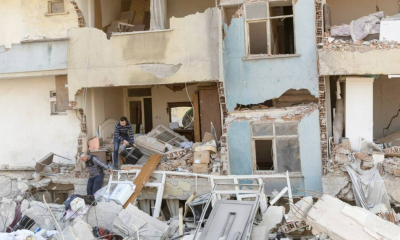
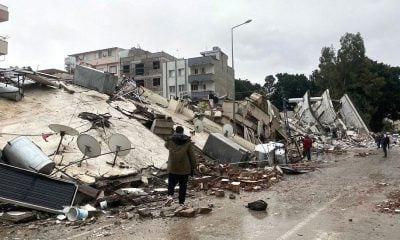
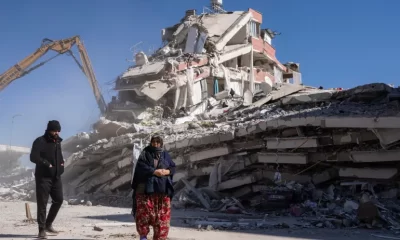
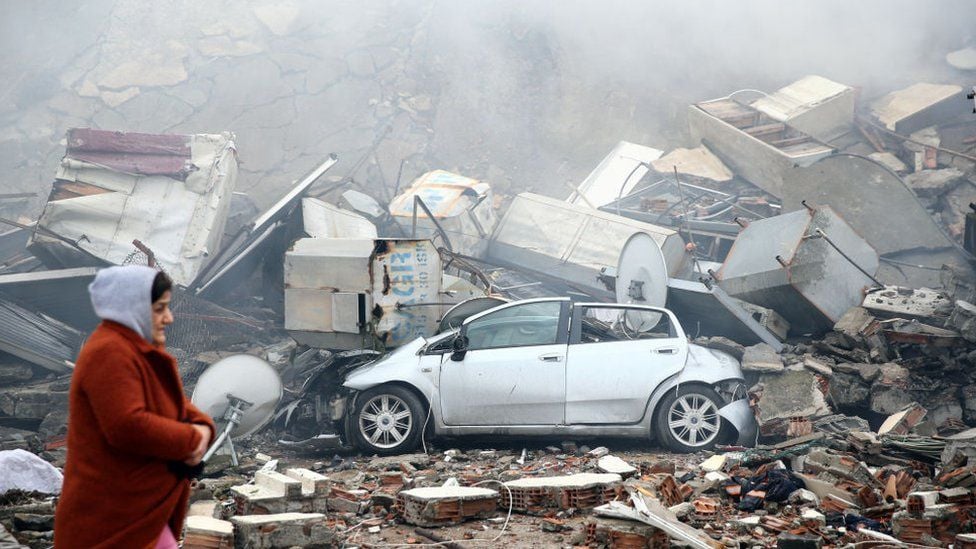
The confirmed death toll mounted to over 4,300 due to mammoth earthquake that tore apart Turkey and neigbouring Syria on Monday even as the World Health Organization (WHO) fears that over 20,000 may have died as rescuers continued to dig the bodies and survivors from beneath the rubble of thousands of buildings flattened by the disastrous tremors.

Published

on

Turkey earthquake

The confirmed death toll mounted to over 4,300 due to mammoth earthquake that tore apart Turkey and neigbouring Syria on Monday even as the World Health Organization (WHO) fears that over 20,000 may have died as rescuers continued to dig the bodies and survivors from beneath the rubble of thousands of buildings flattened by the disastrous tremors.
According to official reports, the confirmed death toll across the two countries has soared above 4,300 after a swarm of strong tremors struck near the Turkey-Syria border.

WHO officials fear that the toll may soar to unimaginable numbers, estimating that 20,000 people may have died.

Reports from the Turkish and Syrian disaster response teams said that over 5,600 buildings have been felled across several cities, including many multi-storey apartment blocks that were filled with sleeping residents when the first quake struck.

An AFP report quoting eyewitnesses in the Kahramanmaras city of southeastern Turkey struggled to comprehend the scale of the disaster as some believed that this was the Apocalypse- the end of days.

Turkey’s relief agency AFAD on Tuesday confirmed that there were now 2,921 deaths in Turkey alone bringing the confirmed tally to 4,365.

Reporters from news agencies and rescue workers have reported horrific scenes from ground zero as sky scrapers continue to tumble left and right with survivors clamoring for safety.

In Gaziantep, a Turkish city home to countless Syrian refugees from the war-torn countries’s decade-old civil war, rescuers picking through the rubble screamed, cried and clamoured for safety as another building collapsed nearby without warning, AFP said in its report.

As per reports, the first quake- measured at 7.8 magnitude- was so massive that it was felt as far away as Greenland, and the impact is big enough to have sparked a global response.

Dozens of nations from Ukraine to New Zealand have vowed to send help, although freezing rain and sub-zero temperatures have slowed the response.

India dispatched the batch of relief material to disaster hit Turkey, hours after an announcement made about the same by the Prime Minister’s Office.

According to the Ministry of External Affairs (MEA), the first batch of earthquake relief material to Turkey- which consists of an expert National Disaster Response Force (NDRF) search and rescue team, highly-skilled dog squads, a range of medical supplies, advanced drilling equipment, and other crucial tools required for the relief efforts- was dispatched aboard an Indian Air Force aircraft.

In the southeastern Turkish city of Sanliurfa, rescuers were working into the night to try and pull survivors from the wreckage of a seven-storey building that had collapsed.

Some of the heaviest devastation occurred near the quake’s epicentre between Kahramanmaras and Gaziantep, where entire city blocks lay in ruins as snow gathers.

On Monday, according to the US Geological Survey, the first quake hit at 4:17am (0117 GMT) at a depth of about 18 kilometres (11 miles) near the Turkish city of Gaziantep, home to around two million people.

Reports by various rescue and disaster relief agencies have estimated that over 14,000 people have been injured Turkey, while at least 3,411 people were reported injured in Syria.

Officials said three major airports have been rendered inoperable, complicating deliveries of vital aid and a winter blizzard has covered major roads into the area in ice and snow.

The Syrian health ministry reported damage across the provinces of Aleppo, Latakia, Hama and Tartus, where Russia is leasing a naval facility.

Even before the tragedy, buildings in Aleppo — Syria’s pre-war commercial hub — often collapsed due to the dilapidated infrastructure, which has suffered from a lack of wartime oversight. Officials cut off natural gas and power supplies across the region as a precaution, also closing schools for two weeks.

Read Also: Uttar Pradesh men beat up elderly man over accident, video goes viral | Watch

WHO fears death toll may soar

WHO officials fear that the toll may soar to unimaginable numbers, estimating that 20,000 people may have died.

The global agency’s senior emergency officer for Europe, Catherine Smallwood told news agency AFP that there’s a continued potential of further collapses to happen as she feared an eight-fold increase in the death count.

Smallwood said that as the per the analysis of the initial reports, the number of dead and injured will, unfortunately, increased “quite significantly” in the following weeks as the dust settle and rescue workers recover more bodies from beneath the rubble.

The WHO official warned that people who’ve lost their homes will be meeting and gathering in collective environments which poses particular risks such as overcrowding and exposure to freezing temperatures. This, she added, may put the survivors at the mercy of respiratory viruses.

Turkey is in one of the world’s most active seismic zones in the world. A 7.8-magnitude tremor in 1939 killed over 33,000 people in the eastern Erzincan province.

The Turkish region of Duzce suffered a 7.4-magnitude earthquake in 1999, when more than 17,000 people died.

Turkey earthquake: India sends first batch of relief, NDRF search team

Pakistan lifts Wikipedia ban after orders from PM Shehbaz Sharif

Latest world news

Israel-Lebanon ceasefire to begin within hours as Trump announces 10-day truce

Israel and Lebanon may begin a 10-day ceasefire within hours after a proposal announced by Donald Trump amid ongoing tensions.

Published

on

Donald Trump

A temporary halt in hostilities between Israel and Lebanon is expected to begin within hours after US President Donald Trump announced a proposed 10-day ceasefire between the two sides, amid ongoing tensions in the region.

According to his statement, the ceasefire is likely to take effect around 5 p.m. Eastern Time, although independent confirmation from both sides is still awaited.

The development follows discussions involving Israeli Prime Minister Benjamin Netanyahu and Lebanese President Joseph Aoun, with mediation efforts led by the United States.

Officials indicated that the proposed truce is aimed at creating a limited window to reduce violence and potentially pave the way for broader diplomatic engagement. The situation along the Israel-Lebanon border has remained tense in recent weeks, with escalation linked to the activities of Hezbollah.

Diplomatic efforts have intensified in recent days, with discussions facilitated by the United States, including the involvement of US Secretary of State Marco Rubio. However, details of the agreement and the extent of coordination between the parties remain unclear.

The situation remains fluid, and the success of the ceasefire will depend on adherence by all sides involved. The conflict has already led to significant humanitarian and geopolitical consequences, including displacement and disruption in affected areas.

While the proposed ceasefire is being seen as an important step toward de-escalation, broader negotiations involving regional stakeholders are expected to be necessary for any lasting resolution.

Continue Reading

Latest world news

US ends oil sanctions waiver for Iran and Russia, impact likely on India’s energy imports

The US decision to end the Iran and Russia oil waiver may impact India’s oil imports, fuel prices and global energy markets.

Published

on

US oil tanker

The United States has decided not to extend a temporary sanctions waiver that allowed limited trade in Iranian and Russian oil, marking a shift towards stricter enforcement of economic restrictions.

The waiver, introduced in March 2026, had permitted the sale of oil already loaded on ships to stabilise global supply during heightened geopolitical tensions. However, it is now set to expire around mid-April without renewal.

US officials have indicated that the move is part of a broader strategy to increase pressure on both Iran and Russia amid ongoing conflicts and geopolitical tensions.

What the waiver did and why it mattered

The short-term waiver allowed millions of barrels of oil—estimated at around 140 million barrels—to enter global markets, helping ease supply shortages and prevent sharp price spikes.

It also enabled countries like India to purchase discounted crude oil from Russia and resume limited imports from Iran after years of restrictions.

Impact on India

India, one of the world’s largest oil importers, is expected to feel the impact of the decision in several ways:

  • Reduced access to discounted oil
    India had been buying cheaper Russian crude and recently resumed Iranian imports under the waiver. Its end may limit these options.
  • Potential rise in fuel costs
    With fewer discounted supplies available, India may need to rely more on costlier sources, which could increase domestic fuel prices.
  • Supply diversification pressure
    India may need to explore alternative suppliers in the Middle East, Africa, or the US to maintain energy security.
  • Geopolitical balancing challenge
    The move adds pressure on India to align with US sanctions while managing its own economic interests.

Global energy market concerns

The end of the waiver comes at a time when global oil markets are already under stress due to conflict in West Asia and disruptions in key routes like the Strait of Hormuz.

Analysts warn that tightening sanctions could:

  • Reduce global oil supply
  • Increase price volatility
  • Intensify competition among major buyers like India and China

Bigger picture

The US decision reflects a broader shift from temporary relief measures to stricter enforcement of sanctions, even if it risks tightening global energy markets.

For India, the development highlights a recurring challenge—balancing affordable energy access with geopolitical realities.

Continue Reading

Latest world news

Sanctioned tanker fails to breach US blockade, turns back near Strait of Hormuz

A US-sanctioned tanker failed to cross the Hormuz blockade and turned back, underscoring rising tensions and disruption in global shipping routes.

Published

on

A US-sanctioned oil tanker failed to break through a newly imposed American naval blockade and was forced to turn back near the Strait of Hormuz, highlighting growing tensions in the region.

The vessel, identified as the Rich Starry, reversed its course after attempting to exit the Gulf, according to shipping data. The development comes just days after the United States enforced restrictions on ships linked to Iranian ports.

The blockade was announced by Donald Trump following the collapse of recent diplomatic talks with Iran. The move aims to restrict maritime traffic associated with Iranian trade.

Officials said that during the first 24 hours of enforcement, no vessel successfully crossed the blockade. Several ships, including the sanctioned tanker, complied with instructions from US forces and turned back toward regional waters.

The tanker is reported to be linked to a Chinese company previously sanctioned for dealing with Iran. It was carrying a cargo of methanol loaded from the United Arab Emirates at the time of the incident.

The situation underscores the rising risks in one of the world’s most critical oil transit routes. The Strait of Hormuz typically handles a significant share of global energy shipments, but traffic has sharply declined due to ongoing geopolitical tensions.

The blockade, which applies specifically to vessels travelling to or from Iranian ports, has added further uncertainty for shipping companies, insurers and global energy markets.

Continue Reading

Trending

© Copyright 2022 APNLIVE.com