English हिन्दी
Connect with us

India News

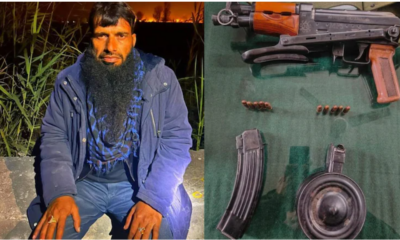
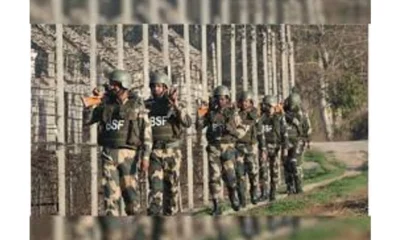
Pakistani intruder arrested by BSF along Punjab border

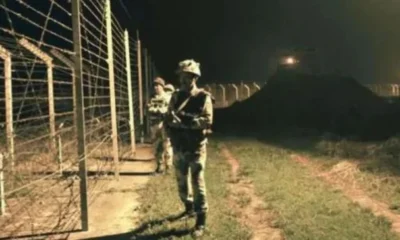
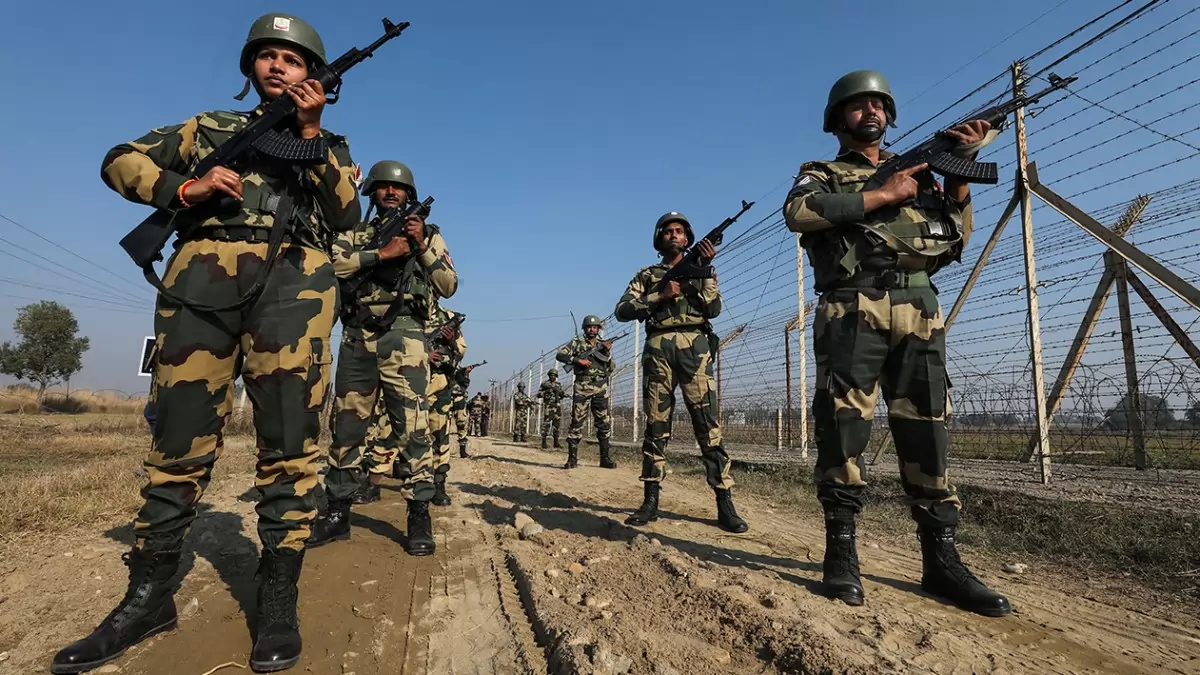
The Border Security Force (BSF), Friday, apprehended a Pakistani man along the India-Pakistan International Border in Punjab, a spokesman of the security force said.

Published

on

India-Pakistan International Border

The Border Security Force (BSF), Friday, apprehended a Pakistani man along the India-Pakistan International Border in Punjab, a spokesman of the security force said.
Giving details, the spokesman said that a Pakistani intruder crossed the border on the intervening night of 9-10 March and entered the Indian side from the area of border post ‘Tirath’ in Ferozepur sector of the state.

He said the man was apprehended by BSF personnel and upon questioning revealed that he was a resident of Pakistan’s Khyber district, adding that the intruder is currently being questioned by a joint team of security and intelligence officials.

The official further said that man may later be handed over to the local police.

Earlier, on Tuesday, a Bangladeshi and a Pakistani national were similarly apprehended by the border force along this front in Punjab.

In a statement issued yesterday, the BSF said that had nabbed a Pakistani intruder along the border in Amritsar sector of Punjab on Thursday morning.

Read Also: Muslim man lynched on suspicion of carrying beef in Bihar’s Saran, local sarpanch among 3 arrested

They border force said that an intruder from the Pakistan side trying to enter India on the intervening night of March 8-9 at Border Out Post in Rajatal in the Amritsar sector, was shot at by BSF personnel and subsequently arrested.

The intruder was nabbed and searched and upon questioning it was revealed that he was a Bangladeshi national, BSF said, adding that the further action will be decided after questioning is finished.

An armed Pakistani infiltrator was shot dead by the BSF in January along the India-Pakistan international border in Punjab’s Gurdaspur sector.

A BSF statement at the time said that an infiltration bid was detected near village Dariya Mansoor in Amritsar district around 8 am on January 3 and the troops subsequently recovered the body of a man, aged around 45-50 years, along with a weapon there. The area falls under BSF’s Gurdaspur sector.

The BSF had said that a pump action gun along with six yellow-colour live cartridges bearing ‘Made in Pakistan’ markings were found near the body of the Pakistani “miscreant”.

AAP MLAs Atishi, Saurabh Bharadwaj take oath as Delhi Ministers today

Xi Jinping becomes China President for third term, first to outlast Deng Xiaoping two-term cap

India News

Rahul Gandhi Attacks Centre over G RAM G bill, calls it an attack on MGNREGA’s core principles

Rahul Gandhi has strongly opposed the G RAM G bill, accusing the Modi government of undermining MGNREGA and shifting the financial burden of rural employment schemes onto states.

Published

on

Rahul-Gandhi

Congress MP and Leader of the Opposition Rahul Gandhi on Monday sharpened his attack on the Centre over the introduction of the G RAM G bill in the Lok Sabha, alleging that the proposed law weakens the foundations of the Mahatma Gandhi National Rural Employment Guarantee Act (MGNREGA) and undermines the rights of the rural poor.

The bill, formally titled the Viksit Bharat Guarantee for Rozgar and Ajeevika Mission (Gramin) Bill, 2025, has been brought in to replace MGNREGA, which was enacted in 2005 under the UPA government.

Reacting to the move, Rahul Gandhi described the legislation as an “insult to the ideals of Mahatma Gandhi” and accused the Narendra Modi-led government of attempting to dismantle a scheme that guarantees livelihood security to millions of rural households.

Rahul Gandhi’s sharp criticism of the G RAM G bill

In a post on X, Gandhi alleged that Prime Minister Modi has consistently opposed the ideas associated with Mahatma Gandhi and has been trying to weaken MGNREGA since coming to power in 2014. He asserted that the Congress would oppose any attempt to dilute or dismantle the employment guarantee framework.

“Modiji has a deep hatred for two things – the ideas of Mahatma Gandhi and the rights of the poor,” Gandhi said, calling MGNREGA a living embodiment of Gandhi’s vision of village self-rule. He also highlighted the role of the scheme as an economic shield for rural India, particularly during the COVID period.

According to Gandhi, the Centre is now “determined to wipe out MGNREGA completely” by replacing it with a new framework that centralises power and alters the funding structure.

Opposition protests in Parliament

The introduction of the G RAM G bill triggered protests from several opposition MPs inside and outside Parliament. Congress MPs, including Priyanka Gandhi Vadra and Shashi Tharoor, raised objections to key provisions of the bill, particularly the removal of Mahatma Gandhi’s name from the scheme.

Opposition leaders argued that MGNREGA is rooted in the right to employment, decentralised decision-making by villages, and a funding structure where the Centre bears the full wage cost and most of the material expenses.

How G RAM G differs from MGNREGA

Rahul Gandhi pointed out that under MGNREGA, the Centre pays 100 per cent of wages for unskilled workers and 75 per cent of material costs, ensuring steady employment based on demand.

The new G RAM G bill proposes a shift to normative funding, under which states will have to bear 40 per cent of the overall costs. Gandhi claimed this would reduce work availability once budgets are exhausted or during crop harvest seasons, leaving rural workers without employment for extended periods.

The funding ratio for northeastern and Himalayan states has been set at 90:10, while union territories will be fully funded by the Centre. Of the estimated annual expenditure of Rs 1.51 lakh crore, the central government’s share is projected at Rs 95,692 crore.

Leaders from several opposition parties, including those from a key BJP ally, have also expressed concerns over the increased financial burden on states.

Government’s defence of the bill

Government sources have maintained that the G RAM G bill aligns with the broader ‘Viksit Bharat 2047’ vision. According to them, the shift from a demand-based to a normative funding model brings the scheme in line with budgeting practices followed for other central government programmes.

However, the sharp political pushback indicates that the replacement of MGNREGA is set to remain a major flashpoint in Parliament in the coming days.

Continue Reading

India News

Priyanka Gandhi leads protest against G Ram G Bill, calls move to replace MGNREGA unconstitutional

Priyanka Gandhi objected in Lok Sabha to the Centre’s G Ram G Bill, saying it weakens MGNREGA and dilutes the constitutional right to employment.

Published

on

Senior Congress leader and Wayanad MP Priyanka Gandhi Vadra on Tuesday led a protest in Parliament against the Centre’s move to replace the Mahatma Gandhi National Rural Employment Guarantee Act (MGNREGA) with the proposed Viksit Bharat Rozgar and Ajeevika Mission (Gramin) Bill, 2025, popularly referred to as the G Ram G Bill.

Holding up photographs of Mahatma Gandhi on the Parliament premises, Congress MPs objected to the introduction of the Bill, alleging that it weakens a landmark welfare law that has supported rural livelihoods for two decades.

Priyanka Gandhi opposes Bill in Lok Sabha

During proceedings in the Lok Sabha, Union Agriculture Minister Shivraj Singh Chouhan sought permission to introduce the new Bill, which aims to replace MGNREGA. Priyanka Gandhi opposed the move under Rule 72(1) of the Rules of Procedure and Conduct of Business, registering what she described as a “strong objection”.

She said MGNREGA had been a revolutionary law since its introduction in 2005 by the UPA government and had enjoyed support across party lines. According to her, the scheme guarantees 100 days of employment annually to the poorest sections in rural India and has played a key role in strengthening the rural economy.

Concerns over funding model and role of Gram Sabhas

Priyanka Gandhi flagged concerns over changes proposed in the new Bill, particularly the shift from a demand-based funding model to a system where allocations are decided in advance by the Centre. She argued that MGNREGA works on demand from the ground, with Gram Sabhas empowered to assess local employment needs.

“The right to employment is being weakened, and this goes against the Constitution,” she said, adding that the proposed law reduces the role of Gram Sabhas and dilutes the core principle of guaranteed work.

She also pointed out that the Centre’s funding share for the scheme has come down to 60 per cent for most states, warning that this could strain state finances at a time when several states are already awaiting GST dues.

Objection to renaming and passage without discussion

The Congress leader questioned what she described as a “craze” to rename existing schemes, noting that such changes involve additional costs. She urged the government not to rush the legislation and to withdraw the Bill for wider discussion in the House.

When members from the treasury benches made a remark referring to her family, Priyanka Gandhi responded by saying that Mahatma Gandhi may not belong to her family but is regarded as family by the entire nation.

Wider opposition, government defence

Several opposition leaders echoed these concerns. Congress MP Shashi Tharoor opposed the Bill, calling it immoral to remove Mahatma Gandhi’s name from the scheme. Other विपक्ष members raised issues over normative funding and the reduced central contribution.

Government sources, however, defended the Bill, saying it aligns with the Viksit Bharat 2047 vision. They argued that normative funding allows predictable and rational budgeting, unlike a demand-based model that can lead to uncertainty, while still ensuring employment or unemployment allowance for eligible workers.

BJP leader and former Minority Affairs Minister Mukhtar Abbas Naqvi dismissed the opposition’s protest, alleging that the objection stemmed from the inclusion of Lord Ram’s name in the scheme.

Continue Reading

India News

Bengal draft voter list revision removes 58 lakh names, triggers political row ahead of polls

The draft voter list published after West Bengal’s Special Intensive Revision shows 58 lakh names deleted, setting off a political storm ahead of the Assembly elections.

Published

on

mamta banerjee

The release of West Bengal’s draft voter list following the Special Intensive Revision (SIR) has set off a fresh political controversy, with 58 lakh names found missing from the rolls. The development comes months ahead of the Assembly elections and has sharpened the ongoing debate between the ruling Trinamool Congress and the opposition BJP.

According to the draft list, 24 lakh voters have been marked as deceased, 19 lakh as relocated, 12 lakh as missing and around 1.3 lakh as duplicate entries. The exercise aims to eliminate duplication and errors from the electoral database and marks the completion of the first phase of SIR, which was last conducted in the state in 2002.

Objection window opens, final list due in February

With the draft list now published, voters whose names have been excluded can file objections and seek corrections. The Election Commission is expected to address these claims before releasing the final voter list in February next year. The announcement of the West Bengal Assembly elections is likely only after the final list is made public.

Trinamool calls deletions injustice, sets up help booths

The Trinamool Congress has strongly objected to the scale of deletions. Party MP Saugata Roy described the removal of 58 lakh names as an injustice and alleged that legitimate voters were being targeted. He said the party has set up voter assistance booths to help people submit forms for re-inclusion of their names.

Chief Minister Mamata Banerjee has also opposed the SIR exercise, accusing the Centre and the Election Commission of attempting to strike off the names of eligible voters ahead of the polls. At a recent rally in Krishnanagar, she urged people to protest if their names were deleted from the rolls.

BJP defends SIR, targets Trinamool vote bank claims

The BJP has defended the revision exercise, accusing the Trinamool Congress of trying to shield illegal and fake voters. Leader of the Opposition in the Assembly Suvendu Adhikari claimed the Chief Minister’s opposition stemmed from fears of losing power as deceased, duplicate and illegal names were being removed from the voter list.

Earlier, Trinamool had also targeted the Election Commission over reports of Booth Level Officers facing extreme work pressure during the exercise. With the draft list now out, the political confrontation over SIR is expected to intensify further in the run-up to the elections.

Continue Reading

Trending

© Copyright 2022 APNLIVE.com

Left Menu Icon