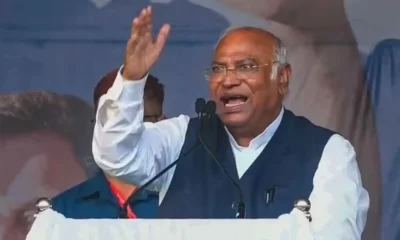
[vc_row][vc_column][vc_column_text]Noisy scenes forcing a ten-minute adjournment marked the speech of Congress president Rahul Gandhi as he launched a stinging attack on Prime Minister Narendra Modi, the government and the BJP during the debate on no-confidence motion in Lok Sabha on Friday, July 20.
As Rahul mounted his attack, his speech was interrupted by Parliamentary Affairs Minister Ananth Kumar who pulled out a rule to cite Rule 353 — ‘No allegation shall be made against any person unless the member has given adequate notice to the Speaker so that the minister maybe able to make an investigation into the matter.’
Apparently the no confidence motion does not allow pointing out wrong doings. Speaker Sumitra Mahajan also said: “It’s a no confidence motion. You can’t make direct allegations, and if you do, there must be proof. If you do take ministers’ names, they must get a chance to respond.” She did allow Defence Minister Niramala Sitharaman to reply after Rahul Gandhi mentioned her in connection with Rafale deal.
Speeches of other members were relatively interrupted.
It was Telugu Desam Party’s Jayadev Galla who initiated the debate on the no-confidence motion moved by his party, the first no-confidence vote in 15 years.
The motion was keenly watched and the top trends on Twitter were all related to the debate.
Starting the debate, Galla spoke of the party and his state Andhra Pradesh being let down by denying it a special category status. “People are tired of empty promises and unfulfilled promises,” Galla said.
“It is not a war between TDP and BJP, but between morality and majority. Motion of no confidence is against the lack of fairness, lack of trust, lack of unbiased approach towards Andhra Pradesh.”
When Galla said that neighbouring state received more during the bifurcation of Andhra Pradesh, Telangana Rashtra Samiti jumped into the well to protest. The speaker asked for calm in the house.
According to Galla, Andhra Pradesh had been deceived. “Since 2016, we have been waiting for the special package that the Union finance minister had said would be equivalent to a Special Category Status (SCS). You (Prime Minister Narendra Modi) deceived us into believing and agreeing to the special package on the lines of the 14th Finance Commission. You didn’t even bother giving it legislative backing,” he said.
Galla reminded Modi of what he had said during the election campaign ahead of the 2014 polls: “Congress killed the mother, saved the child. If I had been there I would have saved the mother too.” Galla said people of Andhra Pradesh fell for this “…and we decided to be with Modi. But instead of saving Andhra Pradesh, the PM through his Finance Minister announced no Special status would be given to us. If they do, other states will demand too. It’s a baseless and trivial statement. The finance minister should know the difference between the two. Cabinet has approved status for Andhra Pradesh.”
After Galla, BJP MP Rakesh Singh addressed the Lok Sabha. He attacked Rahul Gandhi and previous Congress governments, saying, “This time the no-confidence motion is distinct from all other motions of no confidence till now. For the first time, we are seeing a no-confidence motion against a government that is working so well for the country. We recently saw Karnataka chief minister H.D. Kumaraswamy shed tears and say that he has gulped poison in order to form the coalition. I am not sure how many parties have to do the same if they support the motion.”
Singh said that the Narendra Modi government has been “extremely successful” in raising the issues of poor people and bringing them out of poverty. He brought up several schemes including the Ujjwala Yojana, Ayushman Bharat and crop insurance schemes to claim that the poor in the country would “fold their hand in thanks to the prime minister”.
Rahul Gandhi spoke after Singh, beginning his speech by talking to Galla. “You are a victim of the fantastic 21st century political weapon and there are many other victims like you. This weapon is called the ‘jumla strike’. The farmers, Dalits, tribals, youths and women are also victims of this weapon,” Gandhi said.
“Symptoms of the jumla strike include: First there is a great sense of excitement and happiness. After that there is shock and then followed by regret. Youth in India trusted Prime Minister Narendra Modi. In every speech he gave, he said he will give jobs to two crore youth. But only four lakh people have got jobs,” the Congress president continued.
Starting his attack, Rahul Gandhi said, “You said every person will get Rs 15 lakh – this is jumla No 1. You said two crore youth will gets jobs every year, this is jumla No 2. In 2016-17, all over the country, four lakh people have got jobs according to the labour survey. The Indian youth had faith in the PM as in every speech of his he said he will give 2 crore jobs to the youth.”
“China provided 50,000 youth jobs every day. But the PM generates only 400 youth jobs everyday,” Rahul said. Speaking to the PM, he added, “Wherever you go, you speak about jobs — make pakodas, open shops… who will give jobs? Jobs will be given by small business and shops.”
On demonetization, Rahul said, “I don’t know what happened… where you got the message… but at 8 pm you decided to act against black money and initiated the process of demonetisation. Maybe you didn’t understand that farmers and the poor transact in cash. In Surat, people told me that PM Modi has caused them the most hurt.”
Rahul Gandhi told the PM, “The GST was brought by the Congress party. You opposed it when you were the chief minister of Gujarat. We wanted one GST, with petrol and diesel in it, and the country to have one tax with the least disruption. But the PM’s GST now has five taxes, killing small traders and destroying crores of people.”
Referring to the PM’s Jio advertisement, Rahul Gandhi adds, “The PM does things for those who help him. But for the rest of the country and its workforce, the PM doesn’t have a place in his heart.”
Rahul Gandhi targeted the PM saying the government is waiving off loans of the rich but not of farmers. “Farmers are saying, ‘PM you have waived off Rs 2.5 lakh crore of the rich, why don’t you also waive off our loans’, but the government says no, you don’t wear a suit and boot, we can’t do it.” Gandhi also targeted the government for the rising petrol prices, saying they are dropping across the world except in India. “It is going up because the PM wants to put money in the pockets of his rich friends.”
Gandhi also brought up Amit Shah’s son Jay Shah in his speech. The Wire had exclusively reported on how Jay Shah saw a dramatic increase in some of his businesses since Narendra Modi became prime minister. “He said he is India’s chowkidaar. But when Amit Shah’s son Jay Shah increases his income by 16,000 times, Prime Minister Modi remain mum,” he said.
Speaker Sumitra Mahajan said Jay Shah’s name would be expunged from the Parliament records.
Gandhi next moved to Nirmala Sitharaman and the Rafale deal. “Defence minister Nirmala Sitharaman had said she will tell the country about the cost. Then she said it’s a secrecy pact between both countries. I asked the French president about this secrecy pact but he denied the existence of any such pact. He also told me that he had no problems in making public the cost,” Gandhi said.
“I looked Prime Minister Narendra Modi in the eye, and he couldn’t even face me. He is not a chowkidaar, he is bhaagidaar,” Gandhi continued.
Several BJP MPs including Ananth Kumar protested as Gandhi gave his speech and there was commotion. “Dariye mat (Don’t be scared),” Gandhi said to them. The Speaker then adjourned the session for a few minutes. Once the session was resumed, she asked for peace in the house.
Rahul Gandhi resumed speaking, saying Modi and Amit Shah “cannot afford to lose power because when they do, other processes will start against them”.
Referring to a recent report that said that held India as the most dangerous country for women, Gandhi said, “A few days ago, the Economist cover said India can’t protect its women. There is an opinion abroad, that for the first time in its history, it is not able to protect its women. Women face gang-rapes, atrocities – this is the reputation India is building up these days. This is the first time that women safety is in such bad conditions. There are reports of attacks on Dalits, Adivasis, minorities. The prime minister never says a word about them. Are they not a part of our country? Instead, their ministers go and garland the convicts. There is an Indian getting beaten in every corner, but the PM stays mum.”
“Whenever someone is attacked, it is an attack on BR Ambedkar, the Constitution and this House. When your minister talks about changing the Constitution, it is an attack on India. We will not tolerate this,” Gandhi said.
“The difference between us and PM and Amit Shah is that we are willing to lose power. The PM and president of BJP can’t afford to lose power, because when they do other processes will start against them. The prime minister and BJP president act out of fear. This is the fear that is translating in India,” Rahul Gandhi said.
“You might think that I hate PM Modi, BJP, RSS. Instead, I am thankful to them for teaching me the meaning of Congress and Hindustan. You have taught me that no matter what anybody says or hits you, never attack them. You might have anger for me. You might call me names, call me ‘Pappu’, but I will remove this feeling from you. I will turn you into Congress,” he said.
At the end of his speech, he walked across to the PM Modi and hugged him. Modi looked surprised, and shook Gandhi’s hand.
The Speaker gave Nirmala Sitharaman a chance to speak after Gandhi, saying that she deserved the chance to respond to the allegations that had been made.
Before the debate started, Naveen Patnaik-led Biju Janata Dal staged a walkout. “We had no choice, this was a perfect decision. We are not helping the BJP government,” BJD lawmaker Tataghat Satpathy told NDTV.
The Shiv Sena had announced before the vote that it will be abstaining, and also walked out of the house. “We are with the NDA today, can’t say about tomorrow,” the party spokesperson said.
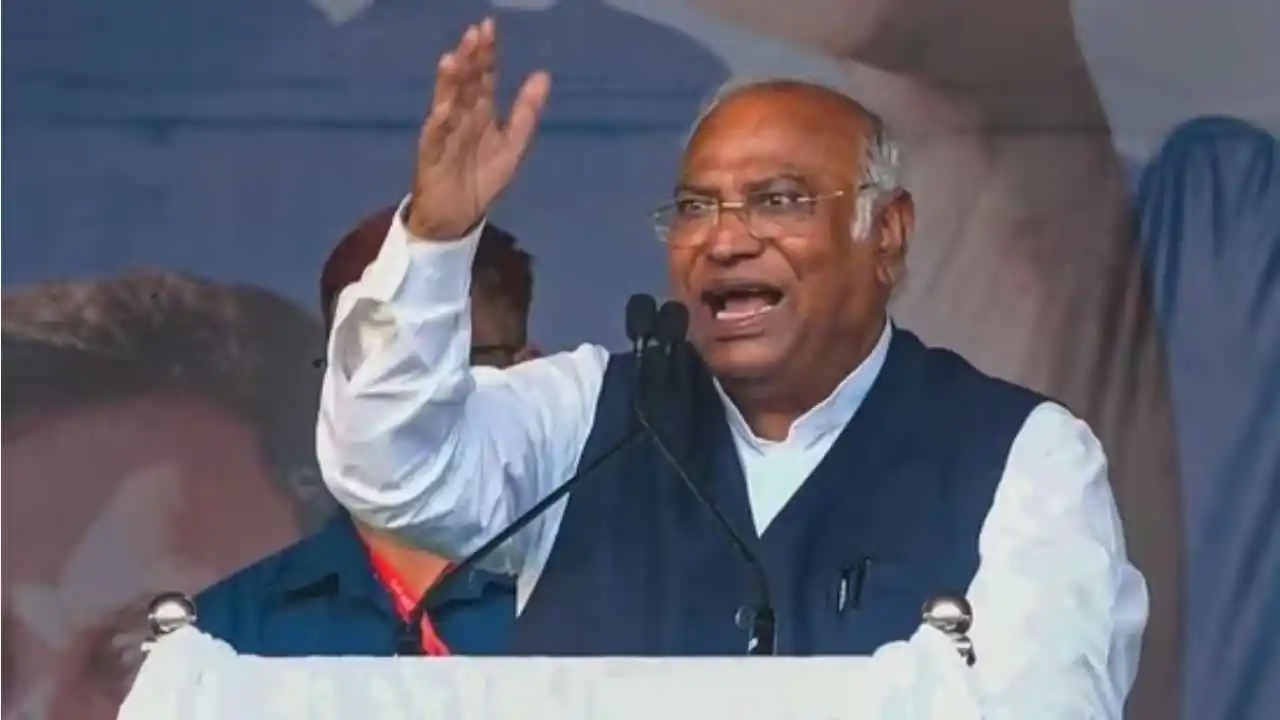
Earlier, Congress leader Mallikarjun Kharge raised the issue of the amount of time given to opposition parties in parliament, saying it was not possible to hold a debate “within one minute”.
Brief background
There have been 26 no-confidence motions in the Lok Sabha in the past. Twenty-five of them were unsuccessful, and one did not reach the voting stage because Morarji Desai resigned as prime minister.
The National Democratic Alliance has 312 members in the 533-member house. The majority mark is 267, as 11 seats are vacant. Besides, with the Shiv Sena and the BJD skipping the session, the number of MPs in the house has reduced to 497 — 534 – (18 19). The ruling dispensation requires 249 votes to win the vote of no-trust.
Though the numbers are stacked against the opposition, the Congress and other parties have indicated that they are keen to utilise the debate to bring up a range of issues including farm distress, slow economic growth and rising incidents of lynching.
Before the discussion, Union minister Ananth Kumar had said that the NDA would prove its majority in the parliament and said the opposition would see the strength of “NDA plus” during the no-trust motion.
Congress leader Anand Sharma at a press conference last evening said the no-confidence motion against the government serves as an opportunity for the Opposition to raise key issues that the country is facing. “We wanted to do it last time also that is where you discuss and debate these issues. That is where we expose the Government,” Sharma said.
BJP leaders had said that ahead of the assembly polls in four states due later this year and the 2019 Lok Sabha elections, BJP leaders see the debate as an opportunity to reach out to the masses with “successes” of the government and also to attack the “opportunist alliance” of opposition parties.
NDA leaders who will speak are Prime Minister Narendra Modi, Rajnath Singh, Arjun Ram Meghwal, Madhya Pradesh BJP leader Rakesh Singh and Kisan Morcha chief Virendra Singh, Meenakshi Lekhi, Akali Dal’s Harsimrat Kaur and LJP’s Ram Vilas Paswan are some of the leaders who will speak during the debate on no-confidence.
For the Congress party, its president Rahul Gandhi and party whip leader Jyotiraditya Scindia lead the charge in Lok Sabha. The BJP, though, has taken on Rahul Gandhi reminding him of his earlier remarks that there would be an earthquake if he spoke in the House. “Yes, there will be an earthquake, but in the Congress party and in the Opposition alliance that they are trying to stitch together,” Parilamentary Affairs Minister Ananth Kumar said, speaking to reporters before entering the House.[/vc_column_text][/vc_column][/vc_row][vc_row][vc_column][vc_column_text css=”.vc_custom_1532085395125{border-top-width: 10px !important;border-right-width: 10px !important;border-bottom-width: 10px !important;border-left-width: 10px !important;padding-top: 10px !important;padding-right: 10px !important;padding-bottom: 10px !important;padding-left: 10px !important;background-color: #d1d1d1 !important;border-radius: 10px !important;}”]How the House stands today: The ruling NDA alliance has 315 MPs — the BJP has 274 including Speaker Sumitra Mahajan, the Shiv Sena has 18, the Lok Janshakti Party has 6, the Shiromani Akali Dal has 4, RLSP has 3, and other small parties total to 10 seats in Lok Sabha.
The UPA has 63 MPs in Lok Sabha. The Congress has 48, the NCP has 7, RJD 4, IUML 2 and JMM 2 totalling 63.
Regional parties: AIADMK has 37 MPs in the House, the Trinamool Congress has 34, the BJD has 19, the TDP has 16 MPs, the TRS has 11, CMP has 9, Samajwadi Party has 7, AAP has four, YSR Congress Party has 4, AIUDF has 3 and 12 other MPs from smaller parties taking the total to 156.[/vc_column_text][/vc_column][/vc_row]