English हिन्दी
Connect with us

Latest business news

India to have policy to promote electric vehicles soon, says PM Modi

Published

on

India to have policy to promote electric vehicles soon, says PM Modi

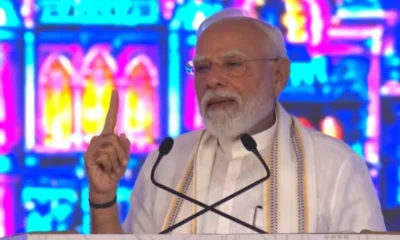
The government will soon issue a policy on electric vehicles and those based on alternative fuels, announced Prime Minister Narendra Modi on Friday, September 7.

He was speaking during the first edition of MOVE: Global Mobility Summit, a two-day event organised by Niti Aayog on developing transportation based on clean energy.

Modi promised global technology and automobile companies a stable policy regime to make India a pioneer in electric mobility.“We will soon put in place a stable policy on electric vehicles and other alternative vehicles… we will do whatever it takes because it is our commitment to heritage and our future generations,” Modi said in his 30-minute speech on the first day of the event.

The government currently doesn’t have a separate policy on electric vehicles, according to a report in Moneycontrol.com. The department of heavy industries has, since 2015, had a framework called FAME, which stands for Faster Adoption and Manufacturing of Electric Vehicles, that provides subsidy to electric car manufacturers.

The second phase of FAME is expected any time now. According to sources, the finance ministry has approved Rs 5,500 crore for the second phase, of which Rs 4,500 crore will be to provide subsidy to all electric vehicles.

The prime minister said mobility is the next frontier in the world’s fight against climate change as it accounts for one-fifth of the world’s carbon emission. He said India is best placed to be an early mover in adoption of transportation solutions based on clean energy.

“India has inherent strength and comparative advantage. We have fewer vehicles per capita than other economies. We do not carry the legacy of other economies which were built on private car ownership,” he said.

Modi said that India will do whatever it takes to usher in electric mobility in a big way as it holds immense promise for economic growth and ease of living.

“We want to drive investments across the value chain from batteries to smart charging to electric vehicle manufacturing. We will soon put in place a stable policy framework for electric and alternate fuel powered vehicles. Policies will be designed as a win-win for all and will enable huge opportunities in the automotive sector,” Modi told industry leaders.

The aim is to have a policy to have a comprehensive set up for a robust and affordable electric mobility ecosystem comprising production facilities and a widespread network of charging points. This would help achieve three key strategic goals – cuttingdown carbon emissions, creating new job opportunities and reducing use of crude oil, about 80% of the requirement of which is met through imports.

Earlier in the day, Narendra Modi met executives from electric vehicle manufacturers, battery makers and technology at an exhibition of their new offerings in the capital.

India aspires to have all new vehicles sold from 2030 to be electric. Many businesses, including state-owned fuel retailer Indian Oil Corp and power producer NTPC Ltd, have ventured into setting up charging stations to tap opportunities arising from a transition to electric mobility. One key challenge to realising the goal of electric mobility is the high cost of batteries which policymakers hope will come down with new technology and economies of scale.

Modi told industry executives that India has doubled the pace of building highways and is connecting more towns with new air routes besides promoting fuel efficiency. “Let us create a template for the world to adopt,” Modi said.

The summit has over 1,200 delegates from the world over with several promoters, chief executive officers and other senior officials of multinationals and Indian corporates attending the grand event.

Mahindra & Mahindra Chairman Anand Mahindra, Suzuki Motor Corporation Chairman Osamu Suzuki, Kalyani Group promoter and Bharat Forge Chairman and Managing Director Baba Kalyani, Toyota Chairman Takeshi Uchiyamada, Tata Motors CEO Guenter Butschek and Ola promoter Bhavish Aggarwal were in the audience as Modi spoke.

Anand Mahindra, chairman of the Mahindra group, who spoke on the occasion, said mobile applications that offer shared and connected multimodal transport options between long distances will change the way people live.

India News

Modi says right time to invest in Indian shipping sector; meets global CEOs

Published

on

Prime Minister Narendra Modi on Wednesday exhorted global investors to take bets on the Indian shipping sector, pointing out that this is the “right time” for such a move.

The Prime Minister also met a select chief executives of global majors, including DP World and APM, at a specially convened meeting on the sidelines of the India Maritime Week 2025 held here.

“For all of you hailing from different countries, this is the right time to work in the Indian shipping sector and also expand (your presence),” Modi said during a public address before the closed-door meeting with CEOs.

Modi listed several targets being chased by India in the maritime sector over the next few years, and underlined the importance of the global community in the same.

“You all are an important partner who will help us achieve all our aims. We welcome your ideas, innovations and investments,” Modi said.

He said that India allows 100 per cent foreign direct investment in the shipping and ports sector, and also provides incentives under the “Make In India, and Make For The World” vision.

Addressing an audience, including leaders of various companies, the Prime Minister affirmed India’s commitment to strengthening the supply chain resilience at a global level.

He also said that India is engaged in creating world-class mega ports, and cited the work undertaken on the Vadhavan Port to the north of the financial capital, which entered the top-10 firms in the world on the first day.

The government is also looking to grow the capacity at 12 major ports by four times and increase India’s share in containerised cargo at the global level.

Later, Modi held a meeting with top CEOs of shipping sector companies from across the world.

As per people in the know, he met AP Moller-Maersk Chairman Robert Maersk Uggla, DP World Group Chairman Sultan Ahmed bin Sulayem, Mediterranean Shipping Company Chief Executive Soren Toft, Adani Ports and SEZ Managing Director Karan Adani and French company CMA-CGM’s Senior Vice President Ludovic Renou.

The participation from over 85 countries in the IMW sends a strong message, Modi said, noting the presence of CEOs of major shipping giants, startups, policymakers, and innovators at the event.

The Prime Minister also thanked Port of Singapore (PSA) for the nearly Rs 8,000 crore investment in the Jawaharlal Nehru Port Authority’s fourth terminal, pointing out that this is also the largest FDI in the port sector in India.

Modi said more than 150 new initiatives have been launched under the ‘Maritime India Vision’, resulting in nearly doubling the capacity of major ports, a substantial reduction in turnaround time, and a new momentum in cruise tourism.

—PTI

Continue Reading

Economy news

ITR filing last date today: What taxpayers must know about penalties and delays

The deadline for ITR filing ends today, September 15. Missing it may lead to penalties, interest charges, refund delays, and loss of tax benefits.

Published

on

Income Tax Return

The deadline to file Income Tax Returns (ITR) for most taxpayers, including salaried individuals, pensioners, and small businesses not requiring audit, ends today, September 15. Those who miss the due date face penalties, interest charges, and loss of certain tax benefits.

Penalties for late filing

If the return is not filed by the deadline, taxpayers can still file a belated return until December 31. However, under Section 234F of the Income Tax Act, late filing attracts penalties.

  • For income up to Rs5 lakh: penalty is capped at Rs1,000.
  • For income above Rs5 lakh: penalty increases to Rs5,000.

Additionally, if any tax remains unpaid, Section 234A imposes an interest of 1% per month (or part thereof) until the return is filed.

Consequences of missing deadline

  • Loss of certain tax benefits: Belated filers cannot carry forward specific losses such as business or capital losses.
  • Restrictions on tax regime change: Taxpayers lose the option to switch between old and new tax regimes after the deadline.
  • Refund delays: Those eligible for refunds will face delays compared to timely filers.

Steps to file before time runs out

  • Gather documents: Form 16, Form 26AS, Annual Information Statement (AIS), bank interest certificates, and proofs of investments or deductions.
  • Use the e-filing portal: File immediately to avoid last-minute portal congestion.
  • Verify your return: Ensure the ITR is verified electronically or physically for it to be considered valid.

Continue Reading

Economy news

India’s GDP surges 7.8% in Q1, outpaces estimates and China

India’s GDP surged 7.8% in Q1 2025-26, the highest in five quarters, driven by strong services and agriculture sector growth, according to NSO data.

Published

on

GDP Growth

India’s economy recorded a sharp growth of 7.8% in the April-June quarter (Q1) of 2025-26, surpassing the earlier estimate of 6.5% and outpacing China’s 5.2% growth in the same period. The figure also marks a notable rise from the 6.5% growth in the corresponding quarter last year, making it the fastest expansion in the last five quarters.

Strong performance across key sectors

According to data released by the National Statistical Office (NSO), the surge was driven primarily by the services sector, which expanded 9.3% compared to 6.8% a year ago, and the agriculture sector, which rose 3.7% against 1.5% last year.

The construction sector, however, witnessed a slowdown, growing 7.6% compared to 10.1% in the same quarter of the previous fiscal.

RBI’s earlier forecast

Earlier this month, the Reserve Bank of India (RBI) had projected a more modest Q1 growth of 6.5%, with overall real GDP growth for 2025-26 expected at 6.5%. RBI Governor Sanjay Malhotra attributed the positive outlook to favorable conditions, including a good monsoon, lower inflation, and strong government capital expenditure.

He said, “The above normal southwest monsoon, lower inflation, rising capacity utilisation and congenial financial conditions continue to support domestic economic activity. The supportive monetary, regulatory and fiscal policies, including robust government capital expenditure, should also boost demand. The services sector is expected to remain buoyant, with sustained growth in construction and trade in the coming months.”

India remains fastest-growing major economy

With China reporting 5.2% growth in April-June, India has retained its position as the world’s fastest-growing major economy. The latest figures highlight resilience in the face of external pressures, including recent US tariffs on Indian imports.

Continue Reading

Trending

© Copyright 2022 APNLIVE.com