English हिन्दी
Connect with us

India News

Gujarat to seek large share of Narmada river as 45 year allocation period ends in December

Officials have pointed out a significant imbalance in water utilization between the two states, with Gujarat having fully utilized its allocated quota.

Published

on

Gujarat is set to request an extension of its current allocation of Narmada River waters from Madhya Pradesh as the 45-year agreement period draws to a close on December 12. Officials have pointed out a significant imbalance in water utilization between the two states, with Gujarat having fully utilized its allocated quota.
Madhya Pradesh has consistently used less than half of its share, with an original allotment of 9 Million Acre Feet (MAF). Gujarat is now searching for an additional 8 and 9 MAF to meet escalating demands for agriculture and industry.

In contrast, Madhya Pradesh, initially allocated 18.25 MAF, has been utilizing approximately 10 MAF each year, raising concerns about inefficient water management practices. Controlled by the Narmada Control Authority (NCA) since its establishment in 1980, water allocations are determined based on factors such as catchment area and regional water scarcity.

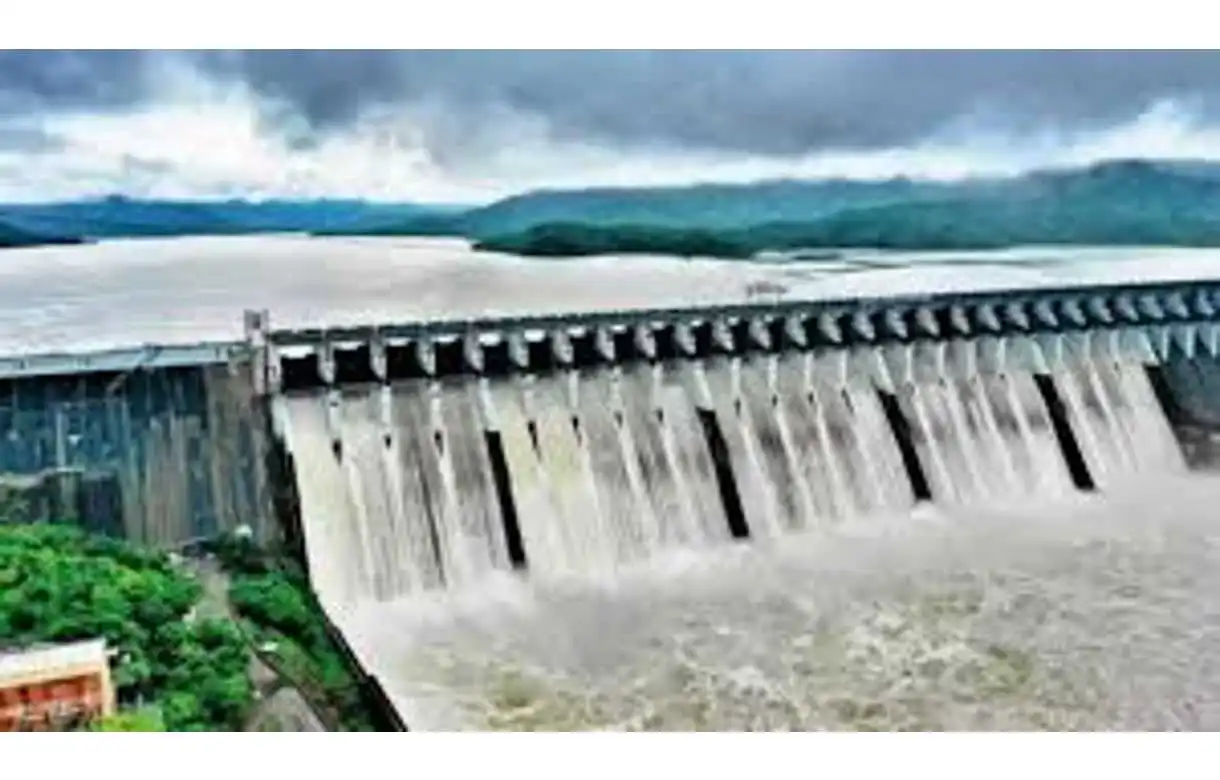
Gujarat heavily relies on the Sardar Sarovar Dam, a crucial component of its water management infrastructure. The upcoming tribunal negotiations will play a pivotal role in redistributing water shares among Gujarat, Madhya Pradesh, Rajasthan, and Maharashtra, influencing agricultural and industrial activities across these states.

In the context of escalating water demands and disparities in utilization, Gujarat’s efforts to secure a larger water allocation are of paramount importance. The NCA’s role in ensuring fair distribution amidst evolving demands and environmental challenges cannot be overstated.

The results of these negotiations are likely to reshape the socio-economic dynamics of the region for generations to come, impacting livelihoods, economic growth, and ecological sustainability across the Narmada basin. The challenge lies not only in meeting current water requirements but also in anticipating future needs and mitigating the effects of climate change and variability.

Gujarat’s stance reflects its proactive approach to safeguarding its developmental interests while balancing the concerns of neighboring states, underscoring the complex interplay of water rights, governance, and sustainable resource management in a multi-state river basin context.

India News

Asish Banerjee found dead in Rampurhat, Mamata Banerjee aide’s death shocks TMC

Former West Bengal deputy speaker and five-time Rampurhat MLA Asish Banerjee was found dead at a Trinamool Congress office in Birbhum.

Published

on

Mamata Banerjee

Former West Bengal Assembly deputy speaker and Trinamool Congress leader Asish Banerjee was found dead at a party office next to his residence in Rampurhat, Birbhum district, on Sunday morning.

Police said his body was found hanging and was sent for postmortem. A large crowd gathered outside the Trinamool Congress office after news of his death spread.

Who was Asish Banerjee?

Asish Banerjee had served as the deputy speaker of the West Bengal Assembly when Trinamool Congress chief Mamata Banerjee was the state’s chief minister. He was also a five-time MLA from Rampurhat.

He had served as Bengal’s education and agriculture minister after Mamata Banerjee’s Trinamool Congress first came to power in the state.

Banerjee contested the West Bengal Assembly election earlier this year but lost the Rampurhat seat to BJP’s Dhruba Saha.

Asish Banerjee’s recent party role

Banerjee stepped down as chairman of the Trinamool Congress’s Birbhum district core committee in June. At the time, he said he would continue as a general member of the party.

He lived in the Hattalapara neighbourhood of Rampurhat, with the party office where his body was found located next to his house.

BJP gains in Birbhum

The BJP won six of the 11 Assembly constituencies in Birbhum in the latest state election. This marked a significant change from 2021, when the Trinamool Congress had won 10 seats in the district while the BJP had secured one.

Police have sent Asish Banerjee’s body for postmortem as the circumstances surrounding his death are being investigated.

Continue Reading

India News

IPS Officer Nupur Prasad gets Medal for Meritorious Service after Sushant Singh Rajput probe

IPS officer Nupur Prasad, who led the CBI investigation into Sushant Singh Rajput’s death, has been selected for the Medal for Meritorious Service this year.

Published

on

IPS officer Nupur Prasad, who led the CBI investigation into actor Sushant Singh Rajput’s death, has been recognised with the Medal for Meritorious Service (MSM) this year.

A 2007-batch AGMUT cadre officer, Ms Prasad recently returned to the Delhi Police after completing her tenure with the CBI. She is currently serving as Joint Commissioner of Police in the Economic Offences Wing (EOW), where she oversees investigations involving financial and economic crimes.

The award is part of this year’s recognition for police personnel for distinguished and meritorious service. Such honours recognise contributions in areas including investigation, crime prevention, public service, law and order and administration.

Nupur Prasad’s role in Sushant Singh Rajput case

Ms Prasad came into national focus during the CBI investigation into the death of Sushant Singh Rajput, who was found dead at his Mumbai residence on June 14, 2020.

The case was transferred to the CBI in August 2020 following a complaint by the actor’s family and a legal dispute over jurisdiction.

During her tenure with the agency, Ms Prasad supervised key aspects of the investigation, including the examination of witness statements, forensic evidence and medical records.

In 2025, the CBI filed closure reports, saying its investigation found no evidence of foul play, abetment to suicide or criminal conspiracy in the actor’s death.

Career across Delhi Police, CBI

Ms Prasad has served in several positions during her career, including assignments in the Delhi Police, CBI, Arunachal Pradesh and West Bengal.

Before joining the CBI, she held senior positions in the Delhi Police and became the first Deputy Commissioner of Police (DCP) of Shahdara. During her tenure, she worked on establishing the district’s policing framework following its creation.

She also led operations targeting drug networks and illegal gambling activities while focusing on crime-prevention measures.

Later, as DCP of North Delhi, she oversaw security arrangements for major events, including Independence Day celebrations at the Red Fort and Delhi University elections.

Community-focused policing initiatives

Beyond investigations, Ms Prasad has been associated with community-focused programmes involving women’s self-defence, youth development, cyber safety and drug de-addiction.

During her CBI tenure, she was also associated with several prominent investigations. Media reports have linked her to cases concerning businessman Vijay Mallya and the AgustaWestland helicopter deal.

Current role in Delhi Police

After completing her assignment with the CBI, Ms Prasad returned to the Delhi Police and took charge as Joint Commissioner of Police in the Economic Offences Wing.

The latest recognition adds to her career spanning investigations, policing and public service across several challenging assignments.

Continue Reading

India News

Kharge, Rahul Gandhi skip Independence Day event for 2nd straight year

Congress chief Mallikarjun Kharge and Rahul Gandhi skipped the 80th Independence Day celebrations at the Red Fort for the second consecutive year.

Published

on

Rahul Kharge

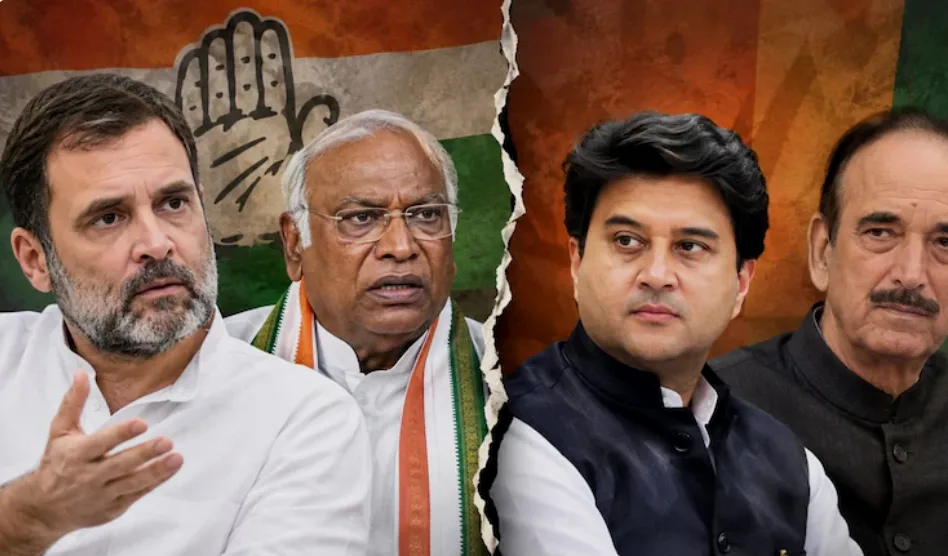
Congress president Mallikarjun Kharge and Leader of Opposition in the Lok Sabha Rahul Gandhi skipped the 80th Independence Day celebrations at Delhi’s Red Fort for the second consecutive year.

Prime Minister Narendra Modi led the Independence Day celebrations at the historic venue on Saturday.

The absence of the two senior Congress leaders comes amid strained relations between the ruling party and the Opposition, which further deteriorated during the Monsoon Session of Parliament that concluded on Thursday.

2024 seating controversy

Rahul Gandhi had attended the Independence Day celebrations in 2024 but his seating arrangement triggered a controversy. The Congress leader, who holds the status of a Cabinet minister as Leader of the Opposition in the Lok Sabha, was seated in the second-last row during the ceremony at the Red Fort.

The Opposition had criticised the seating arrangement, calling it an insult to the people. The Defence Ministry, which organised the event, said the arrangement had been modified to accommodate Olympians at the venue.

According to protocol, the Leader of the Opposition is seated in the front row during ceremonial events.

Opposition-ruling party tensions

Relations between the government and the Opposition remained tense during the Monsoon Session, which ended on Thursday.

The session saw repeated clashes between the two sides, with both the Opposition and the ruling party blaming each other for the low productivity of Parliament.

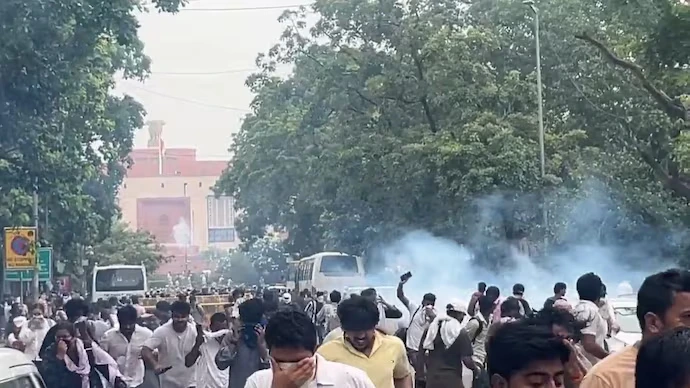
The session began on July 20, with students marching towards Parliament on the first day. Twelve bills were passed during the session, while detailed discussion took place on only one legislation, concerning paper leaks.

The Congress, along with the Trinamool Congress and Samajwadi Party, also boycotted the customary tea party hosted by Lok Sabha Speaker Om Birla after the House was adjourned sine die.

Continue Reading

Trending

© Copyright 2022 APNLIVE.com