English हिन्दी
Connect with us

India News

PM Modi in Gujarat: Vows to eliminate terror thorn amid post-Op Sindoor tensions with Pakistan

In a powerful speech from Gandhinagar, PM Modi vowed to uproot the ‘terror thorn’ from India, outlining a strong response to the Pahalgam attack and Pakistan’s terror strategy.

Published

on

PM Narendra Modi

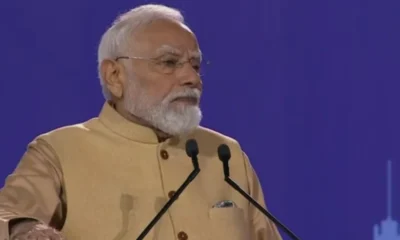
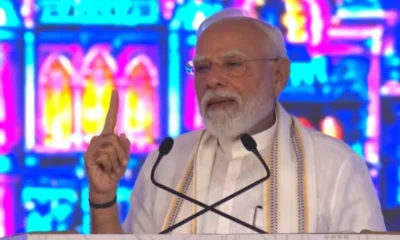
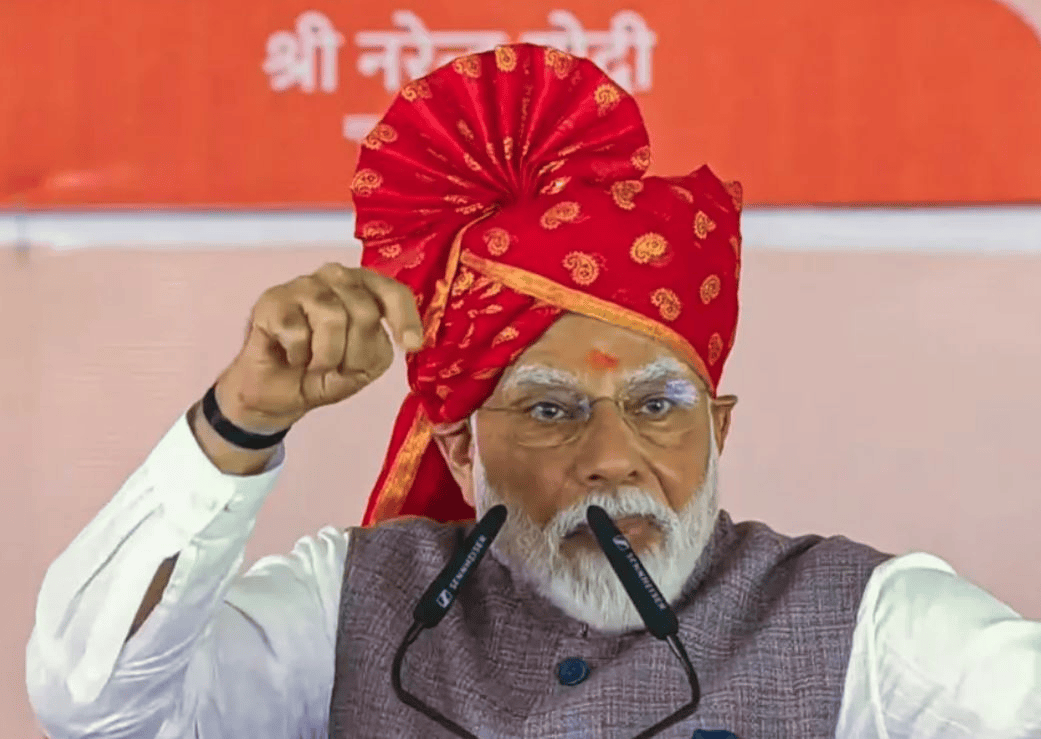
In a fiery address in Gujarat’s Gandhinagar, Prime Minister Narendra Modi declared India’s decisive shift in its fight against terrorism, targeting Pakistan for its continued cross-border support to terror outfits. Referring to Pakistan’s consistent use of terrorism as a strategic weapon, PM Modi stated, “We have decided to remove the ‘terror thorn’ from India.”

The remarks came weeks after the deadly April 22 terror attack in Pahalgam, Jammu and Kashmir, which left 26 civilians dead and intensified tensions between the two nations.

“You are waging war on us”: Modi’s direct message to Pakistan

Rejecting the notion that cross-border terrorism is a mere proxy war, Modi accused Pakistan of openly waging war against India through terrorist proxies. “Terrorism is not a ‘proxy war’… it is your strategy,” he said.

While addressing a rally packed with supporters, Modi emphasized India’s historical restraint, but warned that repeated provocation would not go unanswered. “India believes in peace but if pushed, we must remind the world that this land is also of warriors,” he stated.

Retaliation through Operation Sindoor

India’s response to the Pahalgam attack came swiftly through a tri-service precision military campaign named Operation Sindoor. Conducted on May 7, the 25-minute mission struck four terror camps in Pakistan and five in Pakistan-occupied Kashmir. This marked the first coordinated mission of its kind since the 1971 war.

Following India’s action, Pakistan retaliated with drone and missile attacks on both military and civilian targets. A military engagement ensued for 100 hours, during which India executed additional strikes targeting key Pakistani air bases and radar systems. The conflict ceased after Pakistan agreed to a ceasefire on May 12.

Nationalist sentiments and political undertones

Without directly naming the Congress, Modi criticized political opponents who, in his words, “tolerated proxy wars for 75 years.” Urging the public not to accept recurring attacks on civilians, pilgrims, and tourists, he rhetorically asked, “Should we keep tolerating this?”

The Prime Minister further invoked a wave of patriotic fervor witnessed during his visits to Vadodara, Dahod, Bhuj, and Ahmedabad, describing the crowd response as a “saffron sea” of support for national defense efforts.

Reaching out to the people of Pakistan

Modi also made an unusual appeal directly to Pakistani citizens. Questioning the gains from decades of hostility, he said, “I want to ask the people of Pakistan… what have you gained from terrorism?” Advising them to choose peace over conflict, he concluded, “‘Live a peaceful life, eat your bread… or my bullets are there.’”

India News

PM Modi assures no discrimination in women’s quota, delimitation debate intensifies in Parliament

PM Narendra Modi has assured that women’s reservation will be implemented without discrimination, amid a heated debate over delimitation in Parliament.

Published

on

PM modi

Prime Minister Narendra Modi has assured that there will be no discrimination in the implementation of women’s reservation, as Parliament witnessed a sharp debate over the proposed linkage between the quota and delimitation exercise.

During the ongoing special session, the government reiterated its commitment to ensuring fair representation while addressing concerns raised by opposition parties regarding the timing and structure of the legislation.

The proposed framework aims to reserve 33 percent of seats for women in the Lok Sabha and state assemblies. However, its implementation is tied to a fresh delimitation exercise, which is expected after the next census.

Opposition questions timing and intent

Opposition leaders have raised concerns that linking the women’s quota to delimitation could delay its implementation. They argue that the process of redrawing constituencies may push the actual rollout further into the future.

The issue has triggered a broader political confrontation, with multiple parties questioning whether the move could alter representation across states.

Some critics have also alleged that the delimitation exercise could disproportionately benefit certain regions based on population, a charge the government has rejected.

Government reiterates commitment to fair implementation

Responding to these concerns, the Centre has maintained that the reforms are necessary to ensure accurate and updated representation based on population data.

Leaders from the ruling side have repeatedly emphasized that the process will be carried out transparently and without bias. The assurance that there will be “no discrimination” is aimed at addressing fears among states and opposition parties.

The debate marks a key moment in Parliament, with both sides engaging in intense exchanges over one of the most significant electoral reforms in recent years.

Continue Reading

India News

Give all tickets to Muslim women, Amit Shah says, attacking Akhilesh Yadav on sub-quota demand

A sharp exchange between Amit Shah and Akhilesh Yadav in Parliament over sub-quota for Muslim women highlights key divisions on women’s reservation implementation.

Published

on

A heated exchange broke out in Parliament during discussions on the women’s reservation framework, with Union Home Minister Amit Shah and Samajwadi Party chief Akhilesh Yadav locking horns over the demand for a sub-quota for Muslim women.

The debate unfolded as the government pushed forward key legislative measures to implement 33% reservation for women in the Lok Sabha and state assemblies.

Akhilesh Yadav argued that the proposed reservation must ensure representation for women from marginalised communities, including Other Backward Classes (OBCs) and Muslim women. He said that without such provisions, large sections could remain excluded from political participation.

He also questioned the timing of the bill, alleging that the Centre was avoiding a caste census. According to him, a census would lead to renewed demands for caste-based reservations, which the government is reluctant to address.

Government rejects religion-based quota

Responding to the demand, Amit Shah made it clear that reservation based on religion is not permitted under the Constitution.

He stated that any proposal to provide quota to Muslims on religious grounds would be unconstitutional, firmly rejecting the idea of a separate sub-quota for Muslim women within the broader reservation framework.

The government has maintained that the existing framework already includes provisions for Scheduled Castes (SC) and Scheduled Tribes (ST) women within the overall reservation structure.

Wider political divide over implementation

The issue of sub-categorisation within the women’s quota has emerged as a major flashpoint, even as most opposition parties broadly support the idea of women’s reservation.

Samajwadi Party leaders reiterated that their support for the bill depends on inclusion of OBC and minority women, while the government continues to defend its constitutional position.

The debate is part of a broader discussion during the special Parliament session, where multiple bills linked to delimitation and implementation of the women’s quota are being taken up.

Continue Reading

India News

No state will lose a seat, Centre assures as delimitation debate takes centre stage in Parliament

Parliament’s special session begins with key focus on implementing women’s reservation and delimitation, setting the stage for major electoral changes.

Published

on

Parliament

A special session of Parliament commenced on Thursday, with the Centre set to take up crucial legislation related to women’s reservation and delimitation of constituencies. The session, scheduled over three days, is expected to witness intense debate as the government pushes forward its legislative agenda.

At the centre of discussions is the proposal to operationalise the women’s reservation law, which seeks to allocate 33 percent of seats in the Lok Sabha and state assemblies to women. The law, passed earlier, requires enabling provisions before it can be implemented.

The rollout of the reservation is closely tied to the delimitation exercise — a process that redraws parliamentary constituencies based on updated population data. The implementation is expected only after the next census and delimitation process are completed.

The government is aiming to put in place the framework so that the reservation can be enforced in future elections, likely around 2029.

Delimitation and numbers at play

Delimitation is a key aspect of the proposed changes, as it will determine how seats are redistributed and which constituencies are reserved. The exercise is expected to reflect population shifts and may also involve an increase in the total number of Lok Sabha seats.

This linkage has made the issue politically sensitive, with several opposition parties backing women’s reservation in principle but raising concerns over how and when delimitation will be carried out.

Political reactions and expected debate

The session is likely to see sharp exchanges between the government and opposition. While there is broad agreement on increasing women’s representation, disagreements remain over the timing, process, and potential political implications of the delimitation exercise.

Some leaders have argued that delimitation could significantly alter the balance of representation among states, making it a contentious issue beyond the women’s quota itself.

The government, however, has framed the move as a step toward strengthening women’s participation in governance and ensuring more inclusive policymaking.

Continue Reading

Trending

© Copyright 2022 APNLIVE.com