English हिन्दी
Connect with us

Latest world news

American Senator tells India, China to stop buying Russian oil or else…

Published

on

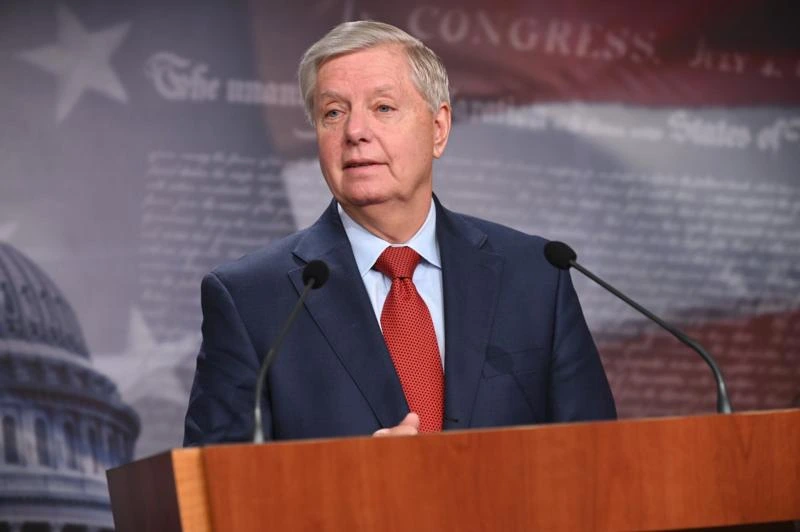
US Senator Lindsey Graham has issued an ultimatum to Russia’s trading partners, including India and China, that US President Donald Trump will impose a steep tariff on them if they don’t stop buying Russian oil. Trump is said to be planning on imposing a 100 per cent tariff on oil imports.

Senator Graham sharply criticized India, China, and Brazil for continuing the purchase of Russian oil, accusing them of indirectly funding the war in Ukraine. He previously introduced legislation proposing a 500 per cent tariff on imports from nations that maintain trade ties with Russia, including India and China.

In a recent Fox News interview, Graham said Trump is planning to target countries purchasing Russian oil and slamming them with harsh tariffs.

Graham said if the three countries, China, India, and Brazil, continue to buy discounted oil from Russia to drive its war in Ukraine, the United States will impose such severe penalties that it will cripple the three economies.

On Vladimir Putin, Graham said his dynamic with the United States has shifted, warning that any attempt to manipulate Trump would backfire and result in severe economic consequences for Russia.

He also accused Putin of pursuing imperial ambitions by attempting to reclaim territories of the erstwhile Soviet Union. Highlighting the betrayal of past agreements, Graham recalled how Ukraine surrendered 1700-warhead nuclear arsenal in the 1990s with a promise for assurances of sovereignty and how Russia violated the promise.

NATO Secretary General Mark Rutte has spoke of India, Brazil and China for their use of Russian oil and threatened them with secondary sanctions. He told the three countries to convince Putin to join peace talks, or be prepared for consequences.

In response to NATO, India’s external affairs ministry said they are monitoring the situation. It emphasized that meeting the country’s energy demands remains a top priority and that they are particularly cautious of any double standards on the matter.

Continue Reading

Latest world news

Jamaat, BNP supporters clash in Dhaka as Bangladesh votes in 13th parliamentary polls

Clashes erupted in Dhaka’s Mirpur as Bangladesh voted in its 13th parliamentary elections, marking the first polls after Sheikh Hasina’s ouster.

Published

on

bangladesh protest

Clashes broke out between supporters of Jamaat-e-Islami and the Bangladesh Nationalist Party (BNP) in Dhaka’s Mirpur-10 constituency as Bangladesh voted in its 13th parliamentary elections on Thursday.

Jamaat-e-Islami chief Shafiqur Rahman is contesting from the Mirpur-10 seat. Polling is being conducted for 299 seats in the Jatiya Sangsad, Bangladesh’s parliament.

Voting details and electoral process

Voting began at 7.30 am local time (7 am IST) under the first-past-the-post system. Results are expected to start coming in by evening.

Out of the 300 parliamentary constituencies, polling in Sherpur-3 has been cancelled following the death of a candidate. A total of 12.77 crore registered voters are eligible to cast their ballots. The majority mark in the 299-seat contest stands at 150.

In addition to these seats, 50 positions in the Jatiya Sangsad are reserved for women. These members are elected by Members of Parliament through proportional representation using the single transferable vote system.

First polls after Hasina’s ouster

This election marks the first parliamentary contest since former prime minister and Awami League chief Sheikh Hasina was removed from office following massive student protests in August 2024. Her long-time political rival, BNP leader Khaleda Zia, passed away in December the following year.

Hasina and Zia alternated in power from 1991 until Hasina returned to office in 2009. She remained prime minister for over 15 years and 200 days and had won the 2024 elections before being deposed months later.

For the first time in decades, voters are participating in national elections without either of the two dominant political figures shaping the contest.

Changing political landscape

With the Awami League excluded from participating due to its crackdown during the student protests, the political space has shifted significantly.

Tarique Rahman, son of Khaleda Zia, returned to Bangladesh in December after nearly 17 years in exile. The 60-year-old has emerged as a frontrunner for the prime minister’s post, drawing on the support base of the BNP and his late mother.

Jamaat-e-Islami, once allied with the BNP, is now leading its own coalition. It has secured backing from the National Citizen Party, a student and Gen-Z platform that emerged from the anti-Hasina protests.

Referendum on July National Charter

Alongside the general election, voters are also participating in a referendum on the July National Charter. The charter has been agreed upon by the Muhammad Yunus-led interim government and several political parties.

Key proposals in the charter include limiting prime ministers to two terms or 10 years, creating an upper House of parliament, and restoring the caretaker government system to oversee elections for 90 days to ensure free and fair polls.

Regional implications

The outcome of the election is expected to influence regional dynamics involving India, China and Pakistan.

Bangladesh had been seen as closer to India during Sheikh Hasina’s tenure. However, there has been a shift towards Beijing and Islamabad in recent times. Relations between India and Bangladesh have reportedly been tense under the Yunus-led interim arrangement.

Among the two principal contenders, the BNP is considered relatively more inclined towards New Delhi than Jamaat-e-Islami.

India is also monitoring the situation amid reports of attacks on minorities and killings of Hindus following Hasina’s ouster. Authorities have expressed concerns about potential violence on polling day.

Continue Reading

Latest world news

Donald Trump calls India trade deal historic, highlights rise in US coal exports

Donald Trump describes the India trade deal as historic and links it to rising US coal exports, while India reiterates national interest in energy decisions.

Published

on

Donald Trump

US President Donald Trump has described the recent trade agreement with India as “historic”, saying it has contributed to a sharp rise in American coal exports.

Speaking at the Champion of Coal Event on Wednesday, Trump said the United States has strengthened its position as the world’s leading energy producer and is rapidly expanding its footprint as an energy exporter.

He said that trade deals signed in recent months with countries including Japan, South Korea and India have helped increase coal exports from the US.

“America is now the number one energy producer in the world. We’re becoming a massive energy exporter. In just the past few months, we’ve made historic trade deals with Japan, Korea, India, and others to increase our coal exports dramatically. The quality of our coal is supposed to be the finest anywhere in the world,” Trump said.

He also asserted that American coal is considered among the best globally in terms of quality.

India says national interest will guide energy choices

Meanwhile, on February 9, Foreign Secretary Vikram Misri said that India’s energy-related decisions will continue to be guided by national interest.

During a special briefing by the Ministry of External Affairs (MEA), Misri underlined that India’s energy policy is driven by adequate availability, fair pricing and reliable supply. His remarks came amid reports suggesting that India may be reducing its oil imports from Russia.

Clarifying how energy sourcing decisions are made, Misri said procurement is handled by oil companies based on prevailing market conditions. These companies assess availability, risks, pricing and logistical considerations while following internal accountability and fiduciary processes.

“As far as the actual sourcing of energy is concerned, this is undertaken by oil companies, which make decisions based on market conditions. They assess availability, evaluate risks, analyse costs, and follow their internal accountability processes and fiduciary responsibilities. At any given time, there is a complex matrix of considerations, including financial and logistical aspects, that these companies must take into account,” he said.

He added that both government and business decisions in the energy sector would continue to prioritise national interest.

Misri also noted that India remains a net importer of oil and gas and, as a developing economy, must remain mindful of resource availability and the inflationary impact of import dependence.

Continue Reading

India News

Piyush Goyal lauds USA’s fabulous effort against India in T20 World Cup

Piyush Goyal praised the US cricket team’s performance against India in the T20 World Cup, calling it fabulous despite the defeat and making a light-hearted remark on tariffs.

Published

on

Piyush goel

Union Commerce and Industry Minister Piyush Goyal on Monday praised the United States cricket team for their performance against India in the ongoing T20 World Cup, saying the side played “fabulously” despite losing the match.

Goyal made the remarks while responding to light-hearted comments by US Ambassador Sergio Gor at a reception hosted by the diplomat. Both were present at the India-USA T20 World Cup match played on Saturday.

Speaking at the event, the minister acknowledged the rapid progress made by the US cricket team in recent years. He also joked that trade policy might have changed the match’s outcome.

“The US may not have won the match, but for a country which has not known cricket and has started playing only a few years ago, the performance was fabulous,” Goyal said.

Referring to Ambassador Gor’s comments, he added humorously that if the US had made reciprocal tariffs zero, “you would possibly have won the match”.

India seal first win of the tournament

India registered their first victory of the tournament with a 29-run win over the USA. After being asked to bat first, India posted 161 for nine in their allotted 20 overs.

Suryakumar Yadav anchored the innings with an unbeaten 84 off 49 balls, hitting 10 fours and four sixes. Ishan Kishan contributed 20 off 16 deliveries, while Tilak Varma added 25 off 16 balls.

For the USA, Shadley van Schalkwyk returned figures of 4 for 29, while Harmeet Singh picked up two wickets for 26 runs.

USA fall short in chase

Chasing 162, the USA were restricted to 132 for eight, falling short by 29 runs.

Milind Kumar scored 34 off 34 balls, while Sanjay Krishnamurthi (37 off 31) and Shubham Ranjane (37 off 22) provided resistance in the middle order.

India’s bowlers shared the spoils, with Mohammed Siraj taking three wickets for 29 runs. Axar Patel and Arshdeep Singh chipped in with two wickets each.

Continue Reading

Trending

© Copyright 2022 APNLIVE.com