English हिन्दी
Connect with us

India News

Nearly twice as many women removed from Bihar electoral rolls compared to men

Bihar’s final electoral roll reveals 38 lakh deletions, with women voters disproportionately affected. This gender gap could sway the closely contested 2025 assembly polls.

Published

on

Nearly twice as many women removed from Bihar electoral rolls compared to men

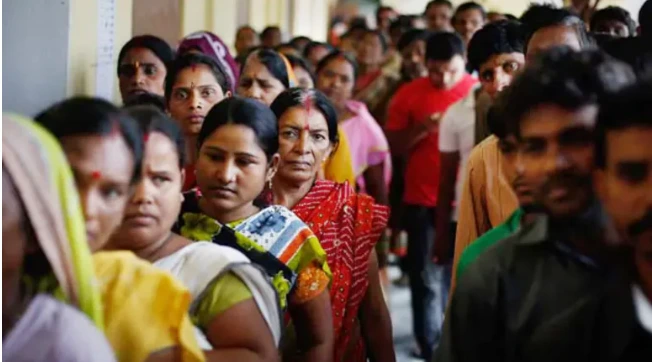
The Election Commission of India (ECI) has released the final electoral rolls for Bihar ahead of the upcoming assembly elections, showing a steep drop in voter numbers, with women voters disproportionately affected.

Women face sharper deletions than men

According to the ECI, the total electorate in Bihar has declined by nearly 38 lakh, falling from 7.8 crore on January 1, 2025, to 7.4 crore in the final list. Male voters saw a reduction of 15.5 lakh (3.8%), while women voters faced a sharper decline of 22.7 lakh (6.1%).

The gender gap in deletions is politically significant, as women voters are a decisive factor for both major alliances in the state.

District-wise impact

The biggest fall in women voters was in Gopalganj, where 15.1% (1.5 lakh) were removed, followed by Madhubani with 1.3 lakh deletions, and Purvi Champaran with 1.1 lakh. Saran and Bhagalpur also recorded large-scale deletions of around 1 lakh women voters each.

Interestingly, these five districts share borders with either Uttar Pradesh, Nepal, or Jharkhand.

Male voters, too, saw sizeable reductions, though not as sharp as women. Madhubani lost 95,000 male voters, Patna 90,000, Saran 86,000, Purvi Champaran 85,000, and Gopalganj 80,000.

Electoral consequences

Most deletions—both male and female—were concentrated in six districts: Gopalganj, Madhubani, Purvi Champaran, Saran, Bhagalpur, and Patna. Together, these areas hold 59 assembly seats.

In 2020, the National Democratic Alliance (NDA) won 34 of these seats, while the Mahagathbandhan (MGB) secured 25. The overall contest was extremely close, with the NDA edging past the MGB by just 11,150 votes statewide.

With the voter rolls showing a larger dip among women, analysts suggest that the deletions could play a crucial role in determining the outcome of the 2025 assembly polls.

India News

Sanchar Saathi not mandatory, clarifies Jyotiraditya Scindia amid privacy outrage

Communications Minister Jyotiraditya Scindia has clarified that the Sanchar Saathi app is not mandatory on new phones and can be deleted, countering Opposition claims of surveillance.

Published

on

Jyotiraditya Scindia

Amid the growing political storm over the Centre’s directive asking mobile phone makers to pre-install the Sanchar Saathi app on all new devices, Communications Minister Jyotiraditya Scindia has clarified that the app is not mandatory and users are free to delete it if they choose.

Minister says app is optional, aims to protect users

Responding to concerns flagged by the Opposition over alleged surveillance risks, Scindia said users will have full control over the app. He compared it to other pre-installed apps that users can choose to keep or remove.

“Don’t activate it. If you want to keep it in your phone, keep it. If you want to delete it, do so,” he said, adding that the app will remain dormant if not used.

The minister emphasised that Sanchar Saathi is designed to safeguard citizens against cyber fraud. “This is a matter of customer protection. There is nothing mandatory. If you do not want to register it, don’t. And if you want to delete it, delete it,” he said, noting that many people are unaware such a tool exists.

Opposition flags privacy concerns, calls move “surveillance”

Congress leaders have accused the government of enabling intrusive monitoring.

  • KC Venugopal said the decision was “beyond unconstitutional”, citing the fundamental right to privacy.
  • Priyanka Gandhi Vadra called Sanchar Saathi a “snooping app”, saying citizens’ privacy was under threat.
  • Priyanka Chaturvedi termed it “another surveillance moment”.
  • Karti Chidambaram alleged the move mirrored actions in authoritarian regimes.

Government rejects criticism, cites rising cyber fraud

Countering Opposition remarks, Scindia said the government was attempting to clear misconceptions. He stated that cyber fraud worth ₹22,800 crore took place in 2024, and Sanchar Saathi was developed to help citizens report fraud, track lost phones, and prevent misuse of telecom resources.

“When we are giving Sanchar Saathi to the common citizen, they are saying it is Pegasus. We cannot show truth to those who don’t want to see it,” Scindia said.

Continue Reading

India News

Delhi-Saharanpur-Dehradun expressway opens for trial run, full launch approaching

A 32 km completed section of the Delhi-Saharanpur-Dehradun Expressway has opened for trial runs, marking a significant step toward its full-scale launch.

Published

on

The Delhi-Saharanpur-Dehradun Expressway, a major high-speed corridor connecting the national capital with western Uttar Pradesh and Uttarakhand, has taken a significant step toward full-scale operations with one of its completed stretches now open for trial use. The move signals that the long-awaited expressway is inching closer to public inauguration.

32-km section prepared for inauguration

Authorities are gearing up to unveil a 32 km-long completed segment between late December and early January. Although the official launch date is yet to be announced, several parts of the project—particularly near Geeta Colony, Seelampur and Shahdara—have already been opened for traffic as part of trial operations. Barriers have been removed in multiple areas of Delhi’s Northeast district, hinting at an imminent larger rollout.

Commuters using the corridor for early access have expressed relief. One such traveller, Rohit Kumar, shared with media that the expressway would ease his frequent travel to his hometown, cutting down on his weekend transit time significantly.

Travel time to reduce drastically

Once fully operational, the 210 km expressway is expected to reduce Delhi–Dehradun travel time from over six hours to just 2–2.5 hours. The high-speed access-controlled route promises much faster connectivity for daily commuters, tourism traffic and commercial transport moving between Delhi, UP and Uttarakhand.

Engineers are currently giving final finishing touches to the six-lane stretch, with provisions built in for expansion to eight lanes in the future. The project includes multiple interchanges, service lanes, underpasses and overbridges to deliver a seamless driving experience along NH 709B.

Route and construction status

Starting near Delhi’s Akshardham Metro Station, the corridor links to the Delhi-Meerut Expressway before continuing through Baghpat, Shamli and Saharanpur districts. It culminates in Dehradun, making it the region’s most direct high-speed connection.

Construction is divided into four phases:

  • Phase 1: Akshardham to Baghpat — ready for use
  • Phase 2: Baghpat to Saharanpur — nearing completion
  • Phase 3: Further stretches toward Uttarakhand — in final stages
  • Phase 4: Tunnels and elevated sections near Dehradun — finishing work underway

Sources indicate that the entire expressway will be open to the public by February 2026, with the government insisting that inauguration should take place only after all four phases are ready to ensure uninterrupted end-to-end travel.

Continue Reading

India News

Bhagwat says global leaders listen to PM Modi as India’s strength rises

RSS chief Mohan Bhagwat said PM Modi is heard attentively worldwide as India’s strength becomes more visible, speaking at the organisation’s centenary event in Pune.

Published

on

Mohan Bhagwat

RSS chief Mohan Bhagwat has said that Prime Minister Narendra Modi is heard with “rapt attention” across the world because India’s strength is becoming visible on the global stage. Speaking in Pune during an event marking 100 years of the Rashtriya Swayamsevak Sangh (RSS), he said the nation is increasingly securing its rightful place internationally.

Bhagwat told attendees that while the organisation has completed a century after facing several challenges, it is important to introspect on why the mission of uniting society remains incomplete. He emphasised that the Sangh has always worked with the objective of fulfilling its responsibilities within time instead of waiting for symbolic milestones.

‘India’s rise contributes to global peace’

The RSS chief noted that history shows global conflicts reduce when India progresses, adding that the current global situation makes this even more necessary.

According to him, Sangh volunteers have consistently worked to fulfil the mission envisioned by founder Dr Keshav Baliram Hedgewar, who established the organisation in 1925 in Nagpur. Bhagwat recalled the sacrifices of early volunteers who continued their efforts despite uncertainty and adversity.

‘We did not arrive late, you started listening late’

Sharing an anecdote, Bhagwat said someone once remarked that the Sangh arrived “30 years late”. He responded that it was not the Sangh but the people who “started listening late”.

Reiterating the RSS’ philosophy, Bhagwat said the organisation believes in dialogue, collective work and unity rooted in diversity. He asserted that India’s philosophical traditions emerge from a common source, making harmony essential for collective progress.

Continue Reading

Trending

© Copyright 2022 APNLIVE.com