English हिन्दी
Connect with us

Latest world news

Trump administration plans fresh H-1B visa restrictions after massive $100,000 fee hike

The Trump administration is set to impose fresh H-1B visa restrictions beyond the recent $100,000 fee hike, potentially affecting thousands of Indian IT professionals and students.

Published

on

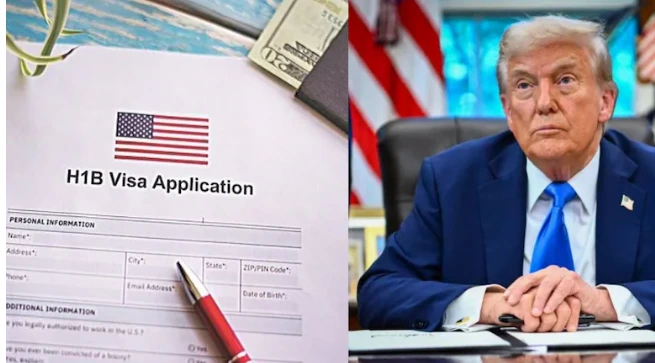
In a move that could significantly reshape the US work visa landscape, the Donald Trump administration is planning additional restrictions on the H-1B visa programme — beyond the recently announced $100,000 mandatory fee. The move is part of Washington’s wider agenda to overhaul immigration rules for high-skilled foreign professionals.

According to a new proposal listed in the Federal Register under “Reforming the H-1B Nonimmigrant Visa Classification Program”, the Department of Homeland Security (DHS) intends to revise eligibility criteria, increase scrutiny of employers violating programme norms, and tighten oversight on third-party placements.

While the specifics remain under discussion, it is unclear whether the administration will narrow exemptions for nonprofit research organisations, universities, and healthcare institutions — all of which currently benefit from being exempt from the annual cap.

“These changes are intended to improve the integrity of the H-1B nonimmigrant program and better protect US workers’ wages and working conditions,” the proposal stated. The revised rules are expected to be published by December 2025, according to the DHS regulatory notice.

Impact On Indian Tech Professionals

The reforms could have a far-reaching impact on thousands of Indian students and skilled workers who depend on the H-1B visa to gain employment in the US. Nearly 75% of all H-1B approvals in 2023 were granted to Indian nationals, according to data by the Pew Research Centre.

Reports also suggest the Trump administration may revive its plan to replace the current lottery-based system with a wage-based selection model — prioritising applicants with higher salaries.

Why H-1B Visas Matter

Created under the 1990 Immigration Act, the H-1B visa allows American employers to hire highly skilled foreign professionals in fields where US talent is scarce. It remains one of the few practical pathways for foreign nationals — especially Indians — to work in the US before obtaining permanent residency.

The US caps annual H-1B issuances at 65,000, with an additional 20,000 reserved for candidates holding a US master’s degree or higher. Certain employers, such as nonprofits and universities, remain exempt from these limits.

A Pew Research Centre analysis found that about 60% of approved H-1B visas since 2012 were for computer-related occupations. However, the programme also benefits sectors such as education, finance, and healthcare.

Research further shows that H-1B visa holders are typically paid on par or higher than their American counterparts, as employers are legally required to pay the prevailing wage in addition to substantial visa fees — often exceeding $6,000.

Latest world news

Bangladesh rocked by violent protests after student leader Sharif Osman Hadi’s death, anti-India slogans raised

Bangladesh has witnessed widespread violence and protests following the death of student leader Sharif Osman Hadi, with arson, anti-India slogans and a nationwide security clampdown.

Published

on

Bangladesh

Violent protests erupted across Bangladesh after the death of student leader and political figure Sharif Osman Hadi, triggering fresh instability in the country and a sharp rise in anti-India sentiment. The situation turned volatile in Dhaka and several other cities as thousands of demonstrators poured onto the streets demanding swift action against those responsible for his killing.

Hadi, 32, was shot in the head by masked assailants while launching his election campaign in Dhaka last Friday. He was later airlifted to Singapore for treatment, where he succumbed to his injuries. Known for his polarising views and strong anti-India rhetoric, Hadi had emerged as a prominent face during the 2024 student uprising that led to the ouster of former prime minister Sheikh Hasina.

Fires, arson and tense streets in Dhaka

Soon after news of Hadi’s death broke, protests intensified in the Bangladeshi capital. Several buildings, including those housing leading media organisations, were set on fire, with authorities confirming that staff members were trapped inside during the blaze. Fire services later said the situation was brought under control, while security forces were deployed in large numbers to prevent further violence.

Demonstrators were seen chanting slogans invoking Hadi’s name, vowing to continue protests until those behind the attack were arrested. Multiple areas in Dhaka remained tense late into the night as police and paramilitary units attempted to restore order.

Protests spread, Indian mission targeted in Chittagong

Violence was not limited to the capital. In the port city of Chittagong, protesters gathered outside the Indian Assistant High Commission, raising anti-India slogans amid heightened anger on the streets. Similar unrest was reported from other parts of the country, signalling the widening scale of the crisis.

In Rajshahi, demonstrators torched Bangabandhu Sheikh Mujibur Rahman’s residence and an Awami League office, causing extensive damage. Authorities have not yet released a detailed assessment of losses, but security has been tightened across sensitive locations.

Anti-India sentiment deepens diplomatic strain

The latest unrest comes amid deteriorating ties between India and Bangladesh following Sheikh Hasina’s flight to Delhi. Earlier in the week, protesters under the banner of “July Oikya” marched towards the Indian High Commission in Dhaka, demanding Hasina’s return and raising hostile slogans against India.

India has formally conveyed its concerns to Dhaka over threats to its diplomatic missions and inflammatory statements by Bangladeshi political figures. New Delhi has rejected allegations linking India to the attack on Hadi, calling such claims false and misleading.

Yunus calls for calm, state mourning announced

In a televised address, interim chief Muhammad Yunus described Hadi’s death as an “irreparable loss” to Bangladesh’s political and democratic space. He urged citizens to exercise restraint, warning that continued violence could derail the country’s path towards a credible election.

The interim administration has announced a day of state mourning in Hadi’s honour, with national flags to fly at half-mast and special prayers planned nationwide. Bangladesh has been under an interim government led by Yunus since August 2024, with national elections scheduled for February 12.

India issues advisory for its nationals

Amid the unrest, the Indian High Commission in Dhaka issued an advisory asking Indian nationals in Bangladesh to avoid non-essential travel and limit movement outside their residences. Emergency contact details of Indian missions have been shared for assistance.

Manhunt launched for attackers

Bangladesh police have launched a manhunt for those behind Hadi’s killing, releasing photographs of two suspects and announcing a reward of five million taka for information leading to their arrest. Yunus has described the attack as a premeditated attempt by a powerful network to sabotage the electoral process.

Continue Reading

Latest world news

India closes two more visa centres in Bangladesh amid worsening security concerns

India has temporarily closed visa application centres in Rajshahi and Khulna, citing security concerns following protests near Indian establishments in Bangladesh.

Published

on

India closes two more visa centres in Bangladesh amid worsening security concerns

India has shut two additional Indian Visa Application Centres (IVACs) in Bangladesh — in Rajshahi and Khulna — citing the prevailing security situation in the country. The move comes a day after protests were held near the Indian High Commission in Dhaka by radical groups, raising concerns over safety around Indian establishments.

An official notification issued on the IVAC website said the centres in Rajshahi and Khulna were closed on December 18 due to security reasons. Applicants who had appointments scheduled for the day have been assured fresh slots at a later date.

The decision follows the temporary shutdown of the visa application centre in Dhaka earlier, even as New Delhi flagged a rise in open hostility towards India, particularly targeting the northeastern region, under the interim government led by Muhammad Yunus.

Bangladesh rejects India’s security assessment

Bangladesh’s Foreign Affairs Advisor Touhid Hossain dismissed India’s concerns and denied any deterioration in law and order. He distanced the interim administration from recent inflammatory remarks made by National Citizen Party (NCP) leader Hasnat Abdullah, who had publicly threatened to cut off India’s “seven sisters” and also issued comments against the Indian High Commissioner.

Hossain said the individual was not part of the government and termed his statements irrelevant. He also claimed that security arrangements were in place and that the shutdown of the Dhaka visa centre coincided with a local programme, which raised security-related questions.

Political backdrop and India’s response

The NCP, which emerged from student-led protests that led to the fall of the previous Awami League government, has extended support to the Yunus-led interim setup. Though the party has limited political presence, radical elements associated with it have organised anti-India demonstrations in Dhaka.

India, in an earlier statement, urged the interim government to ensure internal law and order and hold peaceful elections so that Bangladesh can return to an elected administration. However, the interim government appeared dismissive of this advice, with Hossain stating that India need not advise Dhaka on conducting elections.

Observers in Bangladesh have pointed out that delays in elections could benefit the unelected interim government, while radical groups may attempt to create disruptions by projecting India as a hostile actor. New Delhi has so far maintained a measured stance, despite remarks that directly question India’s sovereignty and territorial integrity, particularly in the northeastern region.

Continue Reading

Latest world news

PM Modi receives Ethiopia’s highest civilian honour, first world leader to get award

PM Modi has become the first global leader to be awarded Ethiopia’s highest civilian honour for strengthening bilateral ties and global leadership.

Published

on

PM modi Ethiopias highest civillian award

Prime Minister Narendra Modi on Tuesday was conferred with ‘The Great Honour Nishan of Ethiopia’, the highest national award of the African nation, becoming the first head of government or state globally to receive the honour.

The award was presented during a special ceremony held at the Addis International Convention Centre, where Ethiopian Prime Minister Abiy Ahmed Ali honoured Modi for his role in strengthening bilateral relations between India and Ethiopia and for his leadership on global issues.

Recognition of India-Ethiopia partnership

According to an official statement, the honour recognises Prime Minister Modi’s contribution to deepening the long-standing partnership between the two countries and his engagement with issues concerning the Global South. The conferment is being seen as a milestone in India-Ethiopia relations and reflects the growing diplomatic and development cooperation between the two nations.

Prime Minister Modi acknowledged the award and dedicated it to the people of India. In a post on X, he said he was honoured to receive Ethiopia’s highest recognition and attributed it to the collective strength and aspirations of 140 crore Indians.

‘Accepted with humility and gratitude’

Speaking at the ceremony, Prime Minister Modi said it was a privilege to accept the honour from one of the world’s most ancient civilisations. He expressed humility and gratitude while thanking Prime Minister Abiy Ahmed and the people of Ethiopia for the recognition.

He also praised the Ethiopian Prime Minister’s leadership and initiatives aimed at promoting national unity, sustainability and inclusive development. Highlighting the role of knowledge and education in nation-building, Modi noted that Indian teachers have been contributing to Ethiopia’s progress for more than a century.

The Prime Minister dedicated the award to both Indians and Ethiopians who have nurtured bilateral ties over generations and conveyed appreciation on behalf of India’s population for the honour bestowed upon him.

Continue Reading

Trending

© Copyright 2022 APNLIVE.com