English हिन्दी
Connect with us

Latest world news

India rejects Dutch PM’s remarks on press freedom, minority rights during Modi visit

India strongly rejected remarks linked to press freedom and minority rights made during PM Narendra Modi’s Netherlands visit, calling them based on a lack of understanding of India’s democracy.

Published

on

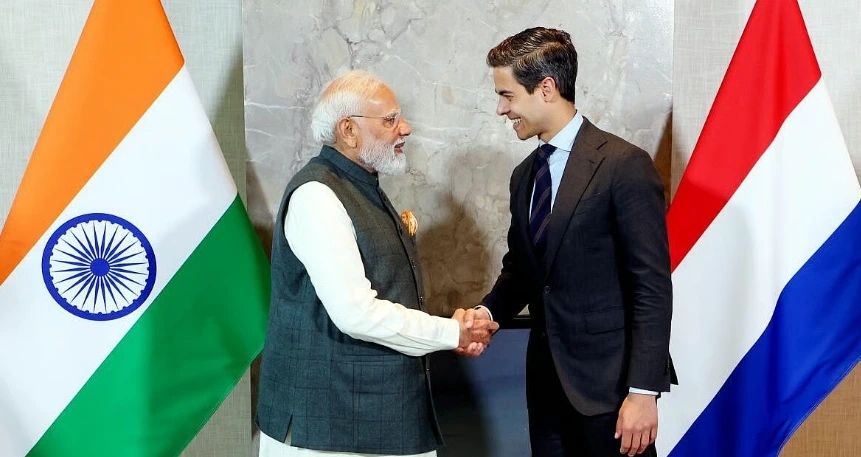
Prime Minister Narendra Modi’s visit to the Netherlands witnessed a diplomatic exchange after reported remarks by Dutch Prime Minister Rob Jetten on press freedom and minority rights in India drew a sharp response from New Delhi.

India rejected the comments, with Ministry of External Affairs Secretary (West) Sibi George saying the concerns reflected a “lack of understanding” about India’s democratic system and social structure.

Addressing the issue during a media briefing in the Netherlands, the Indian diplomat described India as a “vibrant democracy” and pointed to the country’s electoral participation and diversity as evidence of democratic strength. He noted that recent elections in India saw voter participation crossing 90 per cent in some regions.

According to reports, the Dutch Prime Minister had raised concerns linked to press freedom and the condition of minority rights in India before his meeting with PM Modi in The Hague. However, sources indicated that the matter was not formally discussed during the bilateral talks between the two leaders.

India also underlined that people from different faiths coexist peacefully in the country and highlighted the nation’s democratic institutions and constitutional protections.

The exchange came during PM Modi’s visit aimed at strengthening ties between India and the Netherlands across sectors including trade, technology, energy and strategic cooperation. The two countries also discussed expanding bilateral partnerships during high-level meetings in The Hague.

LATEST SPORTS NEWS

Spain beat Argentina after extra time to win FIFA World Cup 2026 title

Spain defeated Argentina 1-0 after extra time to win the FIFA World Cup 2026 title. Ferran Torres scored the decisive goal as Lionel Messi’s expected final World Cup appearance ended in heartbreak.

Published

on

Spain players celebrate after defeating Argentina in the FIFA World Cup 2026 final.

Spain are the new FIFA World Cup champions after defeating Argentina 1-0 following extra time in a hard-fought final, ending the defending champions’ reign and lifting the trophy for the second time.

The match remained deadlocked until Ferran Torres found the breakthrough in extra time, scoring the only goal of the contest to hand Spain football’s biggest prize.

Ferran Torres seals Spain’s historic triumph

Spain and Argentina battled through a tense final before Torres produced the decisive moment in extra time. The goal proved enough to separate the two sides as Spain secured their second FIFA World Cup title.

The victory also brought Argentina’s successful title defence to an end after a closely contested encounter.

Lionel Messi ends campaign in tears

The defeat marked an emotional conclusion for Lionel Messi, who is widely expected to have played his final FIFA World Cup match.

After receiving his runners-up medal, the Argentina captain was seen leaving the field in tears following his team’s narrow defeat.

Trophy ceremony draws mixed reaction

The medal and trophy presentation was attended by U.S. President Donald Trump and FIFA President Gianni Infantino. Leaders from fellow tournament co-hosts Canada and Mexico were also present for the final.

Trump and Infantino were booed by sections of the crowd during the trophy ceremony.

Star-studded halftime show grabs attention

Apart from the football action, the World Cup final also featured a high-profile halftime entertainment show inspired by the Super Bowl format.

The performance included Shakira, Madonna, BTS, Justin Bieber and Burna Boy, with the show curated by Coldplay frontman Chris Martin.

Continue Reading

Latest world news

US strikes Iran for seventh straight night as Tehran warns no border safe if attacks continue

The US carried out a seventh straight night of strikes on Iran as Tehran warned it could expand military operations if attacks continue, raising fears of wider regional escalation.

Published

on

Donald Trump

The United States launched military strikes on Iran for the seventh consecutive night on Friday, while Tehran warned it could significantly expand its offensive if the attacks continue for several more days.

According to the US Central Command, American forces carried out another round of strikes aimed at “continuing to degrade Iranian military capabilities.” The latest attacks come amid an escalating conflict that has seen both countries exchange drone and missile strikes across the region.

Iran warns of wider offensive

Iranian officials accused the United States of targeting civilian infrastructure, including an airport, a railway station and two bridges. Tehran also claimed it had carried out strikes against US military assets across the region.

Major General Mohsen Rezaei, a senior military adviser to Iran’s supreme leader, warned that Iran would resume “full-scale offensive operations” if US attacks continue for another two or three days.

He said Iran would no longer restrict itself to proportional retaliation and warned that “no political border will be safe” if the conflict escalates further.

US President Donald Trump had earlier warned that Iranian infrastructure could become a target, although there was no official confirmation from Washington that such infrastructure had been struck during Friday’s operations.

UN expresses concern over escalation

United Nations Secretary-General Antonio Guterres expressed deep concern over the intensifying conflict and said attacks targeting civilian infrastructure were unacceptable.

The current round of hostilities began on February 28 following US-Israeli strikes on Iran. Tehran responded by effectively closing the Strait of Hormuz, one of the world’s most important oil shipping routes, and launching attacks against Israel and US interests across the Gulf region.

Iranian Revolutionary Guards aerospace force commander Majid Mousavi said operations against US targets would continue until Washington halted military action around Iran’s southern coastal areas and the Strait of Hormuz.

Regional tensions widen

The conflict has increasingly spread across the Middle East.

Iran said it targeted US military positions in Kuwait, where authorities reported damage to a power and water facility. Kuwait’s military also said several personnel were injured in drone attacks on military bases.

Iran’s Revolutionary Guards claimed responsibility for strikes on US radar systems and military aircraft in Qatar. Qatari authorities said they successfully intercepted a missile attack.

Iran also claimed to have attacked two US radar sites in Oman and the Al-Tanf military base in Syria. However, a Syrian military source denied any attack on the base, while US officials said American troops had already withdrawn from Al-Tanf earlier this year.

Jordan’s military said it intercepted three Iranian missiles, while Bahrain reported precautionary measures after Iranian state media claimed US aircraft and helicopters stationed at an airbase there had been targeted.

Civilian impact and diplomatic efforts

The conflict has also affected civilian infrastructure and essential services.

Iran’s energy ministry urged citizens to reduce electricity consumption after it said US strikes placed pressure on the country’s energy facilities and power grid.

In Iraq’s Kurdistan region, the exiled Komala Party of Iranian Kurdistan said drone and rocket attacks killed nine of its members, blaming Iran for the strikes.

Iran’s health ministry said at least 38 people have been killed and more than 400 injured since the latest phase of fighting began.

Meanwhile, diplomatic efforts to end the conflict continued. China and Pakistan called on both Washington and Tehran to halt military operations and return to negotiations.

The wider regional crisis has also disrupted maritime security. The United Kingdom Maritime Trade Operations agency said a commercial tanker was struck by a projectile overnight off the coast of Oman as attacks on shipping in the Strait of Hormuz continued.

Continue Reading

India News

60 US Senators back bill proposing 100% tariffs on countries buying Russian oil, including India

Published

on

By

 A bipartisan group of 60 US Senators has backed a bill proposing 100 per cent tariffs on imports from countries that continue to purchase Russian oil, a move that could have significant implications for India, one of Moscow’s largest crude oil buyers since the outbreak of the Russia-Ukraine war.

The legislation, introduced by late Republican Senator Lindsey Graham and Democratic Senator Richard Blumenthal, is intended to increase economic pressure on Russia by discouraging other countries from continuing to buy its energy exports. If enacted, the bill would authorise the US President to impose steep tariffs on goods imported from nations that continue purchasing Russian crude oil and other petroleum products.

India has sharply increased its imports of discounted Russian crude since the Russia-Ukraine conflict began in February 2022. The Indian government has consistently maintained that its energy procurement decisions are based on national interest, energy security and the need to ensure affordable fuel supplies for its consumers. Officials have repeatedly stated that India will continue sourcing oil from the most economically viable markets.

The proposed legislation has not yet become law. It needs to pass both chambers of Congressthe US Senate and the House of Representativesbefore it can be presented to the US President for approval. Until then, the proposed tariffs will have no legal effect.

The development comes as the United States and its allies continue efforts to tighten economic pressure on Russia over the Ukraine conflict. If passed, the legislation could have far-reaching implications for trade relations with countries that continue importing Russian oil, including India, and may also influence global energy markets and diplomatic ties.

Neither the US administration nor the Indian government has announced any policy change following the introduction of the bill. The proposal is expected to remain under close scrutiny as it moves through the US legislative process.

Continue Reading

Trending

© Copyright 2022 APNLIVE.com