English हिन्दी
Connect with us

India News

Nepal flash floods: Glacial collapse, not earthquake, triggered disaster clarifies USGS

The USGS clarified that seismic activity initially reported as an earthquake was caused by a glacial collapse and debris flow that triggered deadly flash floods in Nepal.

Published

on

The tremors associated with the deadly flash floods in Nepal on Wednesday morning were caused by a powerful landslide involving ice and rock, rather than an earthquake, the United States Geological Survey (USGS) clarified.

The agency said the seismic activity initially reported as an earthquake “was instead a glacial collapse and debris flow” that caused catastrophic impacts downstream.

The USGS had initially reported seismic activity along the Nepal-China border, north of Kathmandu. It later clarified that the event was not an earthquake.

“No earthquake had occurred,” the agency said.

Landslide triggered debris-laden flood

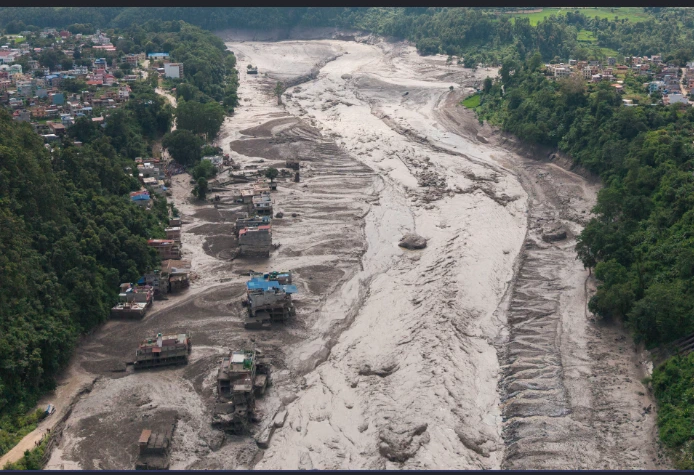
An initial study of satellite imagery from Planet Labs indicated that a landslide involving ice and rock triggered a debris-laden flood in the Lhende River.

The landslide occurred about 20 km northeast of the Nepal-China Rasuwagadhi border crossing.

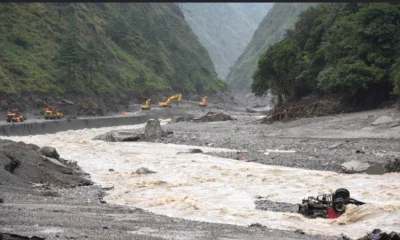
The Lhende Khola River is a tributary of the Bhote Koshi River, which flows from China into Nepal. The powerful landslide sent debris and water downstream, triggering the flash floods.

The event was later registered as seismic activity equivalent to an earthquake measuring 5.2 in magnitude.

157 bodies recovered in Nepal

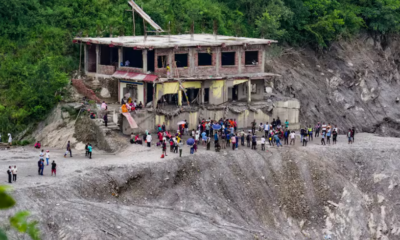
Relief and rescue operations are underway in Rasuwa and other affected areas following the floods.

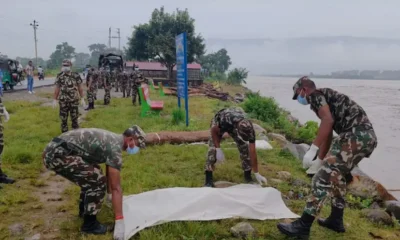
Nepal Police have recovered 157 bodies, while authorities are working to move families living in flood-risk areas to safer locations.

At least 403 tourists, including 341 foreigners, were reported unaccounted for several hours after the disaster, according to the tourism ministry.

The missing foreigners included 142 Indians, along with nationals from Australia, Britain, Malaysia, the Netherlands, Portugal, South Africa, South Korea and the United States, according to the tourism board.

Rescue teams are searching for survivors and bodies buried under mud and debris. Prime Minister Balendra Shah has pledged government resources for relief and rescue operations.

Floods hit several districts

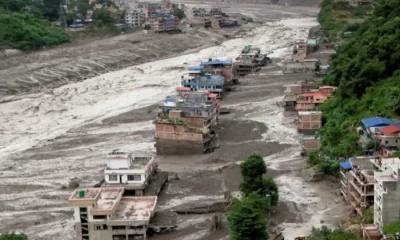
The flood surged through the Bhote Koshi River at around 9 am local time after crossing over from the Tibet side.

Rasuwa and Dhading, which border Tibet, along with Nuwakot, were among the affected districts.

In Tibet, China’s state broadcaster reported that three people were killed and 265 were missing in Gyirong. It said the deaths were still being verified and rescue operations were continuing.

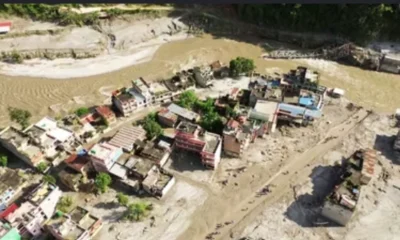
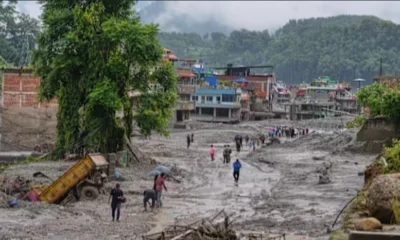
Security footage from the Nepal-Tibet border showed people fleeing moments before a torrent of rock, mud and water swept through the area, destroying buildings and vehicles.

Families search for missing relatives

Residents from affected areas of Nuwakot and Dhading gathered outside a Nepali Army training centre that was being used as a base for helicopter rescue operations.

People sought information about relatives who remained missing after the floods. Police were recording the names of missing people outside the barracks as the area remained without electricity because of damage to hydropower infrastructure.

Across the affected areas, houses, trees and vehicles were submerged or buried beneath mud and debris.

Helicopters continued rescue operations, bringing survivors out of the flood-hit areas.

India News

IMD warns of heavy rainfall in multiple states, thunderstorms likely

Several Indian states are expected to experience rain and thunderstorms, with the India Meteorological Department forecasting heavy rainfall in some regions.
Published

on

cyclone

Several parts of India are likely to experience unsettled weather, with the India Meteorological Department (IMD) forecasting rainfall, thunderstorms and strong winds across multiple regions.

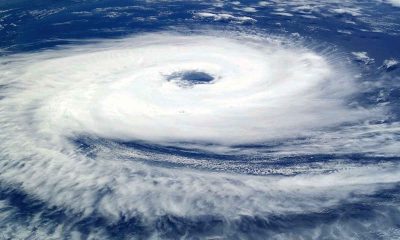
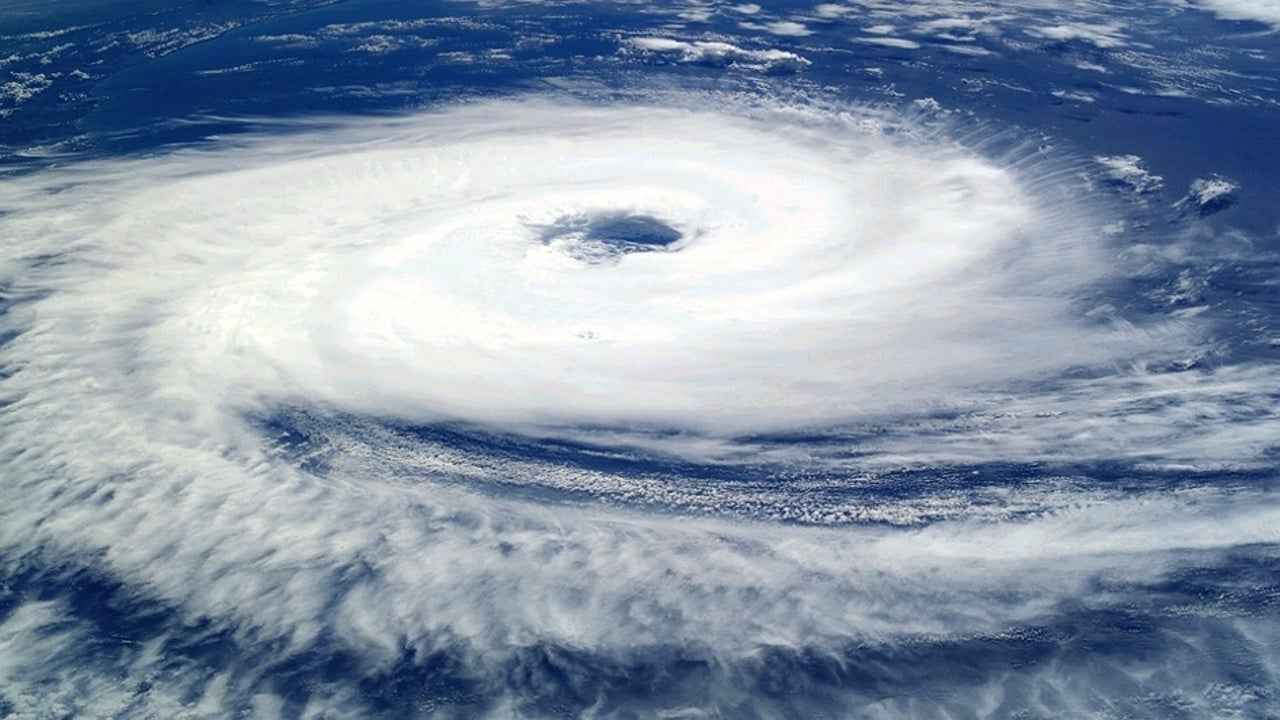
The weather outlook comes amid changing atmospheric conditions associated with Cyclone Arnab and an approaching western disturbance. These systems are expected to influence rainfall activity across parts of northern, eastern and central India.

Rain forecast for northern India

The IMD has forecast widespread rainfall over East Uttar Pradesh, Haryana, Chandigarh and Delhi on October 29 and 30.

Thunderstorms accompanied by strong winds are also likely in Delhi, Haryana, Chandigarh and Punjab. Wind speeds could reach 50-60 kmph, with gusts of up to 70 kmph, while isolated hailstorms are also possible.

Delhi is expected to experience cloudy conditions, with spells of light rain, thunderstorms and lightning. The forecast also indicates the possibility of moderate rain at isolated locations during the morning.

Eastern and central India may see heavy rain

Rainfall activity is expected across several eastern and central regions, including parts of Bihar, Jharkhand, Odisha, Chhattisgarh and Madhya Pradesh.

The IMD has forecast heavy to very heavy rainfall in parts of Chhattisgarh and East Madhya Pradesh, with isolated extremely heavy rainfall possible in Chhattisgarh. Thunderstorms and gusty winds are also expected in some areas.

Gangetic West Bengal and Jharkhand are expected to receive widespread rainfall during parts of October 28-30. Odisha is also forecast to experience rainfall, while Sub-Himalayan West Bengal and Sikkim may receive rain on October 29 and 30.

Rainfall expected in island regions

The Andaman and Nicobar Islands are forecast to receive fairly widespread to widespread rainfall between October 28 and 31. The weather department has also warned of isolated heavy rainfall in the islands during part of this period.

Residents in affected regions should follow the latest IMD forecasts and local weather advisories, particularly where thunderstorms, strong winds or heavy rainfall are expected.

Continue Reading

India News

Brij Bhushan Sharan Singh appointed to UP BJP state executive ahead of 2027 polls

Former BJP MP Brij Bhushan Sharan Singh has been named to the party’s Uttar Pradesh state executive committee ahead of the 2027 Assembly elections. The expanded panel was constituted under state BJP president Pankaj Chaudhary.
Published

on

Brij Bhushan Sharan Singh

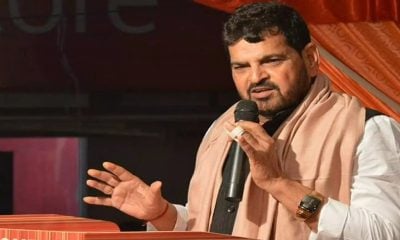
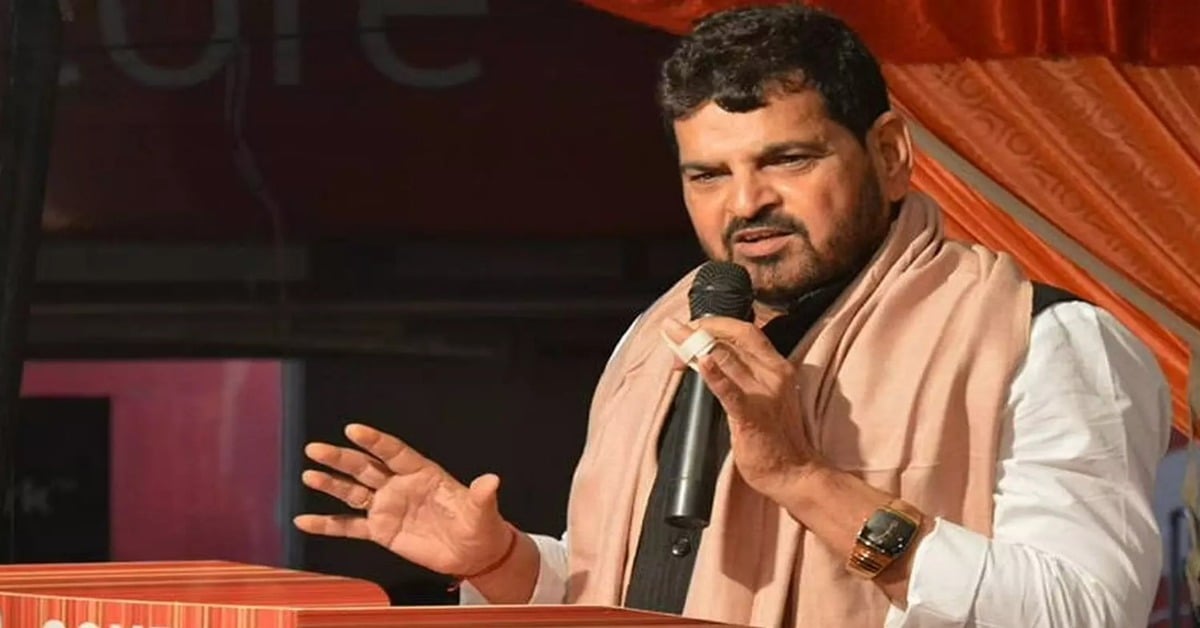
Former BJP MP Brij Bhushan Sharan Singh has been included in the Uttar Pradesh BJP’s state executive committee ahead of the 2027 Assembly elections. The appointment marks his first inclusion in the party’s state-level executive panel, according to the report.

The committee was constituted on October 26 by Uttar Pradesh BJP president Pankaj Chaudhary ahead of a meeting scheduled in Lucknow to discuss the party’s organisational work and preparations for the state elections.

Singh, a former president of the Wrestling Federation of India (WFI), had largely remained away from the BJP’s organisational activities following sexual harassment allegations made by women wrestlers. His inclusion comes nearly three months after a Delhi court acquitted him in the case, although the acquittal has since been challenged.

First inclusion in the state executive committee

Despite his long political career and influence in eastern Uttar Pradesh, Singh had not previously been given a position in the BJP’s national or state organisational structure, according to party sources cited in the report.

A BJP leader described his appointment as the first time Singh had been made a member of the state executive committee. Six other BJP leaders from Gonda district have also been included in the panel.

The expanded committee has 712 members, including 134 special invitees and 30 permanent invitees, according to the report. The previous state executive committee had 184 members.

Prime Minister Narendra Modi has been included as a permanent invitee from Varanasi. Uttar Pradesh Chief Minister Yogi Adityanath, Union Minister Hardeep Singh Puri and former BJP national president Murli Manohar Joshi are also among those included in the panel.

BJP had dropped Singh from the 2024 Lok Sabha race

The BJP did not field Singh in the 2024 Lok Sabha elections amid the sexual harassment allegations against him. Instead, the party nominated his younger son, Karan Bhushan Singh, from the Kaiserganj constituency, which Brij Bhushan had represented previously.

Karan Bhushan Singh won the seat in his first election. During the campaign, Brij Bhushan Singh confined his campaigning to Kaiserganj and urged voters to support his son, describing the outcome as a response to those he said were attempting to end his political career.

A senior BJP leader quoted in the report said the party had denied Singh a ticket in 2024 because of the allegations. The leader added that the court’s acquittal could allow him to participate more actively in party programmes.

However, any decision about a future Lok Sabha nomination would depend on the party’s leadership.

Acquittal challenged by women wrestlers

On August 3, a Delhi court acquitted Singh in the sexual harassment case involving six women wrestlers. The allegations had triggered widespread protests by prominent wrestlers in 2023 and put the BJP under political pressure.

The acquittal has been challenged by four of the women wrestlers. According to the report, a Delhi court on October 28 gave Singh a week to respond to their appeal.

The legal challenge remains relevant to the case’s status, even as Singh’s inclusion in the state executive signals his return to the BJP’s formal organisational structure.

BJP prepares for the 2027 Uttar Pradesh elections

The state executive committee meeting in Lucknow is intended to discuss the BJP’s organisational roadmap ahead of the 2027 Uttar Pradesh Assembly elections. Union Home Minister Amit Shah is scheduled to address the opening session, while Chief Minister Yogi Adityanath is set to address the concluding session, according to the report.

The expanded panel includes leaders from across Uttar Pradesh, with Varanasi and Gorakhpur among the districts with the highest representation.

Singh’s appointment comes as the BJP prepares its organisation for the next Assembly election, while his legal case and political role remain subjects of public and political attention.

Continue Reading

India News

Chandrababu Naidu reviews cyclone damage as Andhra Pradesh estimates Rs. 4,600 Crore Loss

Andhra Pradesh has estimated preliminary damage from Cyclone Arnab at Rs. 4,600 crore. Chief Minister N Chandrababu Naidu surveyed affected areas, announced relief measures and said central teams would assess the damage on October 30.

Published

on

TDP chief Chandrababu Naidu

Andhra Pradesh Chief Minister N Chandrababu Naidu on Thursday inspected areas affected by Cyclone Arnab as the state government put the preliminary damage estimate at Rs. 4,600 crore. The figure could increase following a detailed assessment of losses caused by the cyclone and associated rainfall.

Seven people have died in cyclone-related incidents across Andhra Pradesh, according to the report. The state government is carrying out relief and restoration work in affected districts while preparing to assess the extent of damage to agriculture and infrastructure.

Naidu conducted aerial and ground surveys across Krishna, West Godavari and Dr B R Ambedkar Konaseema districts. His inspection covered flooded paddy fields, damaged banana plantations, uprooted coconut trees and affected aquaculture ponds.

The aerial survey included areas such as Nimmakuru, Pamarru, Bantumilli, Narasapuram, Palakollu, Amalapuram and Katrenikona.

At Vetlapalem, the Chief Minister met affected farmers and inspected waterlogged agricultural fields and damaged coconut trees. Farmers told him that paddy crops due for harvesting in approximately 15 days had suffered extensive damage, raising concerns about reduced yields.

Central teams to assess cyclone damage

Addressing the media at Gachakayalapora village in the Mummidivaram constituency, Naidu said the preliminary estimate of damage from Cyclone Arnab stood at Rs. 4,600 crore. He cautioned that the amount could rise once a comprehensive assessment was completed.

Central assessment teams are scheduled to visit affected areas on October 30. Naidu said he had spoken to Union Home Minister Amit Shah about the situation and submitted a preliminary damage report to the Centre.

The assessment is expected to help establish the extent of losses across affected areas as the state continues its response to the cyclone.

Compensation and relief measures announced

The state government has announced compensation for damage to agricultural and horticultural crops. The assistance will be transferred directly to farmers’ bank accounts after the damage assessment is completed.

Farmers whose coconut and oil palm trees have been damaged will receive Rs. 1,500 per tree, according to the announced measures.

People returning from relief camps will also receive 25 kg of rice, a package of essential commodities and financial assistance.

The government is working to restore electricity and telecommunications services, remove fallen trees and protect irrigation infrastructure. In Konaseema, around 8,000 electricity poles have fallen, adding to the challenges facing restoration teams.

Andhra Pradesh has sought 1,000 personnel from Telangana to speed up electricity restoration. The state may also seek additional assistance from Karnataka and Tamil Nadu.

Farmers and infrastructure among the worst affected

The Chief Minister’s inspections highlighted the impact on agricultural fields, plantations and aquaculture facilities. Waterlogging and damage to crops have created concerns for farmers, particularly those whose paddy harvests were approaching.

The government has also prioritised the restoration of essential services and the clearance of damaged infrastructure in cyclone-hit areas.

Naidu said precautionary measures had been taken based on experience from previous cyclones to reduce the loss of life and property. However, he acknowledged that seven people had died despite these efforts.

Officials have been monitoring the situation across areas extending from Srikakulam to Krishna district.

The Chief Minister assured farmers that crop losses would be assessed promptly and compensation would be released to eligible beneficiaries. He also said the Centre was extending support to Andhra Pradesh as it dealt with the cyclone’s impact and existing financial constraints.

The preliminary damage estimate remains subject to revision as assessment teams examine the affected areas.

Continue Reading

Trending

© Copyright 2022 APNLIVE.com