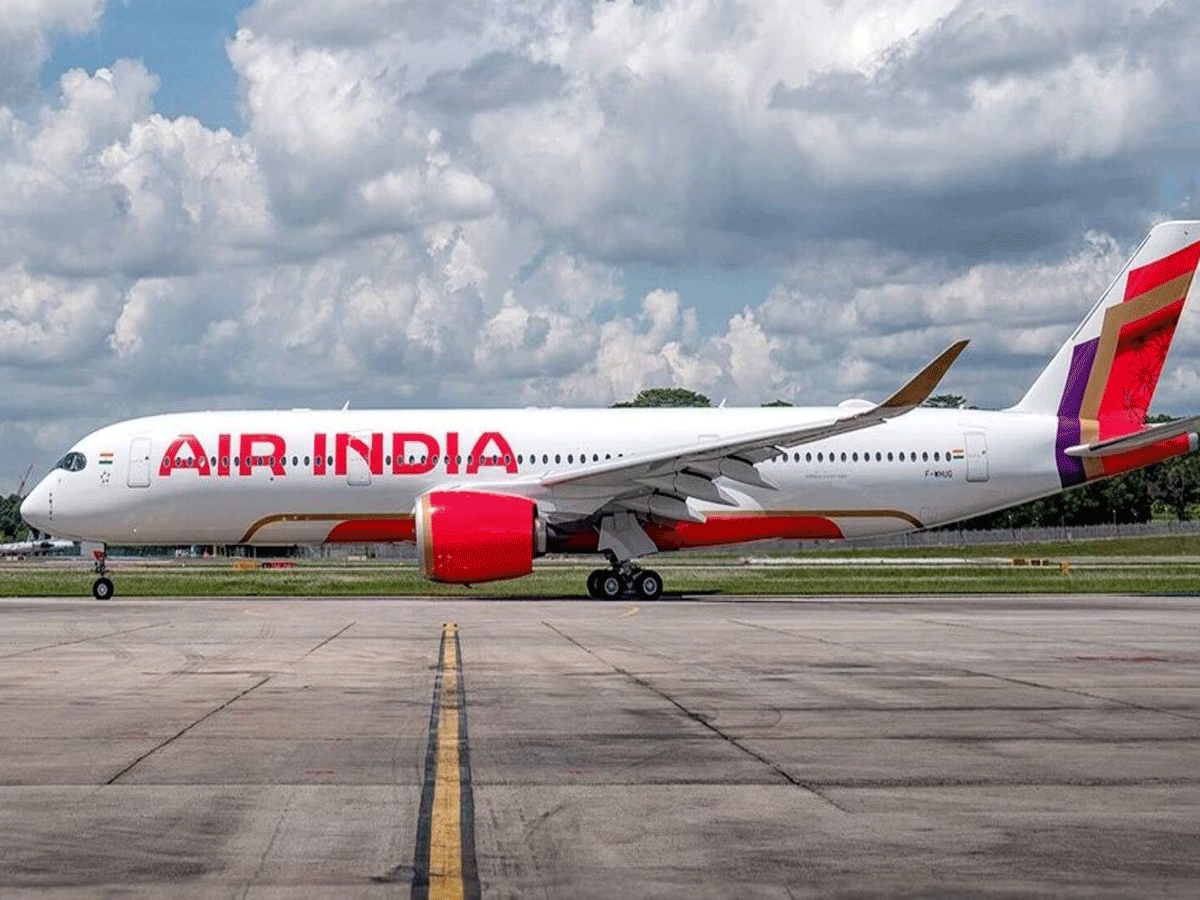
Three Italian nationals travelled from Delhi to Munich without completing mandatory immigration clearance, prompting the Ministry of Civil Aviation to issue a show-cause notice to Air India.
The incident took place in the early hours of September 4. The three passengers had arrived in Delhi from Amritsar on Air India flight AI-1115 at around 12:50 am before boarding Lufthansa flight LH-763 to Munich at approximately 1:45 am.
The ministry has sought an explanation from Air India and given the airline seven days from receipt of the notice to respond.
How the passengers bypassed immigration
The three passengers were travelling under Air India’s hub-and-spoke arrangement, in which travellers from smaller airports connect to international destinations through a major hub.
They travelled from Amritsar to Delhi and were issued domestic, or “D”, boarding passes for their Air India flight. They were also issued boarding passes for their onward Lufthansa flight to Munich at Amritsar.
According to the ministry’s notice, Air India’s standard operating procedure provides for two categories of boarding passes — “D” for domestic passengers and “I” for international passengers. The ministry has questioned the issuance of the additional boarding passes in this case.
After arriving in Delhi, the passengers were taken from Gate 39 towards the International-to-International Transfer Area. They then reached the departure area and boarded the Lufthansa flight without passing through the immigration checkpoint.
Ministry flags five SOP provisions
The Ministry of Civil Aviation has flagged five provisions of Air India’s Domestic-International Operations SOP in connection with the incident.
These include rules concerning the categories of boarding passes, segregation of domestic and international passengers after disembarkation, and access to the International-to-International Transfer Desk.
The ministry has also raised questions over Air India’s requirement to maintain a nodal officer and monitoring team at hub and spoke airports around the clock. These mechanisms are intended to ensure that passengers do not enter the international departure process through an incorrect route without completing the required formalities.
The ministry said the monitoring mechanism failed in this case.
Ministry seeks answers from Air India
The show-cause notice asks Air India to explain how passengers holding domestic boarding passes were able to enter the international transfer area.
It has also sought clarification on why the passengers were issued boarding passes for their onward Lufthansa flight at Amritsar and has asked about the role of Air India personnel and SATS staff involved in handling the passengers.
The ministry has further sought information about the designated nodal officer and monitoring team’s presence and actions at the time. It has questioned why the required reconciliation of domestic and international passengers was not completed promptly.
Questions have also been raised over whether the General Declaration, passenger manifest and API-PNR data concerning the passengers were shared with immigration authorities in time and whether their status was accurately reflected in those records.
Lapse detected during manual reconciliation
According to the notice, the lapse was detected later during manual reconciliation.
The incident has therefore raised questions about both the handling of the passengers and the systems intended to prevent domestic-arrival passengers from entering the international departure process without completing immigration clearance.
Air India gets seven days to respond
The Ministry of Civil Aviation has asked Air India to explain why action should not be initiated against the airline for failing to follow the prescribed SOP and take adequate precautions.
The airline has seven days from receiving the notice to submit its response.
The ministry has warned that failure to respond within the stipulated period could be treated as having no explanation to offer, after which administrative and regulatory action may be considered based on the available records.
What is the hub-and-spoke model?
Under a hub-and-spoke model, passengers from smaller airports travel through a major airport before connecting to international destinations.
In this case, the passengers travelled from Amritsar to Delhi before connecting to a Munich-bound international flight.
At the hub airport, passengers arriving on domestic flights but holding onward international bookings must be identified and routed through the prescribed process, including immigration clearance before leaving India.
In the Delhi incident, the three Italian passengers instead entered the international transfer process and boarded their Munich flight without completing the required immigration formalities.