English हिन्दी
Connect with us

India News

Amarnath Yatra suspended due to separatists’ call for shut down in Kashmir valley

Published

on

Amarnath Yatra suspended due to separatists’ call for shut down in Kashmir valley

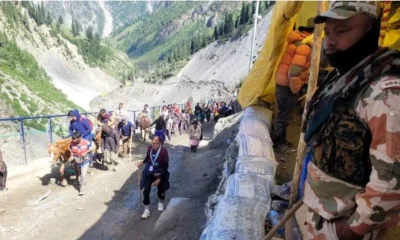
Pilgrimage to the cave shrine of Amarnath was suspended for today (Saturday, July 13)and no pilgrim allowed to move up to Valley from Jammu as a precautionary measure in view of a separatists-sponsored shut down in the Kashmir valley on Martyrs’ Day, officials said.

“Amarnath yatra has been suspended from Jammu as a precautionary measure in wake of the strike called by separatists in Kashmir valley Saturday,” said media reports quoting an official.

July 13 is observed as Martyrs’ Day in Kashmir. On this day in 1931, 22 people were killed in firing by the forces of Dogra ruler Maharaja Hari Singh.

Separatists have called for a shutdown as a mark of respect to those killed in the firing.

The state government observes the day to honour those who fought for Independence in 1947.

Former J&K CM Farooq Abdullah also reached the graveyard with his supporters and paid homage to the 1931 martyrs.

“The governor is a BJP man and won’t come here to pay the tribute,” said Farooq Abdull

Amarnath Yatra was also suspended on July 8 a precautionary measure in view of the third death anniversary of former Hizbul Mujahideen commander Burhan Wani.

Due to the strike, normal life was severely affected in the valley as shops and other business establishments remained closed, while public transport remained off roads, the officials said.

They said some private vehicles, however, were plying in intra-city and inter-district routes of Kashmir.

As many as 12 batches of pilgrims have so far left for the twin base camps of Pahalgam and Baltal in Kashmir valley from Jammu since the beginning of the pilgrimage on June 30, reported The Indian Express.  Over 1.50 lakh pilgrims have visited the cave shrine in the last 12 days of the Amarnath yatra.

Over 1.75 lakh pilgrims have so far registered themselves for the 46-day long pilgrimage, which is through the 36-km Pahalgam track in Jammu and Kashmir’s Anantnag district and the shorter 14-km Baltal route in Ganderbal district.

The pilgrimage commenced on July 1 from both Baltal and Pahalgam routes. Multitier security arrangements were made for smooth and successful conduct of the yatra that concludes on August 15.

As many as 2.85 lakh pilgrims had visited the cave last year, while the number of pilgrims was 3.52 lakh in 2015, 3,20 lakh in 2016 and 2.60 lakh in 2017.

The Cave shrine was discovered in 1850 by a Muslim Shepherd, Buta Malik.Legend says a Sufi saint rewarded the shepherd with a bag of charcoal that turned out to be gold.

Descendants of the shepherd have received a portion of the offerings from the cave shrine for over 150 years.

India News

Amit Shah counters delimitation concerns, says southern states to gain Lok Sabha seats

Amit Shah assures Parliament that southern states will gain Lok Sabha seats after delimitation, countering opposition criticism during the women’s reservation debate.

Published

on

Amit Shah

Union Home Minister Amit Shah on Thursday addressed concerns over the proposed delimitation exercise, asserting in the Lok Sabha that southern states will not lose representation but instead see an increase in their number of seats.

His remarks came during a heated debate linked to the implementation of women’s reservation, where opposition parties have raised fears that population-based delimitation could reduce the political weight of southern states.

Shah rejected these claims, calling them misleading, and said the proposed framework ensures fairness while expanding the overall strength of the Lok Sabha.

Seat count to rise with expansion of Lok Sabha

The government has indicated that the total number of Lok Sabha seats could increase significantly as part of the delimitation process. In this expanded House, the combined representation of southern states is expected to rise from 129 seats at present to around 195 seats.

Shah emphasised that no state will lose seats in absolute terms, and the exercise is designed to reflect population changes while maintaining balance across regions.

State-wise projections shared in Parliament

During his address, Shah also provided indicative figures for individual southern states, suggesting notable increases in representation. According to the projections:

  • Tamil Nadu could see its seats rise substantially
  • Kerala, Telangana, and Andhra Pradesh are also expected to gain additional seats
  • Karnataka’s representation may increase as well

These figures were presented to counter the argument that delimitation would disproportionately favour northern states.

Political debate intensifies over linkage with women’s quota

The delimitation exercise has been closely linked to the rollout of women’s reservation, which proposes one-third seats for women in Parliament and state assemblies.

Opposition leaders have questioned this linkage, arguing that tying reservation to delimitation could delay its implementation and raise federal concerns. Some leaders have also warned that the move could impact national unity if apprehensions among states are not addressed.

The government, however, maintains that the reforms are necessary to ensure equitable representation and to align the electoral system with demographic realities.

Centre dismisses ‘false narrative’ on southern states

Shah reiterated that concerns about southern states losing influence are unfounded. He said the delimitation process will increase representation across regions and described the criticism as a “false narrative” aimed at creating confusion.

The issue is expected to remain a key flashpoint as Parliament continues discussions on the women’s reservation framework and related legislative changes.

Continue Reading

India News

PM Modi assures no discrimination in women’s quota, delimitation debate intensifies in Parliament

PM Narendra Modi has assured that women’s reservation will be implemented without discrimination, amid a heated debate over delimitation in Parliament.

Published

on

PM modi

Prime Minister Narendra Modi has assured that there will be no discrimination in the implementation of women’s reservation, as Parliament witnessed a sharp debate over the proposed linkage between the quota and delimitation exercise.

During the ongoing special session, the government reiterated its commitment to ensuring fair representation while addressing concerns raised by opposition parties regarding the timing and structure of the legislation.

The proposed framework aims to reserve 33 percent of seats for women in the Lok Sabha and state assemblies. However, its implementation is tied to a fresh delimitation exercise, which is expected after the next census.

Opposition questions timing and intent

Opposition leaders have raised concerns that linking the women’s quota to delimitation could delay its implementation. They argue that the process of redrawing constituencies may push the actual rollout further into the future.

The issue has triggered a broader political confrontation, with multiple parties questioning whether the move could alter representation across states.

Some critics have also alleged that the delimitation exercise could disproportionately benefit certain regions based on population, a charge the government has rejected.

Government reiterates commitment to fair implementation

Responding to these concerns, the Centre has maintained that the reforms are necessary to ensure accurate and updated representation based on population data.

Leaders from the ruling side have repeatedly emphasized that the process will be carried out transparently and without bias. The assurance that there will be “no discrimination” is aimed at addressing fears among states and opposition parties.

The debate marks a key moment in Parliament, with both sides engaging in intense exchanges over one of the most significant electoral reforms in recent years.

Continue Reading

India News

Give all tickets to Muslim women, Amit Shah says, attacking Akhilesh Yadav on sub-quota demand

A sharp exchange between Amit Shah and Akhilesh Yadav in Parliament over sub-quota for Muslim women highlights key divisions on women’s reservation implementation.

Published

on

A heated exchange broke out in Parliament during discussions on the women’s reservation framework, with Union Home Minister Amit Shah and Samajwadi Party chief Akhilesh Yadav locking horns over the demand for a sub-quota for Muslim women.

The debate unfolded as the government pushed forward key legislative measures to implement 33% reservation for women in the Lok Sabha and state assemblies.

Akhilesh Yadav argued that the proposed reservation must ensure representation for women from marginalised communities, including Other Backward Classes (OBCs) and Muslim women. He said that without such provisions, large sections could remain excluded from political participation.

He also questioned the timing of the bill, alleging that the Centre was avoiding a caste census. According to him, a census would lead to renewed demands for caste-based reservations, which the government is reluctant to address.

Government rejects religion-based quota

Responding to the demand, Amit Shah made it clear that reservation based on religion is not permitted under the Constitution.

He stated that any proposal to provide quota to Muslims on religious grounds would be unconstitutional, firmly rejecting the idea of a separate sub-quota for Muslim women within the broader reservation framework.

The government has maintained that the existing framework already includes provisions for Scheduled Castes (SC) and Scheduled Tribes (ST) women within the overall reservation structure.

Wider political divide over implementation

The issue of sub-categorisation within the women’s quota has emerged as a major flashpoint, even as most opposition parties broadly support the idea of women’s reservation.

Samajwadi Party leaders reiterated that their support for the bill depends on inclusion of OBC and minority women, while the government continues to defend its constitutional position.

The debate is part of a broader discussion during the special Parliament session, where multiple bills linked to delimitation and implementation of the women’s quota are being taken up.

Continue Reading

Trending

© Copyright 2022 APNLIVE.com