English हिन्दी
Connect with us

Latest world news

US House of Representatives to hold impeachment inquiry against Donald Trump

Nancy Pelosi announced formal impeachment inquiry into Donald Trump on charge of seeking foreign help to smear Democratic rival Joe Biden ahead of next year’s election.

Published

on

United States of America’s House of Representatives Speaker Nancy Pelosi with Donald Trump

United States of America’s House of Representatives Speaker Nancy Pelosi on Tuesday, Sep 24, announced a formal impeachment inquiry into Donald Trump over allegations of seeking foreign help to smear Democratic rival Joe Biden ahead of next year’s election.
The move came after mounting pressure from fellow Democrats, plunging a deeply divided nation into an election year clash between Congress and the President.

Pelosi, who for months had been reluctant to embrace an impeachment effort, said, “The president must be held accountable. No one is above the law.”

In a deeply divided country, the inquiry means there would be highly partisan fight in Congress and a polarised presidential campaign in coming months.

House Speaker Nancy Pelosi announced the inquiry after a closed-door meeting with Democratic lawmakers, saying Donald Trump’s actions undermined national security and violated the US Constitution.

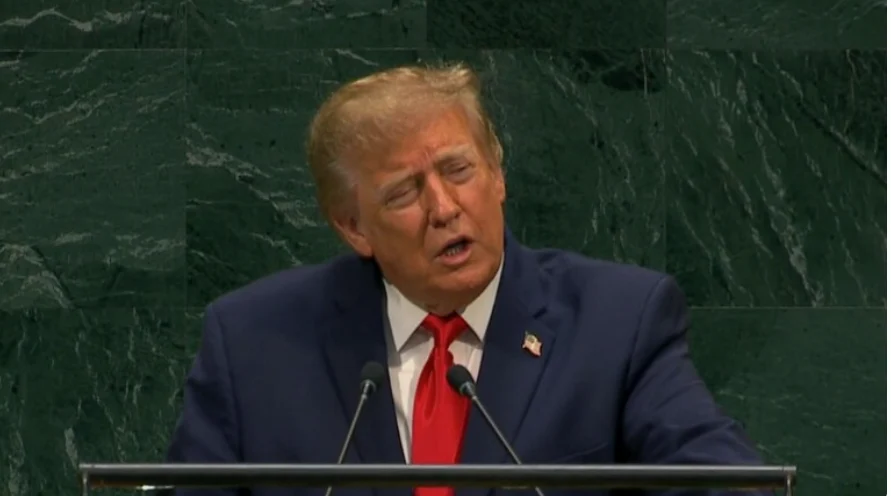
Trump, who was meeting with world leaders at the United Nations, previewed his defense in an all-caps tweet: “PRESIDENTIAL HARRASSMENT!”

He called the inquiry “Witch Hunt garbage”.

Pelosi’s change of heart followed reports that Donald Trump had pressured Ukrainian President Volodymyr Zelenskiy in a July 25 phone call to investigate Biden, the Democratic presidential front-runner, and his son Hunter, who had worked for a company drilling for gas in Ukraine.

In the days before the call, Trump ordered advisers to freeze $400 million in military aid for Ukraine — prompting speculation that he was holding out the money as leverage for information on the Bidens. Trump has denied that charge, but acknowledged he blocked the funds.

Donald Trump promised on Tuesday to release a transcript of his phone call. He has acknowledged he discussed Biden in the call, but denied he withheld nearly $400 million in US aid to Ukraine as leverage to get Zelenskiy to launch a probe that would damage Biden, who leads opinion polls in the Democratic presidential race.

Pelosi said the six congressional committees currently investigating Donald Trump would continue with their probes as part of the inquiry.

The panels would work collaboratively, and then decide whether the House Judiciary Committee should draft articles of impeachment, according to media reports quoting House aides.

“The actions of the Trump presidency revealed a dishonourable fact of the president’s betrayal of his oath of office, betrayal of our national security and betrayal of the integrity of our elections,” Pelosi said.

Congressional allies of Donald Trump accused Pelosi of playing politics with the decision.

Republican Senate Majority Leader Mitch McConnell called it “a rush to judgement”, saying it should have waited until after details of the phone call were revealed. “It simply confirms that House Democrats’ priority is not making life better for the American people, but their nearly three-year-old fixation on impeachment,” he said.

The impeachment inquiry could eventually lead to Donald Trump’s removal from office, although that would be a steep task for Democrats. Even if the Democratic-controlled House voted to impeach Trump, the Republican-majority Senate would have to take the next step of removing him from office after a trial. A conviction would require a two-thirds Senate majority.

It will be the first impeachment inquiry in Congress since the 1998 probe of President Bill Clinton for perjury and obstruction of justice in relation to his affair with White House intern Monica Lewinsky.

The House voted to impeach Clinton in December 1998, but the Democratic president was acquitted two months later by the Senate and remained in office.

The only other president to be impeached, Andrew Johnson in 1868, was also acquitted by the Senate. President Richard M Nixon resigned in 1974 after the House initiated impeachment proceedings but before an official vote, stepping down rather than face the embarrassment of such a rebuke.

Biden said he would back impeachment if the president did not fully comply with congressional investigations. “If we allow a president to get away with shredding the Constitution, that will last forever,” Biden told reporters in Wilmington, in his home state of Delaware.

Most Democratic presidential contenders support an impeachment inquiry, including US Senators Elizabeth Warren, Bernie Sanders, Kamala Harris, Cory Booker and Amy Klobuchar; former US Representative Beto O’Rourke; South Bend, Indiana, Mayor Pete Buttigieg; and former US Secretary of Housing and Urban Development Julian Castro.

But the move carries a risk of backfiring on Democrats if voters believe they are overreaching, as it did on House Republicans who unexpectedly lost seats in the 1998 elections after pursuing impeachment against Clinton.

Donald Trump has proven particularly resilient since taking office in January 2017, withstanding repeated scandals and retaining strong support from Republicans.

He promised to release a “complete, fully declassified and unredacted” transcript of the July 25 Ukraine call on Wednesday.

Democrats are also seeking the original complaint about Donald Trump’s call, filed by a whistleblower within the US intelligence community, as well as information on deliberations over the Ukrainian aid.

House Intelligence Committee Chairman Adam Schiff said his panel was communicating with an attorney representing the whistleblower and that the individual would like to testify this week.

The White House had refused to hand over the whistleblower’s complaint to Congress. But an administration official said late on Tuesday it was now preparing to release it by the end of the week and most likely allow the whistleblower to meet with congressional investigators.

The Senate approved a resolution on Tuesday calling for the complaint to be submitted to the Senate and House Intelligence committees. The House will vote on a similar resolution on Wednesday.

Donald Trump said the transcript would show the Ukraine call was “totally appropriate”, that he had not pressured Zelenskiy to investigate Biden and that there had been no “quid pro quo” for US aid in exchange for a probe.

Donald Trump has produced no evidence of wrongdoing by Biden or his son.

“When you see the readout of the call, which I assume you’ll see at some point, you’ll understand. That call was perfect. It couldn’t have been nicer,” Donald Trump told reporters at the United Nations General Assembly in New York.

Donald Trump indicated there was nothing sinister about withholding the aid to Ukraine but he wanted Europe and not just the United States to step up and provide Ukraine assistance.

The money was later released by the Trump administration. Trump told reporters he had wanted the money for Ukraine frozen, but changed his mind after “people called me.”

Latest world news

Israel-Lebanon ceasefire to begin within hours as Trump announces 10-day truce

Israel and Lebanon may begin a 10-day ceasefire within hours after a proposal announced by Donald Trump amid ongoing tensions.

Published

on

Donald Trump

A temporary halt in hostilities between Israel and Lebanon is expected to begin within hours after US President Donald Trump announced a proposed 10-day ceasefire between the two sides, amid ongoing tensions in the region.

According to his statement, the ceasefire is likely to take effect around 5 p.m. Eastern Time, although independent confirmation from both sides is still awaited.

The development follows discussions involving Israeli Prime Minister Benjamin Netanyahu and Lebanese President Joseph Aoun, with mediation efforts led by the United States.

Officials indicated that the proposed truce is aimed at creating a limited window to reduce violence and potentially pave the way for broader diplomatic engagement. The situation along the Israel-Lebanon border has remained tense in recent weeks, with escalation linked to the activities of Hezbollah.

Diplomatic efforts have intensified in recent days, with discussions facilitated by the United States, including the involvement of US Secretary of State Marco Rubio. However, details of the agreement and the extent of coordination between the parties remain unclear.

The situation remains fluid, and the success of the ceasefire will depend on adherence by all sides involved. The conflict has already led to significant humanitarian and geopolitical consequences, including displacement and disruption in affected areas.

While the proposed ceasefire is being seen as an important step toward de-escalation, broader negotiations involving regional stakeholders are expected to be necessary for any lasting resolution.

Continue Reading

Latest world news

US ends oil sanctions waiver for Iran and Russia, impact likely on India’s energy imports

The US decision to end the Iran and Russia oil waiver may impact India’s oil imports, fuel prices and global energy markets.

Published

on

US oil tanker

The United States has decided not to extend a temporary sanctions waiver that allowed limited trade in Iranian and Russian oil, marking a shift towards stricter enforcement of economic restrictions.

The waiver, introduced in March 2026, had permitted the sale of oil already loaded on ships to stabilise global supply during heightened geopolitical tensions. However, it is now set to expire around mid-April without renewal.

US officials have indicated that the move is part of a broader strategy to increase pressure on both Iran and Russia amid ongoing conflicts and geopolitical tensions.

What the waiver did and why it mattered

The short-term waiver allowed millions of barrels of oil—estimated at around 140 million barrels—to enter global markets, helping ease supply shortages and prevent sharp price spikes.

It also enabled countries like India to purchase discounted crude oil from Russia and resume limited imports from Iran after years of restrictions.

Impact on India

India, one of the world’s largest oil importers, is expected to feel the impact of the decision in several ways:

  • Reduced access to discounted oil
    India had been buying cheaper Russian crude and recently resumed Iranian imports under the waiver. Its end may limit these options.
  • Potential rise in fuel costs
    With fewer discounted supplies available, India may need to rely more on costlier sources, which could increase domestic fuel prices.
  • Supply diversification pressure
    India may need to explore alternative suppliers in the Middle East, Africa, or the US to maintain energy security.
  • Geopolitical balancing challenge
    The move adds pressure on India to align with US sanctions while managing its own economic interests.

Global energy market concerns

The end of the waiver comes at a time when global oil markets are already under stress due to conflict in West Asia and disruptions in key routes like the Strait of Hormuz.

Analysts warn that tightening sanctions could:

  • Reduce global oil supply
  • Increase price volatility
  • Intensify competition among major buyers like India and China

Bigger picture

The US decision reflects a broader shift from temporary relief measures to stricter enforcement of sanctions, even if it risks tightening global energy markets.

For India, the development highlights a recurring challenge—balancing affordable energy access with geopolitical realities.

Continue Reading

Latest world news

Sanctioned tanker fails to breach US blockade, turns back near Strait of Hormuz

A US-sanctioned tanker failed to cross the Hormuz blockade and turned back, underscoring rising tensions and disruption in global shipping routes.

Published

on

A US-sanctioned oil tanker failed to break through a newly imposed American naval blockade and was forced to turn back near the Strait of Hormuz, highlighting growing tensions in the region.

The vessel, identified as the Rich Starry, reversed its course after attempting to exit the Gulf, according to shipping data. The development comes just days after the United States enforced restrictions on ships linked to Iranian ports.

The blockade was announced by Donald Trump following the collapse of recent diplomatic talks with Iran. The move aims to restrict maritime traffic associated with Iranian trade.

Officials said that during the first 24 hours of enforcement, no vessel successfully crossed the blockade. Several ships, including the sanctioned tanker, complied with instructions from US forces and turned back toward regional waters.

The tanker is reported to be linked to a Chinese company previously sanctioned for dealing with Iran. It was carrying a cargo of methanol loaded from the United Arab Emirates at the time of the incident.

The situation underscores the rising risks in one of the world’s most critical oil transit routes. The Strait of Hormuz typically handles a significant share of global energy shipments, but traffic has sharply declined due to ongoing geopolitical tensions.

The blockade, which applies specifically to vessels travelling to or from Iranian ports, has added further uncertainty for shipping companies, insurers and global energy markets.

Continue Reading

Trending

© Copyright 2022 APNLIVE.com