English हिन्दी
Connect with us

India News

Drugs in Bollywood: Jaya Bachchan says entire film industry doesn’t do drugs

Samajwadi Party MP and and member of film fraternity Jaya Bachchan lashed out at BJP MP Ravi Kishan over his “drug addiction is in the film industry” remark.

Published

on

Jaya Bachchan and Ravi Kishan

Samajwadi Party Rajya Sabha MP Jaya Bachchan on Tuesday took offense to Gorakhpur BJP MP and actor Ravi Kishan‘s statement yesterday in the Lok Sabha that drug addiction had gripped the film industry. An agitated Bachchan said the image of the entire film fraternity cannot be tarnished just because some people took drugs.

Without naming Ravi Kishan, Jaya Bachchan said people who made their names in the film industry are now calling it as dirty as a gutter.

Later on, Bachchan said she felt ashamed that yesterday a Lok Sabha member, who is from the film industry, spoke against it. One can’t damage the same industry from where one makes an earning, she said. Bachchan appealed to the government to tell MPs to choose their words before speaking in the House.

sushant-singh-rajput

The entire episode revolves around the drugs angle being probed in the death by suicide of actor Sushant Singh Rajput and the subsequent hounding and arrest of actor Rhea Chakraborty for what the Narcotics Control Bureau calls being part of the drugs trade. While Chakraborty has said the NCB forced her to make such statements in a subsequent bail plea, the film industry finds itself caught in the glare of media focus and investigators probing drug peddlers’ links to actors. An old video of actor Adhyayan Suman had resurfaced recently where he accused actor Kangana Ranaut of asking if he took cocaine.

Read Also: Mughal museum in Agra becomes Chhatrapati Shivaji Maharaj museum: CM Yogi says no space for slave mentality

Speaking to reporters, Kishan said he had expected the veteran actor to support his point of view. He added that not everyone in the film industry is into drugs but those who do are part of designs to bring the curtains down on the world’s largest film industry. Kishan said the situation is vastly different from the time either he or Bachchan joined the film world and stressed that the film industry needs protection.

India News

Delhi lifts GRAP-4 pollution curbs as air quality shows improvement

Delhi has lifted GRAP-4 pollution curbs after air quality improved, though officials warn that AQI levels could rise again in coming days.

Published

on

Delhi-Pollution

Delhi has withdrawn the strictest set of air pollution control measures under the Graded Response Action Plan (GRAP-4) after a noticeable improvement in air quality across the region. The decision was taken by the GRAP sub-committee following a review meeting, where officials noted better atmospheric conditions aiding dispersion of pollutants.

According to the Commission for Air Quality Management, strong winds and favourable meteorological factors led to a sharp improvement in air quality from Tuesday night onwards. As a result, the Air Quality Index (AQI) in the national capital was recorded at 271 on Wednesday, placing it in the ‘poor’ category.

GRAP-4 had been imposed after AQI levels crossed the 450 mark, categorised as ‘severe-plus’, prompting emergency restrictions across sectors. With the situation easing, authorities have now rolled back the highest level of curbs, while confirming that actions under GRAP-1, GRAP-2 and GRAP-3 will remain in force.

What changes for commuters and schools

With the lifting of GRAP-4, older vehicles that were barred from operating during the peak pollution phase are now allowed back on Delhi roads. The earlier restriction permitting entry of only Bharat Stage (BS) 6 vehicles into the capital had affected nearly 1.2 million vehicles registered outside Delhi.

The Delhi government had also directed schools to run classes up to Class 11 in hybrid mode during the severe pollution phase. With the easing of restrictions, schools can now reassess operational decisions in line with the prevailing GRAP stages.

However, officials cautioned that the relief may be temporary. Forecasts by meteorological agencies indicate a possible rise in AQI levels in the coming days due to slower wind speeds. Authorities said they remain prepared to reintroduce stricter measures if pollution levels spike again.

Vehicle norms and ongoing curbs

Under the existing framework, GRAP-1 measures apply when AQI is between 201 and 300, GRAP-2 between 301 and 400, and GRAP-3 between 401 and 450. While GRAP-4 has been lifted, enforcement of emission-related norms continues.

Officials reiterated that vehicles without a valid pollution under control (PUC) certificate will not be allowed to refuel at petrol pumps. The government has maintained that vehicular emissions remain one of the biggest contributors to Delhi’s winter air pollution, accounting for a significant share of particulate matter in busy traffic corridors.

Continue Reading

India News

Unnao rape survivor meets Rahul Gandhi amid protest over court relief to Kuldeep Sengar

The Unnao rape survivor met Rahul Gandhi in Delhi amid protests against court relief to convicted former MLA Kuldeep Singh Sengar, alleging mistreatment during the demonstration.

Published

on

Rahul-Gandhi

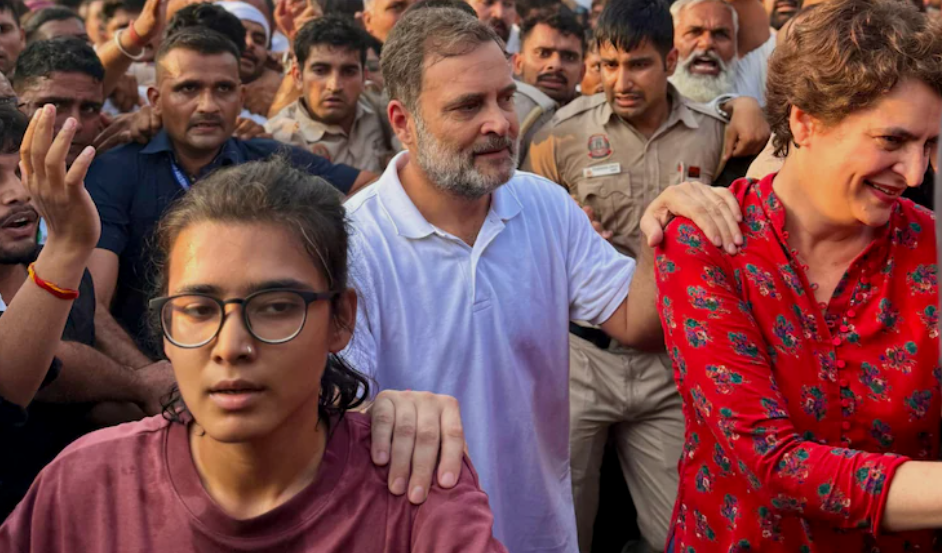
The Unnao rape case survivor and her mother met Congress leader Rahul Gandhi on Tuesday evening as they continue their protest against the Delhi High Court’s recent relief to former BJP MLA Kuldeep Singh Sengar, who has been convicted in the case. The meeting took place at the 10 Janpath residence of Sonia Gandhi, where she was also present.

The survivor and her mother have been demonstrating in Delhi after the court granted interim relief to Sengar, allowing him to remain out of jail while his appeal against conviction and sentence is pending. The development has triggered strong political reactions, with opposition parties questioning the message it sends to survivors of sexual violence.

Allegations of mistreatment during protest

Earlier in the day, the survivor’s mother was allegedly manhandled by Central paramilitary personnel during the protest. According to the account shared by the family, security personnel stopped the mother and daughter from speaking to the media and forced the elderly woman to jump off a moving bus.

The duo had been protesting at India Gate along with their lawyer-activist Yogita Bhayana following the court order. They were later detained. On Tuesday morning, they planned to address the media at Mandi House, but the vehicle arranged to transport them did not stop at the intended location. The CRPF later stated that permission to hold a protest had not been granted.

Rahul Gandhi questions treatment of survivor

Reacting to the incident, Rahul Gandhi posted on X questioning whether the survivor was being mistreated for raising her voice against injustice. In his post, he asked if such treatment of a gang rape survivor was justified and criticised what he described as a justice system that grants bail to convicts while treating survivors like criminals.

The survivor, who was sexually assaulted by Sengar in 2017, has said she also wants to meet the Prime Minister to place her concerns directly before him. The case and the latest court decision continue to draw national attention, reigniting debate over survivor safety and access to justice.

Continue Reading

India News

Jammu and Kashmir High Court rejects Mehbooba Mufti’s plea on undertrial prisoners, calls it politically motivated

The Jammu and Kashmir High Court has rejected Mehbooba Mufti’s PIL on undertrial prisoners, stating it was politically motivated and lacked factual basis.

Published

on

Mehbooba mufti

The Jammu and Kashmir High Court has dismissed a Public Interest Litigation (PIL) filed by People’s Democratic Party (PDP) president Mehbooba Mufti seeking the transfer of undertrial prisoners lodged in jails outside the Union Territory back to prisons within Jammu and Kashmir. The court termed the petition politically motivated, vague and unsupported by facts, observing that it was an attempt to derive political mileage rather than address a genuine public cause.

A bench headed by Chief Justice Arun Palli and Justice Rajnesh Oswal made it clear that public interest litigation cannot be used as a tool to advance political agendas or convert courts into platforms for electoral positioning.

Court says PIL cannot become a political platform

In its observations, the High Court said the plea appeared aimed at projecting the petitioner as a champion of justice for a specific section, rather than raising substantiated legal concerns. The bench underlined that while political parties are free to engage with voters through democratic means, the judiciary must remain insulated from political campaigns.

The court reiterated that PIL jurisdiction is meant to safeguard public interest and not to be misused for electoral gain or political leverage. It cautioned against attempts to draw the judiciary into political narratives.

Undertrials have legal remedies, says court

In the 15-page order passed on Tuesday, the High Court noted that the undertrial prisoners mentioned in the petition are already facing trial before competent courts. According to the bench, adequate judicial remedies are available to such undertrials to raise grievances related to their detention or place of incarceration.

The court further observed that the failure of the concerned undertrials to approach courts on their own indicated that they may not be genuinely aggrieved by their confinement in prisons outside the Union Territory.

No locus standi, petition dismissed

Dismissing the plea, the High Court held that Mehbooba Mufti was a third-party stranger to the cause and therefore lacked the locus standi to invoke the court’s jurisdiction in this matter. The petition was described as misconceived and was rejected accordingly.

Continue Reading

Trending

© Copyright 2022 APNLIVE.com