
Latest business news
The slippery fundamentals of the fight against outsourcing


[vc_row][vc_column][vc_column_text]Even while the US Congress sees the introduction of two more Bills seeking to put an end to the practice or at least limit it significantly, considerations involving cost, pricing, market and talent put a question mark on the wisdom of the proposed legislations
By Sujit Bhar
After the H1B scare, now there is the scare of an Outsourcing Prevention Act from the US. As far as India is concerned—simplifying it as much as possible—these are likely to affect, basically, two categories of workers. The first is technical, hence highly educated, people going to the US for specialised jobs; the second is people who have been pulling even blue collar jobs out of the US, assisted by US companies who see sense in the cost-benefit analysis.
If we forget the Trump ethos for a while, and also disengage from Bernie Sanders’ ideas of why outsourcing should be stopped, looking only at the general American perspective instead, we observe some very interesting developments of late.
We will be pitting this American perspective, not only against an Indian perspective, but also against the world perspective.
As per the US 2017 General Schedule (GS) Pay Scale, as published by the Office of Personnel Management, the pay scale, escalated in ten steps, would be US $ 23,171 per annum.
The GS Pay Scale is the predominant pay scale within the US civil service and is an indicative salary for the majority of white collar personnel (professional, technical, administrative and clerical) positions. And this is actually a huge section of federal civilian employees—as per late 2004 readings, this comprised 71 percent of federal civilian employees.
We are considering the lowest of the GS grade, which is GS-1, and we are taking a simplistic view.
If we consider the general US dollar-INR exchange rate prevalent as of February 6 (rounded off at 67) we see that US $23,171 per annum translates to Rs 15,52,457. This is the lower end of GS. At the absolute higher end, GS goes up to $134,776. That is the ceiling, so to say.
Without comment we present here the Sixth Pay Commission’s recommendations (mostly adopted) for top level government employees (S-16 and above). Feel free to compare from the table below: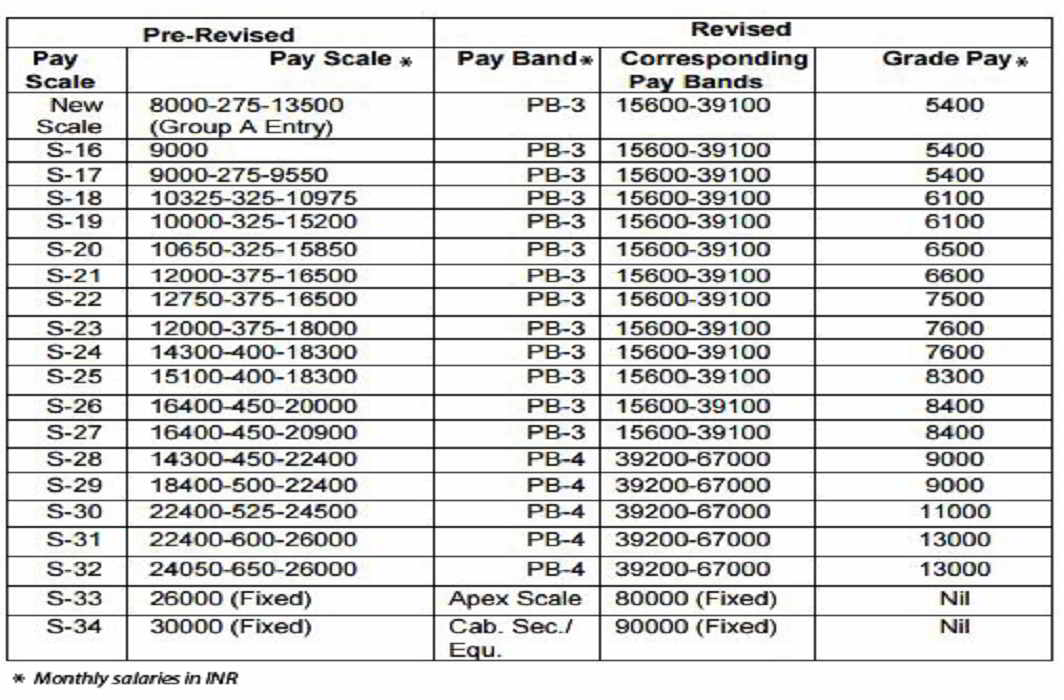
In the US, the GS Pay Scale does not refer to tech-specific jobs, which means they are not specifically H1B. Hence this will fall in the ambit of the second act on general outsourcing.
The World Picture
Regarding tech jobs, we put this in the backdrop of the world picture. Around the world, one general finding (late 2016) shows that 51 percent techies existed in the $60,000-80,000 bracket, while only eight percent in the $120,000-140,000 bracket. That is the worldwide trend.
This tells us two things. The first is, if the new act on H1B raises the minimum rate to $130,000, it will be extremely lucrative for techies around the world to gravitate towards the US. The second is that when majority of the world of techies, as talented, exist in the $60,000-80,000 range, sensible companies would want to gravitate towards that cost level.
Regarding non-tech jobs, the following can be the reading. According to the Census ACS survey, the median household income for the United States was $55,775 in 2015, the latest data available. 2016 Census ACS data (including 2016 national household income numbers) will be released in September of 2017. For argument’s sake, we assume that the median of 2015 has remained unchanged.
Since this covers all white collar jobs, including tech, what justification does any American company have to live in this high overhead ecosystem?
Beyond H1B
Let us consider another set of available data (Link: http://www.statisticbrain.com/outsourcing-statistics-by-country/ ), outside the H1B environment. The US has outsourced 53 percent of manufacturing jobs, 43 percent of IT Services, 38 percent of R&D, 26 percent of Distribution and only 12 percent of Call or Help Centres.
And here are the top reasons as to why companies outsource.
- Reduce or control costs: 44%
- Gain access to IT resources unavailable internally 34%
- Free up internal resources 31%;
- Improve business or customer focus 28%;
- Accelerate company reorganization / transformation 22%;
- Accelerate project 15%; Gain access to management expertise unavailable internally 15%;
- Reduce time to market 9%.
What does that mean? The top two reasons for outsourcing are cost and access to IT resources. Will the possible new legislations be able to create a level playing field for US companies, vis-a-vis companies from other countries?
With even the median household income in the US staying beyond levels that can be attained any time soon by countries outsourced to, cost will never be attained in the manufacturing sector. If we consider the internal consumption of the US, it will not be able to support the huge production capacities needed to be set up for manufacturing to become cost-effective.
Let us consider a typical manufactured article, such as, say, Barbie dolls. If America exports, it will lose the pricing wars from countries like China and even Bangladesh (textiles) and India (IT and pharma). Where will the excess production of Barbie dolls be targeted towards?
If we consider IT, there aren’t as many good-talent techies available in the US to support the fundamental political principles of Trump and Sanders. Which, in turn, will mean a compromise on quality. If Windows 11 came with, say, a plethora of incurable bugs, where will the market be? Debugging is a time-consuming, repetitive job that many Americans just might not like, to put it mildly.
So, if 53 percent of the outsourced manufacturing jobs and 43 percent of the outsourced IT services jobs are to come back into the US again, the US has to set up massive facilities within the country and then somehow create the huge market capable of gobbling up the huge production that will ensue.
We do not wish to term Sanders’ idea as ‘ludicrous’, as Tim Worstall has written in Forbes, but we certainly wish Sanders and Trump all the luck in their respective ventures.
Related read: Will the H1B Bill help or hurt the US?[/vc_column_text][/vc_column][/vc_row]










Latest business news
Xbox announces 3,200 layoffs as Asha Sharma outlines major restructuring plan
Xbox has announced plans to lay off 3,200 employees over the next year while introducing a major restructuring programme that includes management changes, studio restructuring and cost-cutting measures.


India News
Bank holiday today: Are banks open or closed on June 29? Here’s what RBI calendar says
Banks in Himachal Pradesh and Mizoram will remain closed on June 29, 2026, due to regional holidays, while banking operations will continue normally in most other states.

India News
Union Budget 2026 highlights: Nirmala Sitharaman Raises Capex to Rs 12.2 Lakh Cr, West Bengal Gets Major Allocation
Finance Minister Nirmala Sitharaman is presenting the Union Budget 2026 in Parliament today. Follow this space for live updates, key announcements, and policy insights.



Dhruv Rathee gets fresh summons in 2018 BJP IT cell video case

Nobody can browbeat judiciary, Chief Justice warns over Rahul Gandhi’s march

India-US trade deal first phase finalised, drafting underway

Election Commission orders voter roll revision in 17 states, UTs

Actor Imran Khan asked to leave India after CJP protest

Delhi Police offers 11-person limit for CJP’s Connaught Place protest
Actor Imran Khan asked to leave India after CJP protest
Election Commission orders voter roll revision in 17 states, UTs
India-US trade deal first phase finalised, drafting underway
Nobody can browbeat judiciary, Chief Justice warns over Rahul Gandhi’s march

Afghan Men Try To Hang With The Jet Engine Of The Aircraft in Kabul- Afghanistan News – Kabul News
Trending Top 10 News: 10000 Crore Fine on Flipkart, Apple to Launch Unique Feature, Hdfc Bank Job Ad

Trending Top 10 News: Nokia 6310, Apple sales, Bachpan ka Pyar Video Kid, Dainik Bhaskar IT Raid

Trending Top 10 News: Canada bans Indian flights, Rain in Delhi NCR, AIMIM Twitter hacked, Raj Kundra case

Trending Top 10 News: Shein India, Apple New Service, Pocket Oxygen, Oppo Launched New Phone
-
 India News20 hours ago
Dhruv Rathee gets fresh summons in 2018 BJP IT cell video case
-
 India News16 hours ago
Nobody can browbeat judiciary, Chief Justice warns over Rahul Gandhi’s march
-
 India News12 hours ago
India-US trade deal first phase finalised, drafting underway
-
 India News10 hours ago
Election Commission orders voter roll revision in 17 states, UTs
-
 India News9 hours ago
Actor Imran Khan asked to leave India after CJP protest
-
 India News8 hours ago
Delhi Police offers 11-person limit for CJP’s Connaught Place protest
