English हिन्दी
Connect with us

India News

383 police, paramilitary personnel martyred in past year: IB chief

Published

on

Police day

[vc_row][vc_column][vc_column_text]Intelligence Bureau chief Rajiv Jain says 383 personnel, including those from BSF, CISF, ITBP, state police forces killed between September 2016-August 2017

As many as 383 police personnel, including 56 belonging to the Border Security Force and 42 from Jammu and Kashmir, have laid down their lives in the line of duty in the last one year, director of Intelligence Bureau Rajiv Jain said on Saturday.

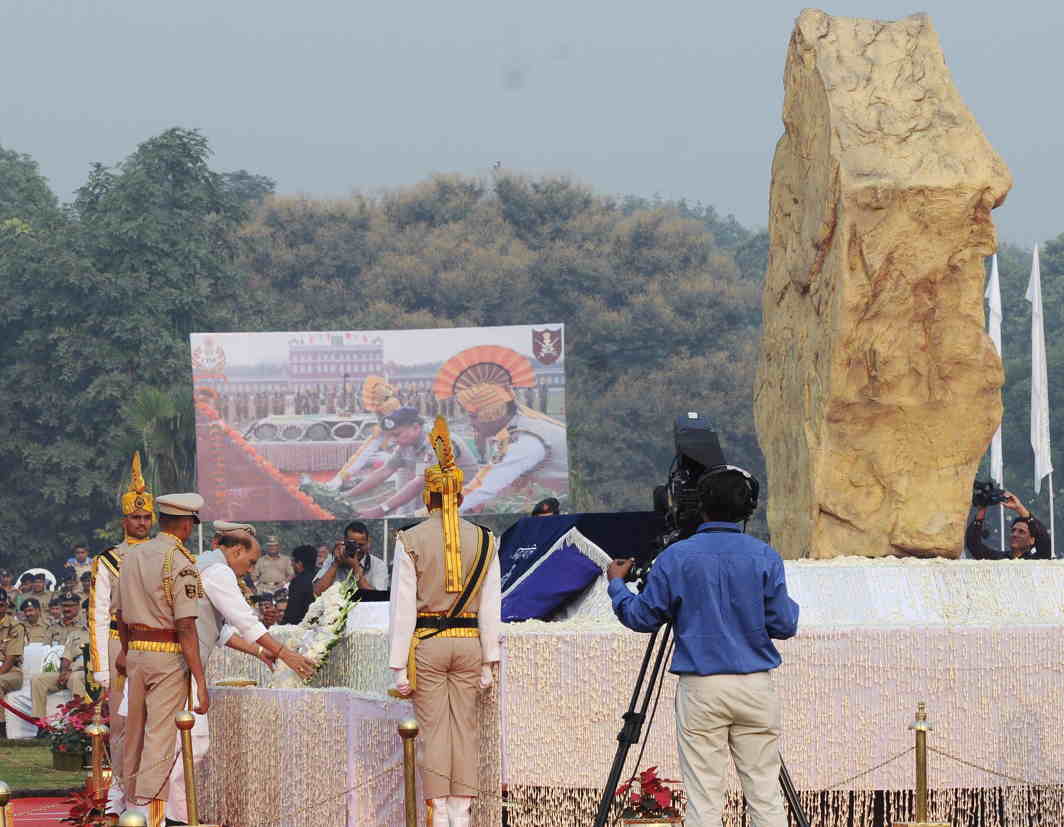
Addressing the Police Commemoration Day, where home minister Rajnath Singh led the nation in paying tribute to martyrs of police forces, Jain said the 383 police personnel were killed while performing various duties across the country from September 2016 to August 2017.

Among these police personnel, 76 belonged to the Uttar Pradesh Police, 56 belonged to the BSF, 49 were from the CRPF, 42 from the Jammu and Kashmir Police, 23 belonged to Chhattisgarh, 16 were from West Bengal, 13 each belonged to Delhi and the CISF, 12 each were from Bihar and Karnataka and 11 from the ITBP.

Majority of the police personnel died while dealing with cross-border firing from Pakistan, fighting militancy in Jammu and Kashmir, Naxals and other law and order duties.

The day is observed to pay homage to 10 policemen killed in firing by Chinese troops in 1959 and 34,400 others who laid down their lives protecting India’s unity and integrity.

Observed as ‘Police Commemoration Day’, October 21 commemorates the sacrifices of the 10 policemen while defending India’s borders with China in 1959, a statement issued by the Home Ministry said.

The Indian police personnel were responsible for manning the 2,500 mile-long border of India with Tibet until the autumn of 1959. On October 20, 1959, three reconnaissance parties were launched from Hot Springs in North Eastern Ladakh in preparation for further movement of an Indian expedition which was on its way to Lanak La.

While members of two parties returned to Hot Springs, the third one comprising two police constables and a porter did not return, the statement said. The remaining forces were mobilised next morning in search of the missing personnel.

A party of about 20 police personnel led by Karam Singh, a Deputy Central Intelligence Officer (DCIO) rank officer, proceeded on horseback while others followed on foot in three sections. At mid-day, the Chinese Army personnel were seen on a hillock who opened fire and threw grenades at the Indian party, the statement said.

Since there was no cover, most personnel were injured. Ten of the brave police personnel were killed and seven others sustained injuries in the incident. Bodies of the 10 personnel were returned by the Chinese on November 13, three weeks after the incident.

The bodies were then cremated with full police honours at Hot Springs in Ladakh.

The annual conference of Inspectors General of Police of States and Union Territories held in January, 1960 decided that October 21 would, henceforth, be observed as ‘Commemoration Day’ in all police lines in the country to mark the memory of these gallant personnel, the statement said.

It was also decided to erect a memorial at Hot Springs, and that members of police forces from different parts of the country trek to Hot Springs every year to pay homage to the gallant martyrs.

Since independence, 34,418 police personnel have sacrificed their lives for safeguarding the integrity of the nation and providing security to people of this country, the statement said.

(This article is from a syndicated feed provided by news agency PTI)[/vc_column_text][/vc_column][/vc_row]

India News

Red Fort bomb threat declared hoax after extensive security checks in Delhi

Delhi Police declared a bomb threat targeting the Red Fort a hoax after conducting a detailed security search following an alert received from Mumbai Police.

Published

on

Red fort

Delhi’s iconic Red Fort witnessed heightened security on Saturday after authorities received a bomb threat targeting the historic monument. Following a detailed inspection and sanitisation drive, Delhi Police confirmed that the threat was a hoax and no explosives were found.

Threat call routed through Mumbai Police

According to officials, the threat was initially received by the Mumbai Police Control Room. The caller allegedly claimed that the Red Fort would be blown up.

Mumbai Police immediately shared the information with the Delhi Police Control Room, which alerted the North District Police. Security personnel were deployed at the monument, and a comprehensive search operation was launched to ensure public safety.

After completing the inspection, officials ruled out any security risk and declared the threat to be false.

Security concerns remain high after previous terror incident

The latest threat comes around eight months after a deadly vehicle-borne improvised explosive device (IED) blast near the Red Fort Metro Station claimed 15 lives and left several others injured.

Investigators had alleged that the blast was carried out by Umar-un-Nabi, a Kashmiri doctor associated with Al-Falah University in Faridabad, who was driving a Hyundai i20. The explosion occurred on the same day security agencies recovered around 2,900 kg of explosives, including ammonium nitrate, from neighbouring Faridabad in Haryana.

According to investigators, the accused allegedly triggered the explosion after two suspected associates were arrested and the explosives were seized during the operation.

Authorities had identified several other accused linked to the case. Investigators alleged that the group was part of a white-collar terror module associated with Ansar Ghazwat-ul-Hind, an al-Qaeda-affiliated terrorist organisation.

Earlier arrests linked to alleged attack plots

In May, Delhi Police’s Special Cell arrested nine men who were allegedly linked to Pakistan’s Inter-Services Intelligence (ISI) and fugitive gangster Dawood Ibrahim.

Police alleged that the accused were planning attacks on critical infrastructure and security personnel in Delhi, Mumbai and other parts of the country. According to investigators, potential targets included airports, railway stations, power plants and other vital installations.

Although Saturday’s bomb threat was found to be fake, the incident once again prompted swift security measures at one of the country’s most significant heritage sites.

Continue Reading

India News

Heavy rain triggers landslides amid floods in Himachal, Uttarakhand and Northeast

Heavy monsoon rainfall continued to batter several states, causing landslides, floods, road closures and multiple deaths as rescue and relief operations intensified across affected regions.

Published

on

Heavy monsoon rainfall continued to affect large parts of India on Friday, triggering landslides in the Himalayan states, flooding rivers in the Northeast and causing rain-related deaths in multiple regions. Authorities intensified rescue and relief operations as highways remained blocked, roads were damaged and thousands of people were moved to safer locations.

While several northern and northeastern states continued to receive heavy rainfall, Delhi-NCR and Rajasthan witnessed relatively dry weather after days of persistent showers.

Himachal Pradesh faces widespread disruption

Heavy to extremely heavy rainfall affected several districts in Himachal Pradesh, damaging roads, bridges and public infrastructure while disrupting daily life. Many educational institutions remained closed as a precaution.

A 70-year-old man died in Kullu district after falling boulders struck him on the Buanda-Chwai road. In Solan district, two people were injured when a boulder hit their vehicle in the Arki area.

Authorities said 27 link roads in Shimla district remained closed, causing inconvenience to commuters. Rockfall incidents were reported at multiple locations along the Kalka-Shimla National Highway.

Officials also expressed concern over a potential landslide threat near the Sangla bridge in Kinnaur district. Any significant damage to the bridge could disconnect Sangla Valley from the rest of the district.

According to the Meteorological Department, Sirmaur and Solan districts recorded the highest rainfall since Thursday evening.

Landslides block key roads in Uttarakhand

Heavy rainfall over the past 24 hours triggered landslides across Uttarakhand, resulting in the death of a teenager, injuries to several people and the closure of schools in affected areas.

Officials said 118 roads across the state, including the Yamunotri National Highway, were blocked due to landslides. A nearly 100-metre stretch of the Yamunotri Highway near Syanachatti in Uttarkashi district was damaged, with restoration work underway.

The Gangotri National Highway also experienced repeated disruptions because of falling rocks and boulders. Continuous rainfall caused the Ganga, Yamuna and several tributaries to swell, prompting authorities to remain on high alert following forecasts of more heavy rainfall.

Floods affect Jammu and Kashmir and Northeast

Flash floods inundated parts of the Ari area in Jammu and Kashmir’s Poonch district, damaging houses and leaving several residents stranded. Police personnel rescued at least 25 people from flooded areas.

In Mizoram, more than 80 families in Lunglei district were shifted to safer locations after the Khawthlangtuipui River overflowed following days of continuous rain. Authorities also reported landslides and rockfalls at more than 29 locations across the state.

A massive landslide blocked National Highway 54 near Bualte village, leaving several tourists stranded for four days and cutting off Lawngtlai and Siaha districts from the rest of Mizoram. The Aizawl-Thenzawl-Lunglei highway also remained blocked because of major rockfalls.

Tripura continued to battle flood conditions, with over 4,000 houses damaged and nearly 11,000 people taking shelter in relief camps. Officials said no fatalities had been reported in the state.

Uttar Pradesh records heavy rainfall and fatalities

Heavy rainfall continued across many parts of Uttar Pradesh, leading to multiple rain-related deaths.

A 28-year-old man died after reportedly falling into a rainwater-filled roadside drain in Noida. In Muzaffarnagar, a 60-year-old woman was killed after her mud house collapsed, while her husband sustained injuries. In Balrampur, a 21-year-old farmer lost his life after being struck by lightning.

The India Meteorological Department (IMD) said the active southwest monsoon over Uttar Pradesh has been strengthened by an upper-air cyclonic circulation over central parts of the state and a well-marked low-pressure area over northwest Madhya Pradesh.

Mawana in Meerut district recorded the state’s highest rainfall at 315 mm during the 24-hour period ending Friday morning, followed by Jansath in Muzaffarnagar with 270.1 mm.

The IMD has issued an orange alert for Uttar Pradesh, forecasting heavy to very heavy rainfall until July 11.

Delhi and Rajasthan likely to see a break from heavy rain

After two consecutive days of rainfall, Delhi experienced clearer skies on Friday. Weather experts indicated that rainfall activity is expected to remain subdued until around July 15 as the monsoon trough has shifted towards the Himalayan foothills.

The weather office also forecast weaker monsoon activity over Rajasthan, with mostly dry conditions expected across much of the state for about a week and only isolated areas likely to receive light rainfall.

West Bengal, Arunachal and Assam remain on alert

Heavy rain continued across parts of West Bengal, causing waterlogging and traffic congestion in Kolkata. Cooch Behar recorded the highest rainfall in the state at 143 mm during the previous 24 hours, while Dum Dum received 96 mm.

In Arunachal Pradesh, fresh floods and landslides damaged houses, roads and agricultural land in West Kameng, Upper Subansiri and Tirap districts. The flood-related death toll in the state rose to seven after the body of a missing woman was recovered in Papum Pare district.

Authorities in Assam advised residents to remain cautious as the IMD forecast widespread rainfall across the state, including Guwahati, over the coming days. The weather agency warned that heavy rainfall could lead to waterlogging, flash floods, slow traffic movement and localised landslides.

The IMD also forecast widespread rainfall across Arunachal Pradesh, Assam, Meghalaya, Nagaland, Manipur, Mizoram and Tripura until July 16, while rainfall activity is expected to remain subdued over central and southern Peninsular India during the next week.

Meanwhile, light rainfall was reported in parts of Haryana, Punjab and Chandigarh. In Kerala, recovery operations at the Wayanad landslide site continued, with one more body recovered, taking the death toll to seven.

Continue Reading

India News

Centre reiterates correct pronunciation, text for National Anthem and Vande Mataram

The Home Ministry has issued fresh directions asking government offices to strictly follow the approved script, pronunciation and protocol while singing or playing the National Anthem and Vande Mataram.

Published

on

National Anthem and Vande Mataram

The Union Ministry of Home Affairs (MHA) has issued a fresh directive asking all central government offices and governor offices to strictly adhere to the prescribed script, text, diction and pronunciation while playing or singing the National Anthem and the National Song.

The ministry reiterated the existing protocols governing the occasions on which the National Anthem, Jana Gana Mana, and the National Song, Vande Mataram, must or may be performed during official functions.

National Song to be played on specified official occasions

According to the order dated July 9, Vande Mataram should be sung during civil investiture ceremonies, on the arrival and departure of the President at formal state functions and other government events, and immediately before and after the President addresses the nation through All India Radio and television.

The order also states that the National Song should be played during the arrival and departure of Governors and Lieutenant Governors at formal state functions within their respective states or Union Territories, as well as when the National Flag is brought on parade.

The ministry said the National Song may also be played on any other occasion if special orders are issued by the Government of India.

Correct pronunciation and script mandatory

The MHA emphasised that the approved script, text, diction and pronunciation must be followed whenever the National Anthem or the National Song is played or sung.

It added that the official text and pronunciation guide are available on the ministry’s website for reference.

The ministry’s order also contains a detailed list of occasions when the National Anthem and the National Song must be played or sung, as well as situations where their performance is optional.

Protocol when State Songs are performed

The ministry clarified that in states where a State Song is performed alongside the National Anthem or the National Song, both national compositions should also be included in the ceremony.

In such cases, Vande Mataram must be performed first, followed by Jana Gana Mana.

The directive also states that everyone present must stand in attention when the National Song is sung.

Earlier protocol and constitutional recognition

The Home Ministry had earlier issued a separate order on January 28 outlining protocols for singing the National Song during official functions, including presidential visits, the unfurling of the National Flag and governors’ speeches. That order specified that all six stanzas of the official version, with a duration of about three minutes and ten seconds, should be sung on such occasions.

The ministry also noted that while it is not possible to specify every occasion on which the National Song may be sung, there is no objection to mass singing of Vande Mataram, provided it is performed respectfully as a salute to the motherland and proper decorum is maintained.

The Centre is currently observing the 150th year of Vande Mataram.

The ministry also recalled that the Constituent Assembly, through a resolution adopted on January 24, 1950, recognised Jana Gana Mana as India’s National Anthem, while declaring that Vande Mataram, which played a significant role in the freedom movement, would be honoured equally and enjoy the same status.

Continue Reading

Trending

© Copyright 2022 APNLIVE.com