English हिन्दी
Connect with us

India News

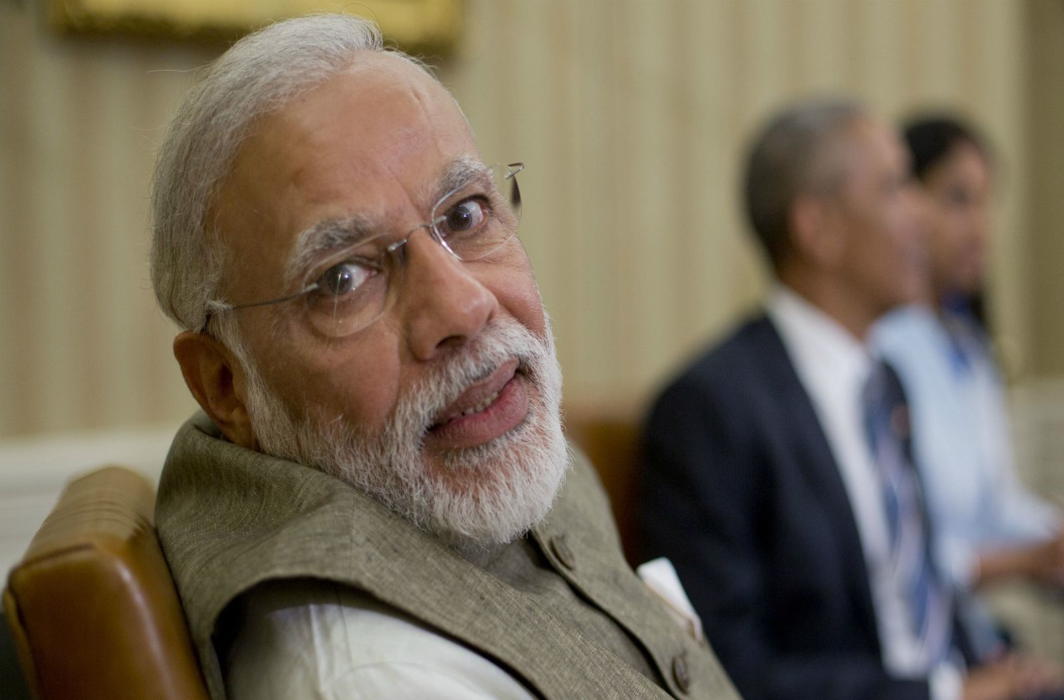
55 % Indians support autocracy, 85 % trust Modi govt: Pew study

Published

on

Narendra Modi

[vc_row][vc_column][vc_column_text]Pew research also says that while 27 per cent Indians want a strong leader, 46 per cent trust the government will do what is right

At a time when the Narendra Modi-led government is under attack from several quarters for its poor handling of the country’s economy, a study by American think-tank – Pew Research Center – may bring in some cheer for the ruling BJP.

The Pew research, which is based on the think-tank’s survey on governance and the electorate’s trust in the respective governments of some key countries of the world, claims that four-fifths or nearly 85 per cent of Indians “trust” their federal government. However, the report also claims that as many as 55 per cent of Indians also endorse “military rule and autocracy” in one way or another.

“In India, where the economy has grown on average by 6.9 per cent since 2012, 85 per cent (of people) trust their national government,” the Pew Research said, while adding that 46 per cent of the relatively miniscule sample size of 2464 Indian respondents also “somewhat” trusted the central government “to do what was right”.

The report also claims that more than one-fourth of the respondents or 27 per cent of the sample size of respondents want “a strong leader”.

The face-to-face survey by Pew by reportedly carried out in eight languages and involved adult respondents from “Delhi and 15 of the 17 most populous states”. The fieldwork was done between February 21 and March 10.

On a global perspective, the research claimed that nearly half of Russians (48 per cent of the sample size surveyed) back governance by a strong leader but also admit that rule by a strong leader is generally unpopular.

The research notes that a global median of 26 per cent of respondents say a system in which a strong leader can make decisions without interference from parliament or the courts would be a good way of governing while nearly 71 per cent respondents believed that this would be “a bad type of governance.”

India is one of the three countries in the Asia Pacific region where people support technocracy, the report added, saying: “Asian-Pacific publics generally back rule by experts, particularly people in Vietnam (67 per cent), India (65 per cent) and the Philippines (62 per cent).”

According to the survey, roughly half of both Indians (53 per cent) and South Africans (52 per cent), who live in nations that often hold themselves up as democratic exemplars for their regions, say military rule would be a good thing for their countries.

“But in these societies, older people (those ages 50 and older) are the least supportive of the army running the country, and they are the ones who either personally experienced the struggle to establish democratic rule or are the immediate descendants of those democratic pioneers,” the report added.

Pew said more than half in each of the 38 nations polled consider representative democracy a very or somewhat good way to govern their country. Yet, in all countries, pro-democracy attitudes coexist, to varying degrees, with openness to non-democratic forms of governance, including rule by experts, a strong leader, or the military.

(With inputs from PTI)[/vc_column_text][/vc_column][/vc_row]

India News

Rohit Pawar alleges big personality link in Ajit Pawar plane crash case

Published

on

Rohit pawar

Nationalist Congress Party (SP) MLA Rohit Pawar on Thursday alleged that a “big personality” was connected to the company linked to the plane crash that killed his uncle, Maharashtra Deputy Chief Minister Ajit Pawar, and others in Baramati last month.

Addressing reporters after holding a protest, Rohit Pawar demanded the resignation of Union Civil Aviation Minister K. Rammohan Naidu. He alleged that the minister’s party had financial links to the company involved in the crash and said he should step down from his post.

“The owner of VSR company is close to very powerful leaders. Many people in Maharashtra are connected to this. There is a clear attempt to protect VSR because some ‘big personality’ is involved in this,” Rohit Pawar said.

Demand for wider probe

The fatal aircraft accident occurred in Baramati on January 28. Following the incident, the investigation into the accidental deaths of Ajit Pawar and others was transferred to the Criminal Investigation Department (CID) of the Pune Police, considering the gravity of the case.

Rohit Pawar questioned the progress of the probe and said the public must be informed about the steps taken so far. He pointed out that the Aircraft Accident Investigation Bureau (AAIB) examines technical aspects of an aviation mishap, but not possible criminal angles.

Additional Director General of Police Sunil Ramanand said the CID investigation is exploring multiple aspects, including whether there was any foul play or sabotage behind the accident, whether criminal negligence played a role, and whether there was any larger conspiracy. He added that the AAIB report would be incorporated into the CID’s findings once received.

Family voices concerns

Referring to concerns raised by family members, Rohit Pawar said that Jay Pawar, Ajit Pawar’s son, had expressed doubts on social media regarding the aircraft’s black box. Sunetra Pawar, Ajit Pawar’s wife, has sought a probe by the Central Bureau of Investigation.

Speaking emotionally about his relationship with his uncle, Rohit Pawar said Ajit Pawar had guided him politically and personally. He added that Ajit Pawar had wished to reunite with Sharad Pawar and had recently spoken to him.

The CID continues its investigation, while awaiting the technical report from the AAIB.

Continue Reading

India News

Over 5,000 tribals join BJP in Assam’s Goalpara ahead of elections

More than 5,000 tribals, largely from the Garo community, joined the BJP in Assam’s Goalpara district during a large-scale ST Morcha programme ahead of elections.

Published

on

Hemanta Sharma

More than 5,000 members of tribal communities formally joined the Bharatiya Janata Party (BJP) at a large-scale event held in Assam’s Goalpara district on February 25, weeks before key elections.

The joining programme was organised by the BJP ST Morcha, Assam Pradesh, at the Agia School playground. The event was conducted under the leadership of Riya Sangma, State Secretary of BJP ST Morcha and in-charge of the Goalpara ST Morcha.

Party leaders said the programme witnessed strong participation, particularly from the Garo community, describing it as a significant political development in the district.

The chief guest at the event was Samir Oran, National President of BJP ST Morcha and outgoing Member of Parliament (Rajya Sabha). Among those present were Bijuli Kalita Medhi, MP from the Guwahati Lok Sabha constituency, Ravindra Raju, Horen Singh Bey, who serves as State President of BJP ST Morcha, and other party leaders.

Goalpara district has traditionally seen strong influence from opposition parties, especially the Congress. Tribal voters in the region have largely remained divided, making the large-scale induction ahead of elections politically significant.

Addressing the media, Samir Oran said the BJP has brought a new phase of recognition and opportunity for tribal communities across the Northeast. He stated that the joining programme reflected growing trust among tribal populations in the party.

Riya Sangma said many tribal communities, particularly members of the Garo community, had earlier felt deprived of adequate respect and development benefits. She added that the participation of over 5,000 people demonstrated confidence in the BJP’s leadership.

Dipankar Nath, BJP Goalpara District President, termed the development a “game-changer” for the constituency. He said the party remains committed to the welfare, development and dignity of tribal communities.

Party leaders expressed confidence that the induction drive would strengthen the BJP’s organisational base in Goalpara and nearby areas ahead of the upcoming polls.

Continue Reading

India News

PM Modi crosses 100 million followers on Instagram, first world leader to achieve milestone

Prime Minister Narendra Modi has crossed 100 million followers on Instagram, becoming the first world leader to achieve the milestone and widening the gap with global counterparts.

Published

on

pm modi followers

Prime Minister Narendra Modi has become the first world leader and politician to cross 100 million followers on Instagram, marking a significant moment in global political communication.

Having joined the platform in 2014, the Prime Minister has steadily built one of the most followed political profiles worldwide. Over the past decade, his Instagram account has featured updates on official engagements, international visits, public outreach programmes, cultural highlights and personal moments, helping him connect with a broad and diverse audience.

With 100 million followers, PM Modi now ranks first among world leaders on Instagram. His follower count is more than double that of US President Donald Trump, who stands at 43.2 million followers.

Other prominent leaders remain considerably behind in comparison. Indonesian President Prabowo Subianto has around 15 million followers, Brazilian President Luiz Inacio Lula da Silva has 14.4 million, Turkish President Recep Tayyip Erdogan has 11.6 million, and Argentine President Javier Milei has 6.4 million followers.

Notably, the combined follower count of the next five major global leaders remains lower than PM Modi’s individual tally, highlighting the scale of his digital outreach. Observers note that his presence on Instagram resonates strongly with younger users in India and abroad, reflecting the growing importance of visual and interactive platforms in political engagement.

Wide gap within India’s political space

The Prime Minister also maintains a substantial lead over other Indian political figures on Instagram. Uttar Pradesh Chief Minister Yogi Adityanath has around 16.1 million followers, while Congress leader Rahul Gandhi has approximately 12.6 million followers.

The gap underlines PM Modi’s dominant position on social media among domestic political leaders.

The milestone reflects a broader global trend of political leaders increasingly using platforms like Instagram to communicate directly with citizens, share governance updates, and expand public engagement beyond traditional media channels.

Continue Reading

Trending

© Copyright 2022 APNLIVE.com