
India News
Who is Aashna Lidder? Daughter of Brigadier LS Lidder killed in chopper crash targeted by woke nationalists for THIS reason
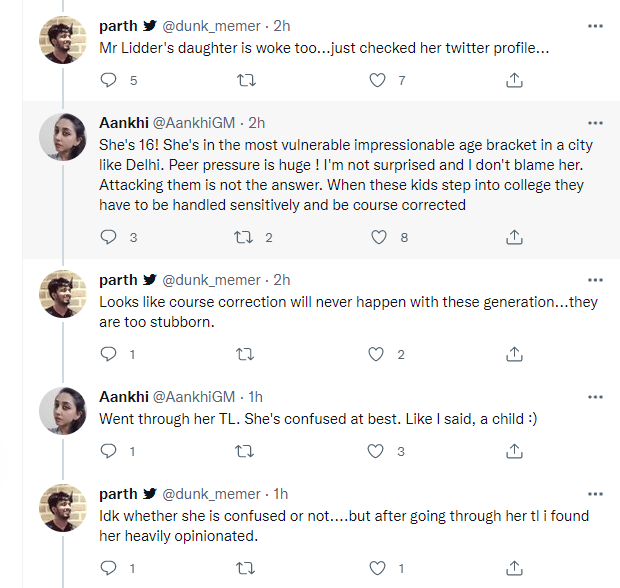
Many claimed that Aashna as ‘woke’, a screenshot of a Twitter thread has been circulating on the microblogging site, in which two people are talking about how ‘military kids can end being woke’.

By Abhishek Kumar
Aashna Lidder, daughter of Brigadier LS Lidder on Friday performed the last rites of her father Brigadier Lakhwinder Singh Lidder. Brigadier Lidder along with CDS General Bipin Rawat and his wife Madhulika Rawat and 10 other army personnel were killed in an army helicopter crash in Tamil Nadu’s Coonoor district.
On December 10, the last rites of CDS General Bipin Rawat, his wife Madhulika Rawat, and Brigadier LS Lidder were performed, before that country’s senior leaders, politicians, and many renowned personalities paid their last respects to the departed souls.
Aashna Lidder, daughter of Brigadier Lidder, told media that, she is proud of her father that it’s not only her family’s loss but also the entire nation’s. Aashna said that her father was a hero and her best friend.
Why Aashna Lidder was trolled?
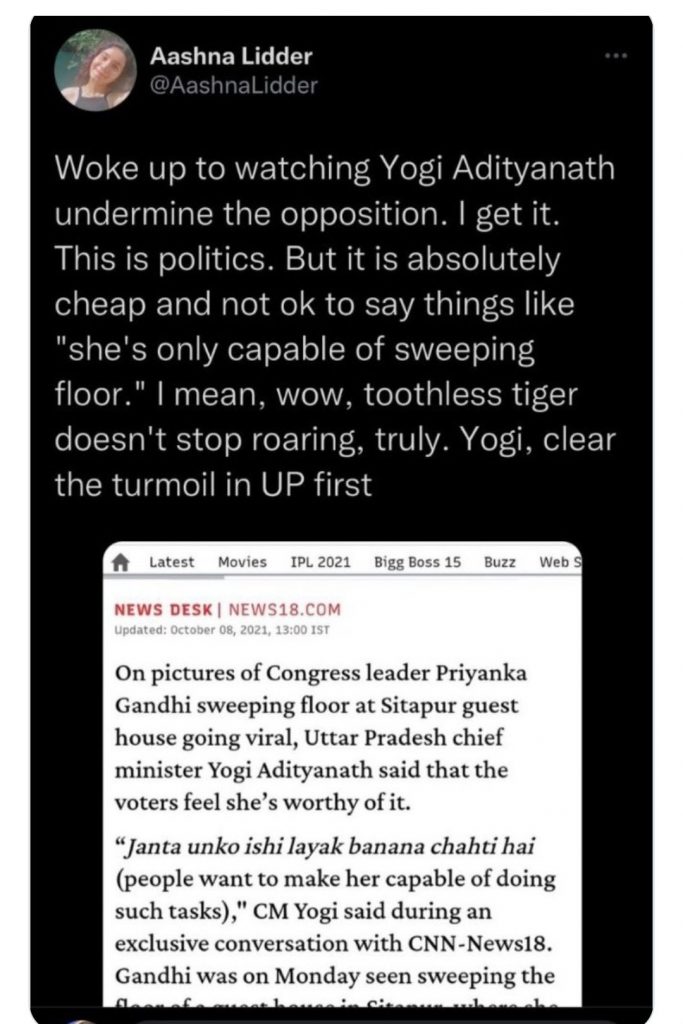
However, after interacting with the media, some people on Twitter started discussions on her Twitter activities and said many things to her. She was heavily criticized and trolled for her expressing her ideology on the microblogging platform. In many of her Twitter activities, she had liked many tweets of the Congress party and its senior leader Priyanka Gandhi Vadra.
When Aashna criticized Yogi Government
In one of her tweets, she had also criticized Yogi Government in Uttar Pradesh, when he had ridiculed Priyanka Gandhi for sweeping the floor in the Sitapur guest house where she was detained by UP police on her way to Lakhimpur Kheri.
Is Aashna Lidder a woke?
Many claimed that Aashna as ‘woke’, a screenshot of a Twitter thread has been circulating on the microblogging site, in which two people are talking about how ‘military kids can end up being woke’.
Has Aashna Lidder deactivated her Twitter account?
After being heavily criticized by trolls, Aashna Lidder, who is still mourning the death of her father, ended up deactivating her Twitter account.

Political leaders and journalists came in support of Aashna
Several political leaders and renowned personalities like Priyanka Chaturvedi, Karthi Chidambaram and many others laid their support to Asshna and lauded her fearlessness or expressing her ideology, extended their support to the 16-year-old Aashna.
More about Aashna Lidder
In one of her old videos uploaded on Twitter, Aashna can be seen how proud she is being a military child. Aashna says that in her 15 birthdays, her father has missed at least 7 of them and at least 20 family functions, all because for him it was country first then family.
Read Also: Viswanathan Anand birthday special: Know mindboggling facts about India’s chess grandmaster
To those who do not know, Aashna Lidder at the age of 16, has written a book ‘In Search of a Title’, the foreword of which was written by none other than Chief of Defence Staff Bipin Rawat. Late CDS General Bipin Rawat appreciated the efforts of Aashna and wrote, growing up in a military family, she has experienced the highs and lows every military child goes through. CDS General wished her best by saying to continue her quest in poetry with passion.
India News
Veeramani POCSO case: Vijay questions Stalin over earlier probe
Tamil Nadu Chief Minister Vijay has questioned MK Stalin over the handling of the Veeramani POCSO case, while Stalin has rejected allegations that the previous DMK government protected anyone.


India News
Women wrestlers challenge Brij Bhushan’s acquittal in sexual harassment case
Four women wrestlers have challenged the acquittal of former WFI chief Brij Bhushan Sharan Singh and co-accused Vinod Tomar in a sexual harassment case.
India News
Congress protests against Gyanesh Kumar, demands Election chief’s resignation
Congress workers took to the streets against Chief Election Commissioner Gyanesh Kumar, with protests and demonstrations held over the party’s allegations concerning the Election Commission.

Assam makes Muslim marriage registration compulsory under new rules
Akhilesh Yadav launches SP’s 2027 UP poll campaign from Rahul Gandhi’s seat

Trump-Xi Summit: Trade, Taiwan and AI among key takeaways

Congress protests against Gyanesh Kumar, demands Election chief’s resignation

Women wrestlers challenge Brij Bhushan’s acquittal in sexual harassment case

Veeramani POCSO case: Vijay questions Stalin over earlier probe
Women wrestlers challenge Brij Bhushan’s acquittal in sexual harassment case
Congress protests against Gyanesh Kumar, demands Election chief’s resignation
Assam makes Muslim marriage registration compulsory under new rules
Trump-Xi Summit: Trade, Taiwan and AI among key takeaways

Afghan Men Try To Hang With The Jet Engine Of The Aircraft in Kabul- Afghanistan News – Kabul News
Trending Top 10 News: 10000 Crore Fine on Flipkart, Apple to Launch Unique Feature, Hdfc Bank Job Ad

Trending Top 10 News: Nokia 6310, Apple sales, Bachpan ka Pyar Video Kid, Dainik Bhaskar IT Raid

Trending Top 10 News: Canada bans Indian flights, Rain in Delhi NCR, AIMIM Twitter hacked, Raj Kundra case

Trending Top 10 News: Shein India, Apple New Service, Pocket Oxygen, Oppo Launched New Phone
-
 India News22 hours ago
Assam makes Muslim marriage registration compulsory under new rules
-
India News22 hours ago
Akhilesh Yadav launches SP’s 2027 UP poll campaign from Rahul Gandhi’s seat
-
 India News22 hours ago
Trump-Xi Summit: Trade, Taiwan and AI among key takeaways
-
 India News13 hours ago
Congress protests against Gyanesh Kumar, demands Election chief’s resignation
-
 India News12 hours ago
Women wrestlers challenge Brij Bhushan’s acquittal in sexual harassment case
-
 India News12 hours ago
Veeramani POCSO case: Vijay questions Stalin over earlier probe
