English हिन्दी
Connect with us

India News

Yogi Adityanath asks Samajwadi Party to expel Abu Azmi, says bring him to UP and will take care

“The Samajwadi Party must decide its position on this matter. Expel this wretched individual from your party and send him to Uttar Pradesh. We know how to deal with such people here,” Adityanath said, escalating his criticism of the SP.

Published

on

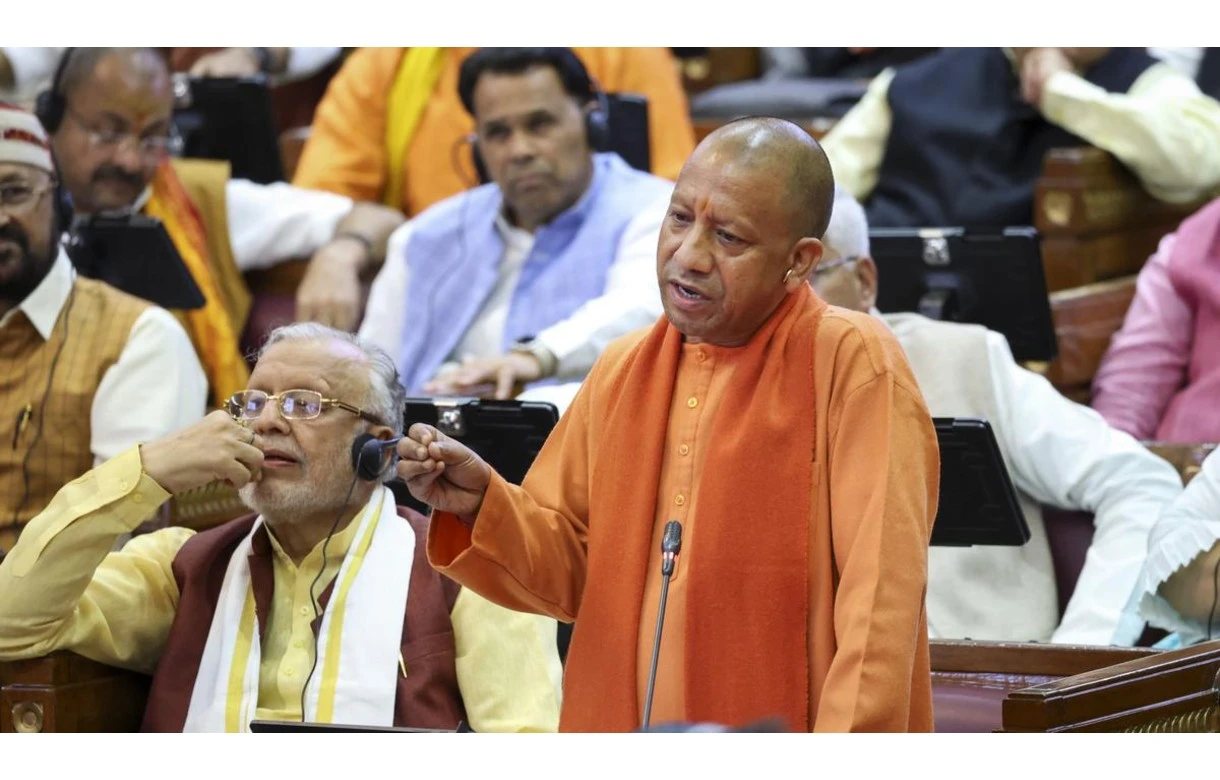
Uttar Pradesh Chief Minister Yogi Adityanath on Wednesday launched a scathing attack on the Samajwadi Party (SP) over Maharashtra MLA Abu Azmi’s controversial remarks glorifying Mughal ruler Aurangzeb. Addressing the Legislative Council, Adityanath demanded that the SP take a clear stand on the issue and expel Azmi from the party, accusing the SP of double standards and disrespecting India’s cultural heritage.

“The Samajwadi Party must decide its position on this matter. Expel this wretched individual from your party and send him to Uttar Pradesh. We know how to deal with such people here,” Adityanath said, escalating his criticism of the SP.
The Chief Minister’s remarks came after SP members interrupted him during his speech in the Council. He challenged the party to publicly condemn Azmi’s statements and take decisive action. “Either call him to a public gathering and make him clarify his remarks or send him to Uttar Pradesh. We do not take long to deal with such people here,” Adityanath asserted.

Adityanath questioned Azmi’s loyalty to India, asking, “A person who feels ashamed of the legacy of Chhatrapati Shivaji Maharaj but considers Aurangzeb his hero—does he even have the right to live in India?”

He accused the SP of hypocrisy, pointing out that while the party criticizes events like the Kumbh Mela, it glorifies Aurangzeb, a ruler known for his intolerance and destruction of temples. “On one hand, you criticize the Kumbh, and on the other, you glorify Aurangzeb—a ruthless, fanatical ruler who crushed India’s faith. What is stopping you from taking action against this leader?” Adityanath asked.

The Chief Minister also criticized the SP for deviating from the principles of socialist leader Dr. Ram Manohar Lohia, who upheld India’s cultural unity despite being a political rival of the Congress. “Even if you do not take pride in India’s heritage, at least follow the ideology of the leader whose name you use for political gain,” Adityanath said, quoting Lohia’s belief that India stands on the pillars of Lord Ram, Lord Krishna, and Lord Shiva.

Adityanath further highlighted Aurangzeb’s tyrannical rule, including his imprisonment of his father, Shah Jahan, in Agra Fort. “Aurangzeb left his own father to die of thirst. If the SP feels proud of Aurangzeb, they should read Shah Jahan’s autobiography, where he laments that even a Hindu son is better than Aurangzeb,” he said.

The Chief Minister also questioned why the SP venerates a ruler who imposed the jizya tax, persecuted non-Muslims, and attempted to Islamize India. “The SP must answer whether it truly considers a tyrant like Aurangzeb its role model, a ruler who attacked India’s faith and traditions,” he said.

Adityanath’s attack comes amid an ongoing controversy in Maharashtra, where Azmi was suspended from the state Assembly until the end of the Budget Session for his remarks eulogizing Aurangzeb. The Chief Minister’s remarks have intensified the political debate over the SP’s stance on historical figures and its commitment to India’s cultural heritage.

As the controversy unfolds, Adityanath’s challenge to the SP to clarify its position and take action against Azmi has put the party in a tight spot, with the BJP aiming to capitalize on the issue ahead of upcoming elections.

India News

Rahul Gandhi attacks G RAM G bill, says move against villages and states

Rahul Gandhi has criticised the G RAM G bill cleared by Parliament, alleging it dilutes the rights-based structure of MGNREGA and centralises control over rural employment.

Published

on

Rahul Gandhi

Leader of the Opposition Rahul Gandhi has launched a sharp attack on the Modi government after Parliament cleared the Viksit Bharat Guarantee for Employment and Livelihood Mission (Rural) Bill, commonly referred to as the ‘G RAM G’ bill. He described the proposed law as “anti-state” and “anti-village”, arguing that it weakens the core spirit of the Mahatma Gandhi National Rural Employment Guarantee Act (MGNREGA).

The new legislation, which is positioned as an updated version of MGNREGA, was passed amid protests by opposition parties and is expected to replace the existing scheme once it receives presidential assent.

‘Bulldozed without scrutiny’, says Rahul Gandhi

Rahul Gandhi criticised the manner in which the bill was cleared, saying it was pushed through Parliament without adequate debate or examination. He pointed out that the opposition’s demand to refer the bill to a standing committee was rejected.

According to him, any law that fundamentally alters the rural employment framework and affects crores of workers should undergo detailed scrutiny, expert consultation and public hearings before approval.

Claim of dilution of rights-based guarantee

Targeting the central government, the Congress leader said the proposed law dismantles the rights-based and demand-driven nature of MGNREGA and replaces it with a rationed system controlled from Delhi. He argued that this shift undermines the autonomy of states and villages.

Rahul Gandhi alleged that the intent behind the move is to centralise power and weaken labour, particularly impacting rural communities such as Dalits, OBCs and Adivasis.

Defence of MGNREGA’s impact

Highlighting the role of MGNREGA, Gandhi said the scheme provided rural workers with bargaining power, reduced distress migration and improved wages and working conditions, while also contributing to rural infrastructure development.

He also recalled the role of MGNREGA during the Covid period, stating that it prevented crores of people from slipping into hunger and debt. According to him, any rationing of a jobs programme first affects women, landless workers and the poorest communities.

Opposition to name change and provisions

The Congress has also objected to the renaming of the scheme, accusing the government of attempting to erase the legacy associated with Mahatma Gandhi. Opposition MPs staged a dharna within the Parliament complex, questioning provisions of the bill that they claim dilute the “soul and spirit” of the original law enacted in 2005.

Under MGNREGA, the government guaranteed 100 days of work in rural areas along with an unemployment allowance if work was not provided. The ‘G RAM G’ bill proposes to raise the guaranteed workdays to 125, while retaining other provisions. However, critics have flagged concerns over employment being linked to pre-approved plans.

The bill was cleared after a midnight voice vote in the Rajya Sabha, following its passage in the Lok Sabha amid protests and walkouts. It will become law once approved by the President.

Continue Reading

India News

G RAM G bill replacing MGNREGA passes Parliament amid opposition walkout and protests

The G RAM G Bill replacing MGNREGA has been passed by Parliament after overnight debate in the Rajya Sabha, triggering protests and walkouts by opposition parties.

Published

on

Parliament

Parliament has cleared the Viksit Bharat Guarantee for Employment and Livelihood Mission (Rural) Bill, commonly referred to as the G RAM G Bill, paving the way for the replacement of the Mahatma Gandhi National Rural Employment Guarantee Act (MGNREGA). The legislation was passed within two days amid sharp political confrontation, walkouts and overnight protests by opposition parties.

The bill was approved by the Lok Sabha despite repeated disruptions and protests. In the Rajya Sabha, the debate stretched beyond midnight, with voting held around 12.15 am. The bill was eventually passed by a voice vote after opposition members staged a walkout, leaving the ruling alliance members present in the House.

Opposition objects to name change and provisions

The Congress and other opposition parties mounted a strong challenge to the bill, objecting both to the change in the scheme’s name and its revised framework. A key point of contention was the removal of Mahatma Gandhi’s name from the legislation, which opposition leaders said reflected an ideological shift rather than a policy necessity.

Congress president Mallikarjun Kharge launched a sharp attack during the Rajya Sabha debate, urging the government to withdraw the bill and warning that it would harm the rural poor. He accused the government of speaking in the name of welfare while undermining the interests of vulnerable communities, making an emotional appeal to reconsider the legislation.

Several opposition members initially demanded that the bill be referred to a standing committee for detailed scrutiny. When that demand was not accepted, they called for the bill’s withdrawal and later staged a walkout. Members of the Trinamool Congress and other parties subsequently sat on a dharna within Parliament premises.

Heated exchanges in the Upper House

The debate witnessed intense exchanges between the treasury benches and the opposition. Trinamool Congress MP Derek O’Brien linked the passage of the bill with developments in West Bengal, alleging that the Centre’s actions had consequences for the implementation of rural employment schemes in the state. He also referred to the state government’s decision to rename its employment initiative following the Lok Sabha vote.

As Rural Development Minister Shivraj Singh Chouhan rose to reply, opposition members raised slogans demanding the withdrawal of what they termed a “black bill”. When the protests continued, opposition MPs walked out, allowing the bill to be passed without their presence.

Responding sharply, Chouhan criticised the walkout and accused the opposition of refusing to engage in debate. He defended the government’s move, arguing that the earlier scheme had suffered from corruption and inefficiencies, and said the new law was drafted after consultations with stakeholders.

Government defends overhaul of rural employment scheme

The government has maintained that updating the two-decade-old MGNREGA framework was necessary to address structural shortcomings and align it with current rural needs. According to the provisions outlined, the new law increases the guaranteed days of work from 100 to 125 while retaining key elements of the earlier scheme.

However, critics have pointed out that employment under the new framework will be based on pre-approved plans rather than demand-driven applications at the gram panchayat level. The work categories have also been streamlined into four segments—water security, core rural infrastructure, livelihood-related assets, and climate resilience—raising concerns that local flexibility may be reduced.

Opposition leaders have argued that these changes dilute the original spirit of MGNREGA, which was designed as a rights-based, demand-driven employment guarantee programme.

Protests continue after passage

Following the bill’s passage, opposition parties reiterated their charge that the legislation weakens the guarantee, livelihood assurance and social security that formed the core of the original programme introduced in 2005. Despite these objections, the government’s numerical strength ensured the bill’s smooth passage through both Houses.

With parliamentary approval now secured, the G RAM G Bill is set to replace MGNREGA, marking a significant shift in India’s rural employment policy framework amid continuing political debate.

Continue Reading

India News

Priyanka Gandhi meets Nitin Gadkari over Kerala road projects, light moments mark discussion

Priyanka Gandhi met Nitin Gadkari in Parliament to discuss road projects in Kerala, with the meeting marked by humour, political remarks and an informal food tasting.

Published

on

Priyanka Gandhi meets Nitin Gadkari (1)

Congress MP Priyanka Gandhi Vadra on Thursday met Union Road Transport and Highways Minister Nitin Gadkari at his office in Parliament to raise issues related to road infrastructure projects passing through Kerala. The meeting combined formal discussions with lighter moments, including a humorous exchange and an unexpected food tasting session.

Kerala road projects discussed at Parliament meeting

Priyanka Gandhi, the Member of Parliament from Wayanad in Kerala, discussed six road projects that pass through the state. During the interaction, Nitin Gadkari clarified that some of these projects fall under the jurisdiction of the Kerala government and therefore cannot be directly handled by the Centre. However, he assured the Congress leader that the remaining proposals would be examined.

According to those present, the discussion remained cordial, with both sides acknowledging administrative limitations while exploring possible ways forward.

‘Bhai ka kaam ho gaya’ remark draws laughter

The meeting also saw a light-hearted moment when Gadkari referred to a recent interaction with Rahul Gandhi, the Leader of the Opposition in the Lok Sabha. He said Rahul Gandhi had met him earlier regarding road-related concerns in Rae Bareli.

In a humorous remark, Gadkari said that if work was done for the brother but not for the sister, it could lead to complaints. The comment prompted laughter from Priyanka Gandhi and others present in the room.

Congress confident of future action in Kerala

During the conversation, Priyanka Gandhi expressed confidence about the Congress party’s prospects in the upcoming Kerala Assembly elections. She indicated that proposals currently under the purview of the Left Front government in the state would be taken forward once Congress comes to power.

Her remarks reflected political confidence while keeping the focus on infrastructure needs in Kerala.

A homemade dish adds informal touch

Apart from policy discussions, the meeting included an informal culinary moment. Nitin Gadkari had prepared a rice-based dish after learning the recipe from online videos. Visitors to his office were offered rice balls served with chutney.

Gadkari encouraged Priyanka Gandhi to taste the dish, and she, along with Congress leader Deepender Singh Hooda, was seen sampling the food while continuing their conversation with the minister.

Continue Reading

Trending

© Copyright 2022 APNLIVE.com