English हिन्दी
Connect with us

India News

Atishi sworn in as Delhi Chief Minister

The Kalkaji MLA’s name was proposed by Kejriwal, who tendered his resignation as Chief Minister, for the top post.

Published

on

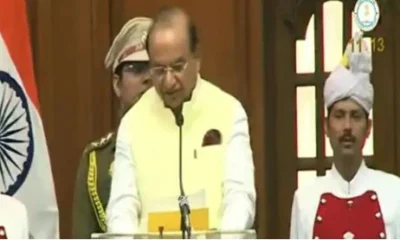
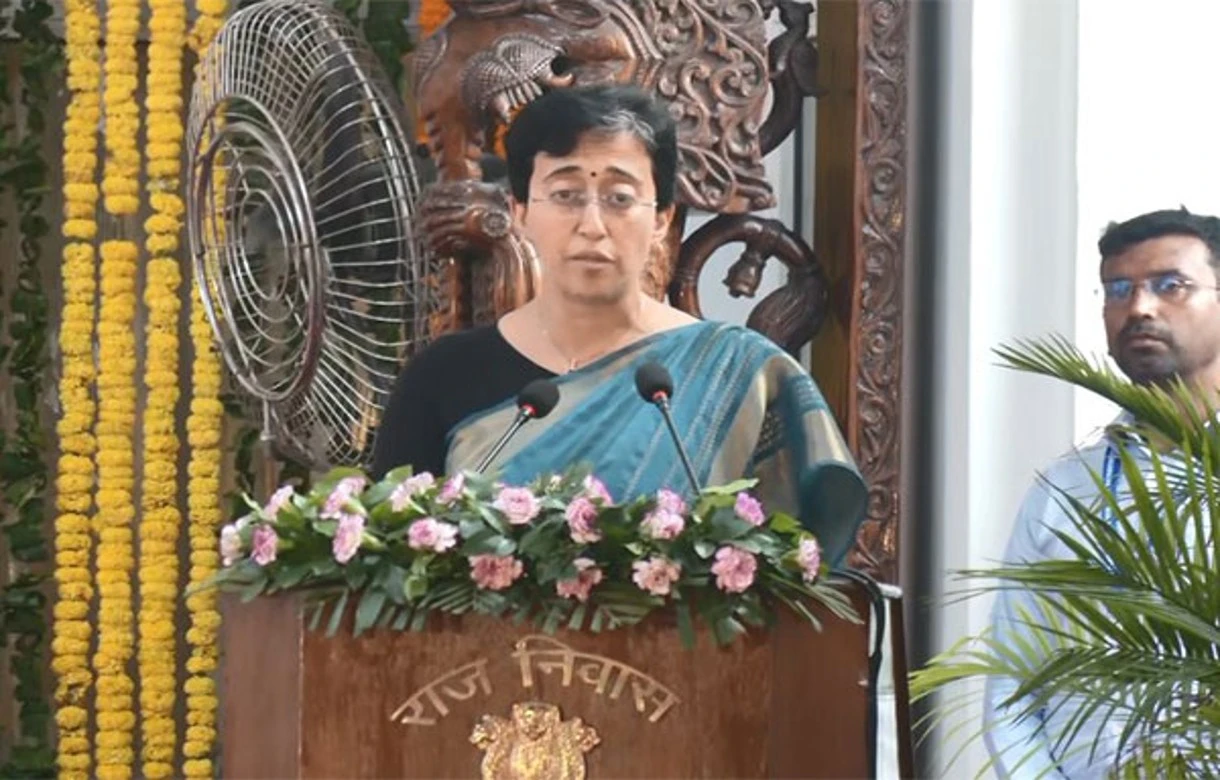
Aam Aadmi Party leader Atishi took oath as Chief Minister of Delhi at Raj Niwas on Saturday. With this, she became the 17th woman to hold the top office in independent India and the third youngest after Sushma Swaraj and Sheila Dikshit in the national capital.

Former Chief Minister Arvind Kejriwal, senior AAP leader Manish Sisodia, and other dignitaries were also present during the swearing-in ceremony. Atishi’s parents Vijay Singh and Tripta Wahi were also present.

The Council of Ministers including Saurabh Bharadwaj, Gopal Rai, Imran Hussain, Kailash Gahlot, and new Sultanpur Majra MLA Mukesh Ahlawat also took oath into the Delhi Cabinet along with Atishi.

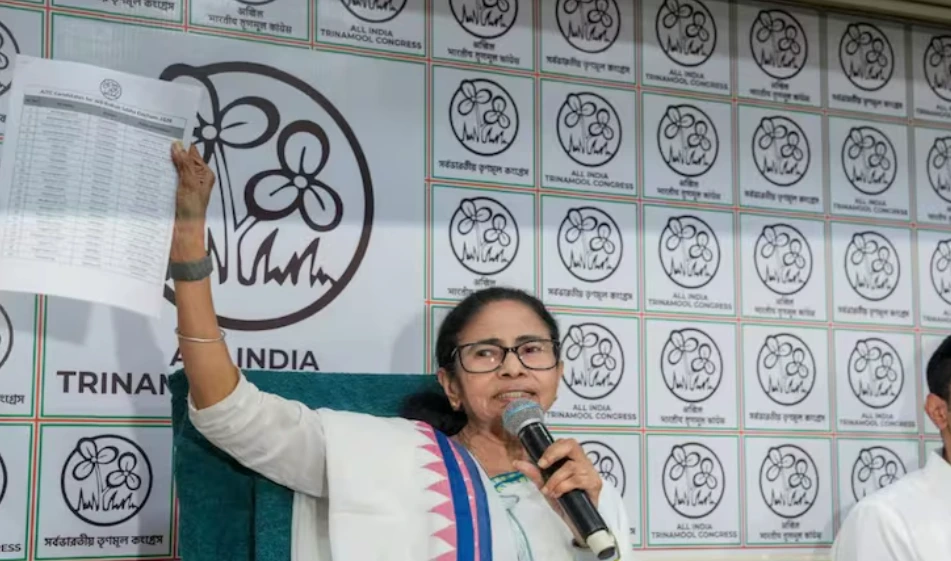
The senior AAP leader, who will have a brief tenure in office as Assembly elections in the national capital are due in February, has become the second woman sitting Chief Minister alongside West Bengal’s Mamata Banerjee.

The 43-year-old has been a key face of the party and managed AAP’s operations during Arvind Kejriwal’s time in Tihar jail in connection with the excise policy case.

The Kalkaji MLA’s name was proposed by Kejriwal, who tendered his resignation as Chief Minister, for the top post.
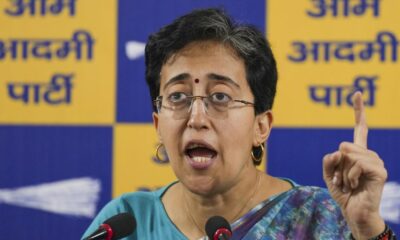
A first-time legislator, Atishi, name was selected unanimously following a meeting of the party MLAs in the presence of top leaders including AAP convener Arvind Kejriwal.

After taking the oath, Atishi was overwhelmed with emotion and sought the blessings of her mentor and AAP chief, Arvind Kejriwal, by touching his feet.

On Friday, President Droupadi Murmu appointed Atishi as Delhi Chief Minister from the date of her being sworn in while accepting Kejriwal’s resignation. She also cleared the proposal to appoint five ministers.

After taking oath as the Delhi Chief Minister, Atish thanked AAP convener Kejriwal who has given her the responsibility to serve two crore Delhiites.

“Arvind Kejriwal understood the struggle of the common man and changed the face of Delhi in the last 10 years with excellent education and health facilities, free electricity and many other facilities,” the new Chief Minister said in her post on X.

“Kejriwal is not the Chief Minister of Delhi today, this is a very emotional moment for us. But we have only one objective in the upcoming elections – to make Arvind Kejriwal the Chief Minister of Delhi again,” she said.

Also, in these 4 months, under the guidance of Arvind Kejriwal, all the work of Delhiites will be done which was stopped by BJP through its conspiracies, she asserted. Kejriwal is now out of jail and will not let any conspiracy of BJP succeed, Atishi added.

After being inducted as Minister in Delhi cabinet, AAP leader Kailash Gahlot said that Kejriwal’s guidance as party’s national convenor will remain. “Our only goal is to continue to work for the people of Delhi like before and to bring back Arvind Kejriwal,” he added.

AAP MLA Gopal Rai, after taking oath as Delhi Minister, emphasised carrying forward the work that was started in Delhi under the leadership of Arvind Kejriwal to new heights by the time of the next elections.

“Along with this, we will work as a team to control pollution that increases during the winters. We will also work on other pending work,” the newly inducted Minister added.

Speaking to reporters after taking oath as Delhi Minister, Mukesh Ahlawat said that the ministry that he is being assigned with has always been challenging. However, he said he would fulfill his responsibilities properly.

Another inducted Minister in Delhi cabinet, Imran Hussain, said, “In another 4-5 months, Delhi Assembly elections will be held and Delhi will make Arvind Kejriwal the CM again. The work is being done under the guidance of Arvind Kejriwal – be it the education model, free water, free bus travel for women and others.”

India News

Shashi Tharoor questions Centre over Kerala name change to Keralam

Shashi Tharoor has criticised the Centre’s decision to approve renaming Kerala as Keralam, questioning its impact and pointing to the lack of major projects for the state.

Published

on

shashi tharoor

Congress MP Shashi Tharoor has criticised the central government over its decision to approve the renaming of Kerala as ‘Keralam’, arguing that the move prioritises symbolism over development.

Reacting to the Union Cabinet’s approval, Tharoor said that the state’s name has always been ‘Keralam’ in Malayalam and questioned the practical impact of introducing the Malayalam term into English usage.

“It has already been ‘Keralam’ in Malayalam. So now, a Malayalam word is coming into English. I don’t know what difference it makes,” he said, adding that the state has not received major projects such as an AIIMS or new institutions from the Centre. He also pointed out that no significant allocations were made for Kerala in the Union Budget.

In a separate post on X, Tharoor raised what he described as a “small linguistic question” about what residents of the state would be called if the name change is implemented. Referring to existing terms such as “Keralite” and “Keralan”, he remarked that alternatives like “Keralamite” sounded like a microbe and “Keralamian” like a rare earth mineral.

The Union Cabinet, chaired by Prime Minister Narendra Modi, cleared the proposal on Tuesday. The move comes ahead of the upcoming state Assembly elections, in which 140 members of the legislative assembly are to be elected. The poll schedule is yet to be announced by the Election Commission of India.

The state assembly had earlier passed a resolution seeking the change in official records. Chief Minister Pinarayi Vijayan had moved the resolution in 2024, urging the Union government to adopt the name ‘Keralam’ in all languages listed in the Eighth Schedule of the Constitution.

He had stated that the demand for a united Kerala for Malayalam-speaking people dates back to the national freedom movement.

Continue Reading

India News

Tamil Nadu potboiler: Now, Sasikala to launch new party ahead of election

Sasikala has announced the launch of a new political party ahead of the Tamil Nadu Assembly elections, positioning herself against AIADMK chief Edappadi K Palaniswami.

Published

on

In a significant political development ahead of the Tamil Nadu Assembly elections, expelled AIADMK leader V. K. Sasikala has announced that she will float a new political party and contest the polls by fielding her own candidates.

Speaking in Madurai before heading to Pasumpon for a public event, Sasikala said she would unveil her party’s flag later in the evening. She indicated that more details regarding the party’s structure and plans would be shared at the gathering.

The event venue carries political symbolism. Pasumpon is the birthplace of Thevar leader Muthuramalinga Thevar, and Sasikala herself belongs to the influential Thevar community in southern Tamil Nadu. The programme was held as part of birth anniversary events of former Chief Minister J. Jayalalithaa.

Direct challenge to EPS

Sasikala’s move is being viewed as a direct political challenge to AIADMK general secretary Edappadi K. Palaniswami (EPS). After Jayalalithaa’s death in 2016, Sasikala briefly took control of the party and had appointed Palaniswami as Chief Minister. However, following her conviction in the disproportionate assets case, she served a four-year prison term, and during that period, she was expelled from the party.

Palaniswami later aligned with O. Panneerselvam, whom Sasikala had earlier removed from the Chief Minister’s post. The two leaders subsequently adopted a dual leadership arrangement within the party and government.

Sasikala remains disqualified from contesting elections until 2027 due to her conviction. Nevertheless, she has stated that she intends to field candidates under her new party banner.

Fragmented Thevar vote base

Over the years, expulsions within the AIADMK — including Sasikala, her nephew TTV Dhinakaran and O Panneerselvam — have led to divisions within the Thevar support base. Political observers have linked this fragmentation to the party’s weakened electoral performance in the elections following Jayalalithaa’s passing.

While Dhinakaran has returned to the NDA fold, reports suggest Palaniswami is opposed to any arrangement that includes Sasikala or Panneerselvam. OPS, meanwhile, has exited the NDA.

Sasikala has repeatedly criticised Palaniswami, describing him as a betrayer, while he maintains that his leadership stems from the support of AIADMK legislators rather than her backing.

The AIADMK has not issued an official statement on Sasikala’s announcement. However, a senior party leader questioned her political standing, pointing out her disqualification from contesting elections and referring to legal issues linked to Jayalalithaa’s death.

With the Assembly polls approaching, Sasikala’s re-entry into active politics could further complicate the opposition space in Tamil Nadu and influence electoral calculations, particularly in the southern districts.

Continue Reading

India News

As stealth reshapes air combat, India weighs induction of Sukhoi Su-57 jets

India is assessing the possible induction of up to 40 Sukhoi Su-57 fifth-generation fighter jets as stealth becomes central to future air combat strategy.

Published

on

Sukhoi Su-57 jets

Aerial warfare is increasingly being defined by the ability to remain undetected rather than by traditional dogfighting skills, and India is now assessing options to strengthen its capabilities in this new paradigm. Defence circles are abuzz with indications that the Indian Air Force may consider procuring up to 40 Russian fifth-generation Su-57 fighter jets, according to sources.

The possible move comes less than a year after Operation Sindoor, which was launched in May last year following the Pahalgam terror attack. The air engagements with the Pakistan Air Force during the operation are understood to have provided fresh operational insights, prompting discussions on future preparedness.

Why stealth is central to fifth-generation fighters

Fifth-generation fighter aircraft are designed with a strong emphasis on low observability. Platforms such as the Su-57 incorporate airframes shaped to reduce radar signatures and use radar-absorbent materials to make detection more difficult across radar, infrared and visible spectrums.

These aircraft typically integrate advanced avionics, sensor fusion and supercruise capabilities. They are also configured to carry specialised weapons internally, enhancing stealth during combat missions.

According to information available on Sukhoi’s official platform, the Su-57 is equipped with a deeply integrated avionics suite that offers a high level of automation and intelligent crew support. Its onboard systems enable it to operate autonomously and exchange data in real time with ground control systems or as part of a coordinated task force.

The aircraft can deploy a broad range of air-to-air and air-to-surface munitions, allowing it to undertake both fighter and strike roles. Sukhoi states that the jet is capable of conducting covert missions owing to reduced visibility across multiple wavelength ranges.

The Su-57 is also fitted with an auxiliary power unit designed to improve deployment autonomy and lower fuel consumption during ground operations. An onboard oxygen extraction unit enhances operational endurance. Additionally, the aircraft features an explosion-proof fuel tank system described as a generator-type neutral gas system, aimed at improving combat survivability.

Regional security context

The reported deliberations come amid evolving regional dynamics. China, regarded as Pakistan’s close strategic partner, has developed the J-20 fifth-generation stealth fighter, and there are indications that such capabilities could eventually be shared with Pakistan.

India is also pursuing its own fifth-generation programme, the Advanced Medium Combat Aircraft (AMCA). The first flight of the AMCA is expected around 2028 or 2029, with induction into the Air Force projected around 2035.

In this backdrop, any decision on the Su-57 would form part of a broader effort to ensure that the Indian Air Force remains prepared for future aerial warfare scenarios where stealth and advanced sensing capabilities play a decisive role.

Continue Reading

Trending

© Copyright 2022 APNLIVE.com