
India News
Bulandshahr violence: SSP, two other police officers transferred, soldier arrested


[vc_row][vc_column][vc_column_text]Uttar Pradesh government has transferred Bulandshahr district police chief, Senior Superintendent of Police (SSP) Krishna Bahadur Singh and two others police officers for failing to act promptly to curb violence in the area six days ago, said media reports today (Saturday, Dec 8).
Inspector Subodh Kumar Singh and a youth reportedly involved in the rampage, Sumit Kumar, were shot and killed in the violence.
An army soldier suspected of killing the inspector in UP mob frenzy was detained in Jammu and Kashmir last night. Jitendra Malik, also known as Jeetu Fauji, was detained last night by a team of the Uttar Pradesh police from Jammu and Kashmir”s Sopore town, said media reports.
In UP, SSP Singh has been moved to Lucknow. Superintendent of Police of Sitapur, Prabhakar Chaudhary, has replaced him.
The government transferred two other police officers; Syana Circle Officer DSP Satya Prakash Sharma was sent to Police Training College in Moradabad and Chingravathi police station in-charge Suresh Kumar was transferred to Lalitpur.
The development comes a day after ADG (Intelligence) SB Shiradkar, who was asked to probe the violence over allegations of cows being killed, submitted his report to Chief Minister Yogi Adityanath.
A senior home department official said they have been taken to task for not being fast enough in reacting to the situation that arose after animal carcasses were found in a forest near a village, reported IANS.
The action was taken after a high-level meeting was presided over by the Director General of Police (DGP) OP Singh, who had handed over the report to Chief Minister Yogi Adityanath on his arrival from New Delhi.
Violence an ‘accident’, Inspector’s killing not ‘mob lynching’: Adityanath
Adityanath, who, in his first briefing to the police after the violence, had told the police to focus primarily on the issue of cow slaughter with little mention of the murder of the police inspector, said on Friday that the Bulandshahr incident was an “accident” and that the death of Inspector Subodh Kumar Singh was not a case of “mob lynching”. He added that the law was taking its course and the culprits would not be spared.
He had earlier said the incident was result of a “big conspiracy” but at a media event in Delhi on Friday, he said that the incident was actually an accident.
“Uttar Pradesh mein mob lynching ki koi ghatna nahi hai, ek. Bulandshahr ki ghatna ek durghatna hai, aur isme kanoon apna karya kar raha hai. Koi bhi doshi baksha nahi jayega. Illegal slaughtering, keval cow hatya hi nahi, illegal slaughtering poore UP mein ban hai and DM, SP uske prati poore jawabdeyi honge,” Adityanath said, while speaking at the Jagran Forum in Delhi.
(There is no mob lynching in UP. The Bulandshahr incident was an accident, and the law is taking its course. No culprit will be spared. Illegal slaughtering, and not just cow slaughter, is banned in the entire state and the DM and SP will be answerable).”
This comes after ADG (Intelligence) SB Shiradkar’s findings which, as reported by News18 yesterday, said carcasses of cows found in Syana village were two days old and probably brought from outside and planted there. Moreover, the report said, the mob’s intention seemed to be to provoke a clash with the Muslims’ procession on the occasion of their festival of Ijetma.
Soldier detained, eight arrests in Inspector’s murder case
In connection with Inspector Subodh Kumar’s killing, the police have arrested eight accused but the main conspirator Yogeshraj Singh, the district convener of the Bajrang Dal, remains missing.
The army soldier Jitendra Malik, also known as Jeetu Fauji, who has emerged as the key suspect in the killing of a police inspector in mob frenzy over alleged cow slaughter in Uttar Pradesh’s Bulandshahr on Monday, was detained from 22 Rashtriya Rifles Army camp in Sopore, Jammu and Kashmir, by a team of the Uttar Pradesh police, said media reports.

Jeetu Fauji, who is posted in Srinagar, was in his hometown Bulandshahr on 15-day leave when the mob violence took place, and can be seen in various videos shot that day.
Quoting sources, NDTV said he fled to Sopore the same evening inspector Subodh Kumar Singh and a civilian were killed.[/vc_column_text][/vc_column][/vc_row]









India News
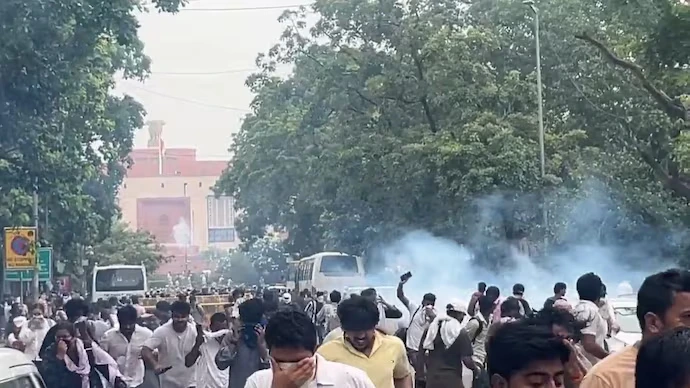
Delhi deploys 25,000 personnel, installs CCTV cameras ahead of CJP march
More than 25,000 police and paramilitary personnel have been deployed in Delhi ahead of the CJP’s planned protest march at Connaught Place. Authorities have also imposed restrictions and stepped up CCTV surveillance.

India News
Mallikarjun Kharge’s ‘Your Friends’ jab at Rahul Gandhi over congress exits
Congress president Mallikarjun Kharge took a dig at Rahul Gandhi after the Leader of the Opposition reportedly described former party leaders Jyotiraditya Scindia and Ghulam Nabi Azad as among those who had left the Congress.

India News
Delhi Police offers 11-person limit for CJP’s Connaught Place protest
Delhi Police has offered to facilitate a group of 11 people at Central Park in Connaught Place for the Cockroach Janata Party’s October 16 protest, while warning that violations of prohibitory orders could invite legal action.


India-US trade deal first phase finalised, drafting underway

Election Commission orders voter roll revision in 17 states, UTs

Actor Imran Khan asked to leave India after CJP protest

Delhi Police offers 11-person limit for CJP’s Connaught Place protest

Mallikarjun Kharge’s ‘Your Friends’ jab at Rahul Gandhi over congress exits

Magnitude 7 earthquake strikes Russia’s Kamchatka Peninsula

Delhi deploys 25,000 personnel, installs CCTV cameras ahead of CJP march
Mallikarjun Kharge’s ‘Your Friends’ jab at Rahul Gandhi over congress exits
Delhi Police offers 11-person limit for CJP’s Connaught Place protest
Actor Imran Khan asked to leave India after CJP protest

Afghan Men Try To Hang With The Jet Engine Of The Aircraft in Kabul- Afghanistan News – Kabul News
Trending Top 10 News: 10000 Crore Fine on Flipkart, Apple to Launch Unique Feature, Hdfc Bank Job Ad

Trending Top 10 News: Nokia 6310, Apple sales, Bachpan ka Pyar Video Kid, Dainik Bhaskar IT Raid

Trending Top 10 News: Canada bans Indian flights, Rain in Delhi NCR, AIMIM Twitter hacked, Raj Kundra case

Trending Top 10 News: Shein India, Apple New Service, Pocket Oxygen, Oppo Launched New Phone
-
 India News23 hours ago
India-US trade deal first phase finalised, drafting underway
-
 India News21 hours ago
Election Commission orders voter roll revision in 17 states, UTs
-
 India News21 hours ago
Actor Imran Khan asked to leave India after CJP protest
-
 India News20 hours ago
Delhi Police offers 11-person limit for CJP’s Connaught Place protest
-
 India News8 hours ago
Mallikarjun Kharge’s ‘Your Friends’ jab at Rahul Gandhi over congress exits
-
 India News8 hours ago
Delhi deploys 25,000 personnel, installs CCTV cameras ahead of CJP march
-
 Latest world news8 hours ago
Magnitude 7 earthquake strikes Russia’s Kamchatka Peninsula
