Cabinet reshuffle hopes: Jyotiraditya Scindia begins prayers before Delhi flight, Pashupati spotted looking for apt kurta in Bihar
Multiple media reports said that Prime Minister Narendra Modi will hold a crucial meeting at his residence on Tuesday at 5 pm to give the final touch to the cabinet reshuffle, however, the meeting has been cancelled.
Amid the growing cabinet reshuffle buzz this week, a crucial meeting of Prime Minister Narendra Modi with BJP chief J.P. Nadda and other senior ministers at his residence at 5pm on Tuesday, possibly to give final touches to the new-look cabinet, now stands cancelled.
Home Minister Amit Shah, Defence Minister Rajnath Singh, Finance Minister Nirmala Sitharaman, Nadda and party national general secretary BL Santhosh were expected to attend the meeting among others.
The Union Cabinet, which can have 81 members, currently has 53 ministers. This means 28 ministers can be added as there has been no expansion in the Union Cabinet since the Modi government returned to power in May 2019.
The Cabinet reshuffle comes amid the backdrop of criticism of the government’s Covid second wave handling where several ministers have not been doing justice to their respective portfolios.
In the current cabinet, some ministers hold as many as three portfolios while some ministries do not have an MoS, however, the current cabinet have remained with ministers only from the BJP after the withdrawal of the Akali Dal from the NDA.
With Uttar Pradesh, Uttarakhand, Gujarat, Goa, Manipur, Punjab and Himachal Pradesh heading to elections next year, the BJP obviously wants to keep everyone happy and hope to get re-elected in all 7 states. Even Maharashtra and West Bengal are expected to see more faces in the Cabinet.
Several leaders have made a beeline for the capital in the hope of landing a berth. These include Congress import Jyotiraditya Scindia, former Assam CM Sarbananda Sonowal, who was pipped to the post by the deft Himanta Biswa Sarma, Maharashtra MP Narayan Rane and Janata Dal leader RCP Singh.
Scindia, a former Union minister who switched to the BJP in March 2020, is expected to be part of the council of ministers while Sonowal is being considered a stronger contender than the Gwalior raja. Scindia, whose defection led to the collapse of the Congress government in Madhya Pradesh last year, is likely to be rewarded for his role in getting the state back in the BJP kitty.
Sushil Modi, the former Bihar deputy chief minister, is also likely to be accommodated in the cabinet. Other candidates who are in Delhi are Anupriya Patel of Apna Dal, Pankaj Chowdhury, Rita Bahuguna Joshi, Ramshankar Katheria, Varun Gandhi, Lallan Singh and Rahul Kaswan. Dinesh Trivedi and Jitin Prasada, formerly of Trinamool and Congress respectively, also figure in the really long list.
The elevation of Thawarchand Gehlot as Karnataka Governor leaves the Social Justice and Empowerment Ministry open for a new minister.
Sources claimed that it is not going to be a minor arrangement but a major reshuffle due to which some ministers may lose berths.
Pundits have indicated that the JD (U), an ally of the BJP, would like to be represented in the ministry as the party did not have any representation in the Council so far. It is also believed that the BJP’s allies such as the JD-U, LJP (Paras faction) and Apna Dal may get representation in the Union cabinet.
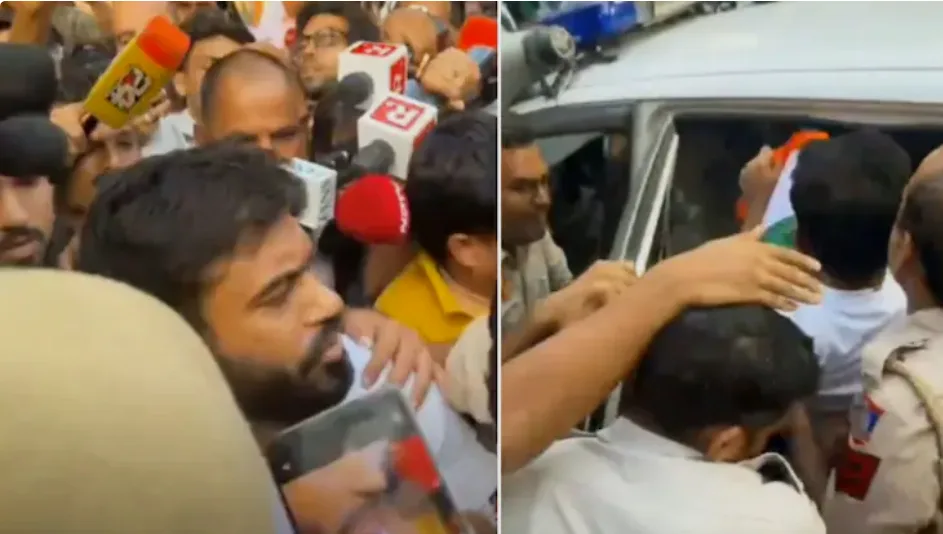
Pashupati Paras, who led the split in the Lok Janshakti Party (LJP) against former cabinet minister and LJP founder Ram Vilas Paswan’s son Chirag Paswan, was spotted shopping for a kurta. He whispered he had received an invitation from Delhi and wished it be kept a secret.
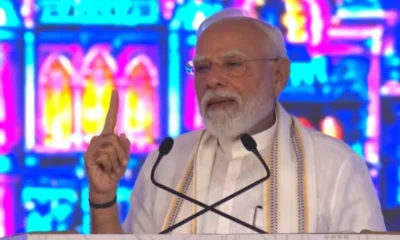
Prime Minister Narendra Modi revived his ‘dimagi Naxal’ remark while addressing the centenary celebrations of Shri Ram College of Commerce (SRCC) in Delhi on Saturday, using the term to criticise his opponents.
Speaking to students at the Delhi college, PM Modi described the phrase as a “homeopathic pill” and said it had prompted those he described as “dimagi Naxals” to come forward and reveal their views.
The prime minister also used his address to speak to Gen-Z about India’s development journey and asked students to consider the challenges the country had faced in the past.
PM Modi recalls past crises
During his speech, PM Modi referred to the 2013 Kedarnath disaster and the 2008 global financial crisis while criticising the handling of national emergencies by previous governments.
He said the government at the time of the Kedarnath disaster was shaken and questioned its ability to respond to the crisis.
Referring to the 2008 banking crisis, PM Modi alleged that the government of the time failed to effectively deal with the situation and claimed that India’s banking system was pushed close to collapse.
Prime minister lists challenges faced by his government
PM Modi also highlighted several major global crises that occurred during his government’s tenure.
He mentioned the COVID-19 pandemic, the Russia-Ukraine war, disruptions to global trade and supply chains, and the crisis in West Asia.
The prime minister said there had been concerns that India would struggle during these crises but argued that the country had continued to move forward.
PM Modi’s earlier SRCC visit
PM Modi had earlier visited SRCC in 2013, when he was the chief minister of Gujarat. His speech at the college received significant attention, particularly on social media, ahead of the 2014 Lok Sabha election.
His latest visit came during the college’s centenary celebrations, where his address focused on young people, India’s development ambitions and the challenges faced by the country.
India Metro Rail Network May Overtake US in 2 Years
India’s metro rail network has reached 1,170 km across 26 cities. Union minister Manohar Lal said the country could overtake the US in network length within two years.
India is on track to become the country with the second-largest metro rail network in the world after China, with Union Minister Manohar Lal saying the country could overtake the United States within the next two years.
India’s metro rail network has now expanded to 1,170 km across 26 cities. The network is only 216 km shorter than the US metro rail network, which stands at 1,386 km, according to figures cited by the minister.
India’s metro network expands rapidly
Speaking after the inauguration of an extended metro service in Indore, Manohar Lal highlighted the pace at which metro connectivity has grown in India.
He said metro services were operational across just 245 km in five cities when Prime Minister Narendra Modi assumed office in 2014. The network has since expanded to 1,170 km across 26 cities.
The minister said India could overtake the US in terms of metro rail network length in the next two years and become the world’s second-largest country in this segment after China.
China currently has around 8,000 km of metro rail lines, according to the figures cited by the minister.
Indore metro extension inaugurated
The minister made the remarks after inaugurating an extended section of the Indore metro. The project was built at a cost of around Rs 2,850 crore.
The Indore metro was earlier operating commercially on a six-km stretch between Gandhi Nagar and Super Corridor-3 stations. Following the extension, the service will operate on a 17-km route between Gandhi Nagar and Malviya Nagar Chauraha.
Madhya Pradesh Chief Minister Mohan Yadav said the metro service would mark a new phase in Indore’s development. He also said the network would eventually be extended to Ujjain and other nearby areas.
India’s metro rail network: Key figures
India currently has 1,170 km of operational metro rail network.
Metro services are operational across 26 cities.
The US has around 1,386 km of metro rail network.
India is currently 216 km behind the US.
China has around 8,000 km of metro rail lines.
India’s operational network stood at 245 km across five cities in 2014.
Prime Minister Narendra Modi returned to Delhi University’s Shri Ram College of Commerce (SRCC) on Saturday, 13 years after his previous visit to the institution as Gujarat chief minister.
His latest visit came as SRCC marked its centenary celebrations. Modi’s 2013 address at the college had attracted significant attention as he spoke about India’s youth, governance and the country’s demographic potential.
In 2013, Modi was Gujarat chief minister and had not yet been named the BJP’s prime ministerial candidate. He returned to the same campus this year as Prime Minister, having completed 12 years as Prime Minister and serving his third consecutive term.
What PM Modi said at SRCC in 2013
The 2013 lecture was titled Emerging Business Models in the Global Scenario. The address also covered governance and India’s young population.
He described India’s youth as a source of national strength rather than simply a group of new-age voters. He also highlighted India’s demographic advantage and argued that the country needed to make better use of its young population.
One of the notable moments from the speech involved a glass of water. Modi contrasted the conventional descriptions of a glass as half full or half empty and said he viewed it as full, with half containing water and the other half air.
The speech also included his remarks on technology and young Indians. Referring to an anecdote from a visit to Taiwan, Modi used the phrase “mouse-charmers” to describe Indians using computers and suggested that young Indians had the ability to influence the world through technology.
‘Minimum government, maximum governance’
Modi’s 2013 address also touched on governance. He spoke about the role of government and the need for better governance.
He also spoke about India’s potential in the 21st century.
Modi returns as PM for SRCC centenary
The September 5 visit coincided with Teachers’ Day and SRCC’s 100th anniversary. The Prime Minister’s Office had announced that Modi would participate in the college’s centenary celebrations and address the gathering. SRCC was established in 1926 by industrialist and philanthropist Sir Shri Ram.
Earlier this year, Modi also met the SRCC governing body at his residence in April in connection with the college’s centenary celebrations and released a commemorative postage stamp marking the occasion.
The return to SRCC came 13 years after his 2013 appearance at the college, when he addressed students as Gujarat chief minister.
APN News is today the most watched and the most credible and respected news channel in India. APN has been at the forefront of every single news revolution. The channel is being recognized for its in-depth, analytical reportage and hard hitting discussions on burning issues; without any bias or vested interests.