English हिन्दी
Connect with us

India News

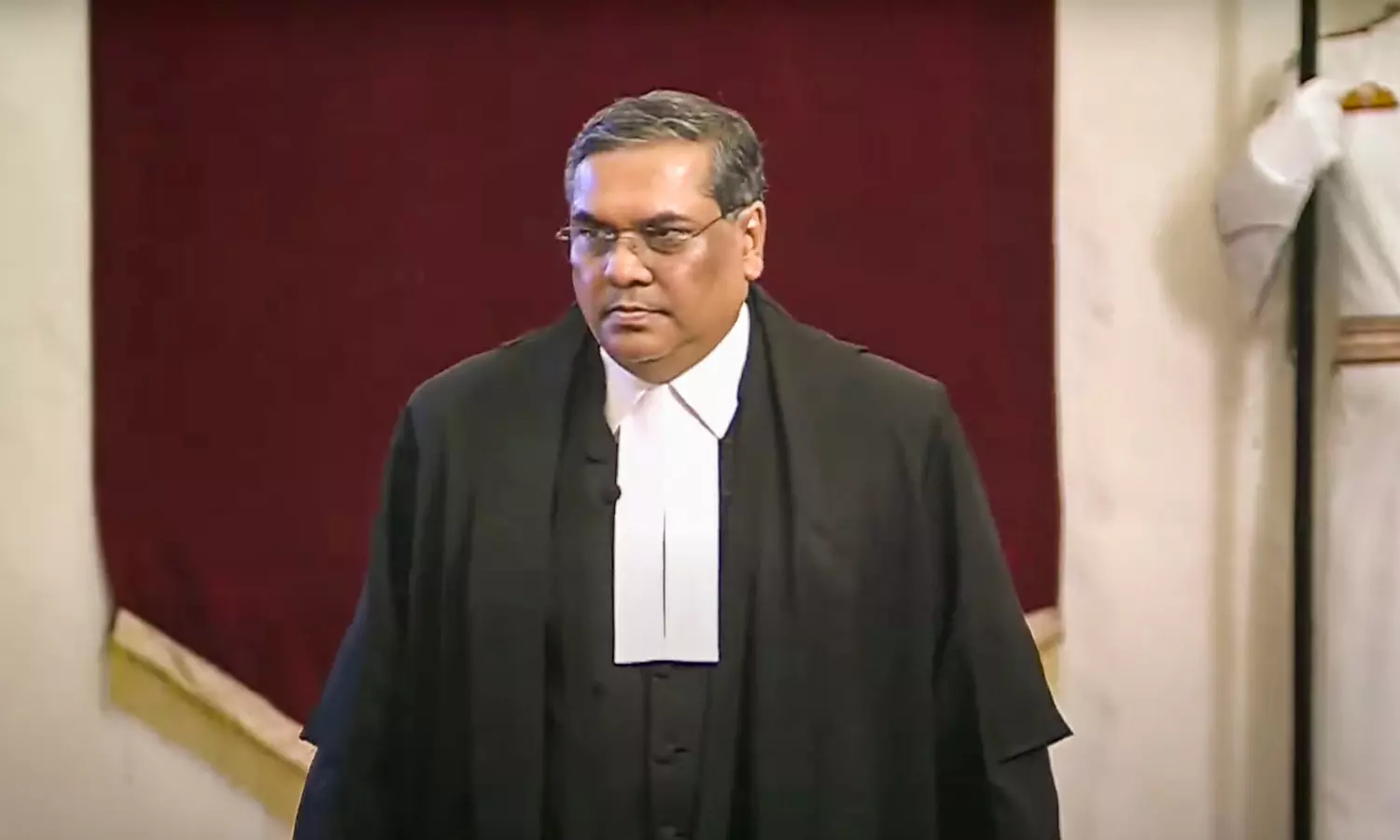
CJI Sanjiv Khanna says will consider Bar leaders’ demand for withdrawal of Collegium recommendation to transfer Justice Varma

The day began with Bar representatives from High Courts across Allahabad, Gujarat, Kerala, Jabalpur, Karnataka, and Lucknow submitting a memorandum to the CJI’s office and requesting a meeting with Justice Khanna.

Published

on

Chief Justice of India Sanjiv Khanna has said that he will consider the Bar leaders’ demand from various Bar associations to withdraw the collegium’s recommendation to transfer Justice Yashwant Varma from the Delhi High Court, informed president of the Allahabad High Court Bar Association Anil Tiwari on Thursday.

An assembly of representatives from six different High Court Bar associations convened with the CJI and other Collegium members, including Justices B R Gavai, Surya Kant, Abhay S Oka, and Vikram Nath, in the afternoon.

Following discussions on the Bar associations’ memorandum, Tiwari indicated that they would reconsider their decision on the ongoing indefinite strike, which commenced on March 25 in protest of Justice Varma’s proposed return to his original posting at the Allahabad High Court.

The day began with Bar representatives from High Courts across Allahabad, Gujarat, Kerala, Jabalpur, Karnataka, and Lucknow submitting a memorandum to the CJI’s office and requesting a meeting with Justice Khanna.

The situation surrounding Justice Varma includes allegations of cash found at his residence following a fire on March 14, which led to concerns about tampering with evidence. The members of the Bar associations have expressed their dissatisfaction over the lack of an FIR regarding this incident.

In their memorandum, the Bar associations commended the CJI for taking steps towards transparency, including making the report from the Chief Justice of the Delhi High Court available on the apex court’s website. They called for the withdrawal of Justice Varma’s transfer and the reinstatement of all administrative tasks that had been removed.

The memorandum urged the CJI to initiate criminal proceedings, citing concerns that articles were removed from Justice Varma’s residence a day after the fire. They emphasized that failure to register an FIR could hinder the prosecution of any potential accomplices.

This cash discovery incident transpired during a fire at Justice Varma’s Lutyens Delhi residence, which prompted a swift response from fire services. As a result of the controversy, the Supreme Court collegium recommended Justice Varma’s transfer back to the Allahabad High Court, withdrawing his duties following a directive from the CJI.

On March 22, the CJI established a three-member committee to conduct an internal inquiry into the allegations, with plans to publish the findings from Chief Justice D K Upadhyay of the Delhi High Court. Justice Varma firmly denies the allegations, asserting that neither he nor his family members placed any cash in the storeroom.

Continue Reading

India News

Opposition demands Dharmendra Pradhan’s resignation before NEET discussion in Parliament

The Opposition has demanded Union Education Minister Dharmendra Pradhan’s resignation before any discussion on the NEET paper leak in Parliament, while the Centre says it is fully prepared for a debate.

Published

on

The political deadlock over the NEET paper leak issue continued in Parliament on Wednesday, with Opposition parties demanding the resignation of Union Education Minister Dharmendra Pradhan before any discussion takes place. The Centre, however, maintained that it is fully prepared to debate the matter during the ongoing Monsoon Session.

Leading the Opposition in the Rajya Sabha, Congress president Mallikarjun Kharge said there could be no fair discussion on the NEET issue unless Dharmendra Pradhan resigned from his post.

Centre rejects Opposition’s condition

Responding to the Opposition’s demand, Leader of the House JP Nadda said the government was not avoiding a discussion and remained open to debating all issues, including the alleged NEET paper leak.

He said the government had already made its position clear and described it as transparent, adding that it was willing to discuss every matter raised by the Opposition.

Parliamentary Affairs Minister Kiren Rijiju also reiterated that the Centre had been ready for discussions since the beginning of the Monsoon Session. He said the government had consistently conveyed its willingness to debate the NEET issue and other important matters.

Rijiju added that if the Opposition was looking for reasons to avoid a discussion, it would not be appropriate. According to him, the procedure and timing of the debate would be decided after consultations among all parties under the Chair’s guidance.

Opposition maintains resignation demand

The government also informed the House that its willingness to discuss the issue had been communicated to Congress leaders and representatives of other political parties.

Samajwadi Party chief Akhilesh Yadav echoed the Opposition’s stand, saying students were seeking the resignation of the Education Minister before any discussion. He asserted that the resignation should come first, followed by parliamentary debate on the issue.

Akhilesh Yadav also joined Rahul Gandhi and other Opposition MPs during a march towards the Prime Minister’s residence in New Delhi on Tuesday as part of the protest over the NEET controversy.

Continue Reading

India News

Protesters pour in to Jantar Mantar, Centre readies for discussion in Parliament

Published

on

By

The agitation led by the Cockroach Janta Party (CJP) over alleged irregularities in the NEET-UG examination continued on Wednesday, with more people making a queue to join the demonstration at Jantar Mantar despite Delhi Metro shutting station gates, police action, ongoing negotiations with the Centre and heightened security across the capital.

Protesters regrouped at Jantar Mantar from late at night on Tuesday with CJP leaders warning that the Parliament march was “just a trailer” and that larger demonstrations would follow if the government failed to respond. The protest’s impact was also felt in Parliament, where repeated Opposition protests over the police action led to disruptions and adjournments in both the Lok Sabha and the Rajya Sabha.

Last evening, Congress leaders led by Rahul Gandhi and Priyanka Gandhi and Samajwadi Party president Akhilesh Yadav had staged a demonstration outside PM Narendra Modi’s residence. While Rahul’s protest drew kudos all around, AAP leaders mocked him for trying to hijack the movement that had been led by the CJP.  

In a related development, the Supreme Court declined an urgent hearing on a plea seeking intervention over the alleged police action against CJP protesters, directing the petitioner to follow the regular listing procedure.

Meanwhile, Delhi Police registered multiple FIRs in connection with Monday’s violence and maintained heavy deployment around Parliament House and Jantar Mantar. The Delhi Metro Rail Corporation closed 16 Metro stations across central Delhi, with trains passing through without halting. Interchange facilities were available at Rajiv Chowk, Mandi House and Central Secretariat, while commuters were advised to check official service updates. Traffic diversions and station closures disrupted travel across the city.

With protesters refusing to withdraw and the Centre signalling that dialogue will continue, the agitation remains one of the biggest political challenges confronting the government during the Monsoon Session.

The CJP agitation took on a new lease of life and urgency on Monday when thousands of CJP supporters marched to Parliament under the banner of Chalo Sansad on the opening day of the Monsoon Session. Protesters demanded the resignation of Education Minister Dharmendra Pradhan, a parliamentary debate on the alleged examination irregularities and reforms in the examination system. Delhi Police stopped the procession near Parliament, citing security concerns and the absence of permission. They then used tear gas and lathicharged the march saying some protesters attempted to cross barricades. Several demonstrators, including CJP founder Abhijeet Dipke, were briefly detained. Over 100 students were treated for injuries including fractures and pellet wounds, a similar number of police personnel were also injured thought not as severely, reports said.

The stalemate in the government position to engage with the protesters broke on Monday. Health Minister JP Nadda met a CJP delegation, which submitted a memorandum outlining its demands. Government sources said the minister urged protesters to end the agitation and assured them that their concerns would be examined. However, CJP leaders said the meeting produced no concrete outcome and vowed to continue the protest.

Activist Sonam Wangchuk, who was forcibly moved to hospital by police after his health deteriorated on his indefinite fast, remains under medical supervision with the court’s clearing his request to be moved from Safdarjung Hospital to Medanta hospital.

Continue Reading

India News

Vijay’s TVK demands scrapping NEET, seeks state control of medical education

Published

on

By

Tamil Nadu CM Vijay speaking on stage

Tamilaga Vettri Kazhagam (TVK), led by Tamil Nadu Chief Minister C. Joseph Vijay, has on Wednesday again demanded the complete abolition of the National Eligibility-cum-Entrance Test (NEET).

The party described its position as an “uncompromising and firm stand”, stating that it is not merely seeking reforms in the examination system but wants NEET scrapped entirely. The statement comes amid nationwide protests and growing concerns over alleged irregularities in the medical entrance examination.

A TVK statement said medical education should come under the full control of state governments rather than the Centre. The party demanded that education be shifted from the Concurrent List to the State List of the Constitution, allowing states to decide their own admission policies for medical colleges. As an interim measure, TVK proposed creating a Special Concurrent List that would grant states greater authority over education until constitutional changes are made.

The party criticized what it called the “One Nation, One Education” approach, arguing that a single national entrance test places students from rural areas, government schools, Tamil-medium institutions, and economically weaker sections at a disadvantage. TVK reiterated its demand that admissions to MBBS, BDS, and AYUSH courses under the state quota should be based on Class 12 examination marks instead of NEET.

TVK’s latest statement comes as students and activists across the country continue to protest over examination irregularities. The party clarified that its opposition to NEET is not limited to recent controversies but is based on its long-standing belief that states should have complete authority over medical education and admissions. It criticized political parties that promised to abolish NEET without delivering on those commitments, without naming the rival DMK.

The demand has reignited the debate over the future of NEET and the balance of power between the Centre and the states. Supporters believe scrapping the examination would provide a fair opportunity for students from different backgrounds, while opponents argue that NEET ensures a uniform standard for medical admissions across India.

At present, NEET remains a national-level entrance examination, and the Union Government has not announced any decision to abolish it. However, TVK has said it will continue to press for constitutional changes and greater state autonomy in medical education.

Continue Reading

Trending

© Copyright 2022 APNLIVE.com