
English हिन्दी
Connect with us

India News

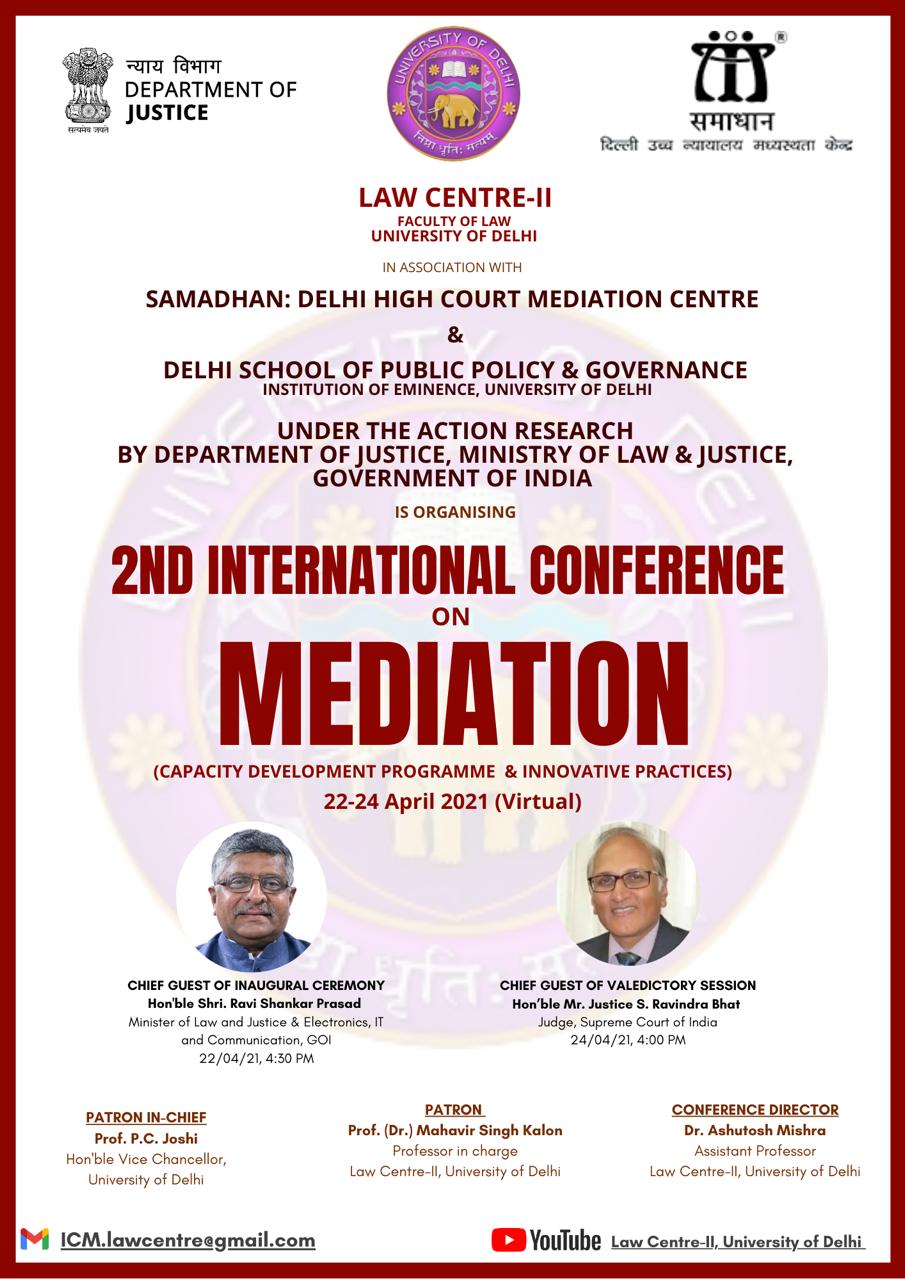
DU Law Faculty’s 2nd international conference on mediation to start April 22

Union Law and Justice Minister Ravi Shankar Prasad will inaugurate the 2nd International Conference on Mediation organised by Delhi University’s Law Centre II on April 22.

Published

on

DU Law Faculty's 2nd international conference

Union Law and Justice Minister Ravi Shankar Prasad will inaugurate the 2nd International Conference on Mediation organised by Delhi University’s Law Centre II on April 22.

The conference is being organised by Law Centre II along with Samadhan: The Delhi High Court Mediation & Conciliation Centre and Delhi School of Public Policy and Governance, Institute of Eminence (IoE), the University of Delhi under the action research project of the Department of Justice, Ministry of Law & Justice. The two-day event will be held in the virtual mode and will end on April 24, Supreme Court judge Justice S. Ravindra Bhat will be the chief guest for the valedictory session.

After April 22’s inaugural session, the next day will see two sessions: one on Capacity Development Programme and the other on Innovative Practices and Online Mediation. The last day, April 24, will have three sessions on focusing on mediation in four fields: Family Disputes, IPR Disputes, Ease of Doing Business and Commercial Disputes.

With registration for the conference compulsory, the organizers invite judges, faculty members, advocates, research scholars, entrepreneurs, students, faculty members, and other professionals to participate. E-certificates will be provided to the attendees after successfully attending all the sessions.

Link for registration :

https://docs.google.com/forms/d/e/1FAIpQLSd8OXd56glPEFTMvjqN7RXP2bUQp5rQcD4O0NDubOc7R_9lPg/viewform

About the Conference

Mediation as an Alternate Dispute Resolution is a process of resolving disputes with the help of a third neutral person who assists the parties in the dispute to reach a negotiated resolution. It is empowering every common person of the society and imparting justice in a cost-effective and expeditious manner.

Through awareness and confidence-building measures, this conference would help potential litigants as well as the general public, thereby reducing the burden on the courts.The expertise of the speakers as well as the esteemed dignitaries in the event is invaluable to the entire legal fraternity including lawyers, judges, law teachers, law students, and legal researchers.

Recent legislative changes have also placed reliance on mediation as a prominent mode of the dispute resolution process. It shows the increasing intent of the legislature to bring the same at the forefront which is also in tandem with the changing demands of the times.Better dissemination of knowledge and information regarding the process of mediation will build the faith of the general public in this process and, ultimately lead to better administration of justice.

Also Read: Russian Covid vaccine deliveries to India to begin in April, production to start in May

In a dynamic country like ours, a speedy, equitable, and innovative dispute resolution system like mediation brings positive externalities for the economy, the society, the legal ecosystem, and the general prosperity of the nation as a whole.

About Law Centre

Law Centre-II, Faculty of Law, University of Delhi is a premier institution and is known for its qualitative teaching, research and other co-curricular and extracurricular activities. Started in 1971, it has a glorious past of 50 years. The current state of art infrastructure, commitment and assiduity of faculty members with huge quality student strength separates it from other institutions of the country. Law Centre-II feels proud to have the alumni who got the position like Governor, Cabinet and State Ministers, Parliamentarians, Hon’ble Judges, distinguished Jurists, leading advocates, policymakers and some of the academicians of the country.

About Samadhan

The Delhi High Court Mediation and Conciliation Centre, known as Samadhan, was established in May 2006. Its objective is to act as a catalyst in providing a healing touch to the litigating public in amicably resolving their disputes.

Samadhan is administered by a Joint Committee of lawyers and Judges that has been smoothly coordinating and supervising all its activities. It has cemented a vital and unique collaboration between the Bar and the Bench that has been able to empower disputants to amicably resolve their disputes and find peace and harmony in their lives.

About Delhi School of Public Policy and Governance

The Delhi School of Public Policy and Governance (DSPPG) at the University of Delhi has been established under the Institution of Eminence (IOE) of the University. The University of Delhi has got the privilege to be declared as an Institution of Eminence by the Ministry of Education, Government of India. It aims to serve as the key platform to promote and foster excellence in Public Policy and Governance studies, research and outreach, and policy making. The School shall be the University’s interface for engaging with the wider community of academics and practitioners in initiating, developing and sharing ideas to address various emerging domestic and international public policy challenges. More important, the School shall fill the existing void in building a specialized and efficient cadre of professionals dedicated to public service in India

Also Read: Avoid travel to India, even if fully innoculated, US medical body issues advisory

Organising Committee

PATRON IN-CHIEF : Prof. P.C. Joshi,Hon’ble Vice Chancellor,University of Delhi

PATRON :Prof. (Dr.) Mahavir Singh Kalon,Professor In Charge, Law Centre-II,Faculty of Law,, University of Delhi

Conference Director: Dr. Ashutosh Mishra,Assistant Professor, Law Centre-II,,Faculty of Law, University of Delhi;OSD, Delhi School of Public Policy & Governance, Institution of Eminence, University of Delhi (Project Investigator)

Conference Co-Director: Mr. Ashutosh Acharya , Assistant Professor, Law Centre- II,Faculty of Law, University of Delhi (Co-Project Investigator)

Dr. Ajay Sonawane,Assistant Professor, Law Centre- II,Faculty of Law, University of Delhi 

Contact

Khushal Garg : +91-9643546263

Shubham Kumar : +91-8084845441

[email protected]

India News

PM Modi assures no discrimination in women’s quota, delimitation debate intensifies in Parliament

PM Narendra Modi has assured that women’s reservation will be implemented without discrimination, amid a heated debate over delimitation in Parliament.

Published

on

PM modi

Prime Minister Narendra Modi has assured that there will be no discrimination in the implementation of women’s reservation, as Parliament witnessed a sharp debate over the proposed linkage between the quota and delimitation exercise.

During the ongoing special session, the government reiterated its commitment to ensuring fair representation while addressing concerns raised by opposition parties regarding the timing and structure of the legislation.

The proposed framework aims to reserve 33 percent of seats for women in the Lok Sabha and state assemblies. However, its implementation is tied to a fresh delimitation exercise, which is expected after the next census.

Opposition questions timing and intent

Opposition leaders have raised concerns that linking the women’s quota to delimitation could delay its implementation. They argue that the process of redrawing constituencies may push the actual rollout further into the future.

The issue has triggered a broader political confrontation, with multiple parties questioning whether the move could alter representation across states.

Some critics have also alleged that the delimitation exercise could disproportionately benefit certain regions based on population, a charge the government has rejected.

Government reiterates commitment to fair implementation

Responding to these concerns, the Centre has maintained that the reforms are necessary to ensure accurate and updated representation based on population data.

Leaders from the ruling side have repeatedly emphasized that the process will be carried out transparently and without bias. The assurance that there will be “no discrimination” is aimed at addressing fears among states and opposition parties.

The debate marks a key moment in Parliament, with both sides engaging in intense exchanges over one of the most significant electoral reforms in recent years.

Continue Reading

India News

Give all tickets to Muslim women, Amit Shah says, attacking Akhilesh Yadav on sub-quota demand

A sharp exchange between Amit Shah and Akhilesh Yadav in Parliament over sub-quota for Muslim women highlights key divisions on women’s reservation implementation.

Published

on

A heated exchange broke out in Parliament during discussions on the women’s reservation framework, with Union Home Minister Amit Shah and Samajwadi Party chief Akhilesh Yadav locking horns over the demand for a sub-quota for Muslim women.

The debate unfolded as the government pushed forward key legislative measures to implement 33% reservation for women in the Lok Sabha and state assemblies.

Akhilesh Yadav argued that the proposed reservation must ensure representation for women from marginalised communities, including Other Backward Classes (OBCs) and Muslim women. He said that without such provisions, large sections could remain excluded from political participation.

He also questioned the timing of the bill, alleging that the Centre was avoiding a caste census. According to him, a census would lead to renewed demands for caste-based reservations, which the government is reluctant to address.

Government rejects religion-based quota

Responding to the demand, Amit Shah made it clear that reservation based on religion is not permitted under the Constitution.

He stated that any proposal to provide quota to Muslims on religious grounds would be unconstitutional, firmly rejecting the idea of a separate sub-quota for Muslim women within the broader reservation framework.

The government has maintained that the existing framework already includes provisions for Scheduled Castes (SC) and Scheduled Tribes (ST) women within the overall reservation structure.

Wider political divide over implementation

The issue of sub-categorisation within the women’s quota has emerged as a major flashpoint, even as most opposition parties broadly support the idea of women’s reservation.

Samajwadi Party leaders reiterated that their support for the bill depends on inclusion of OBC and minority women, while the government continues to defend its constitutional position.

The debate is part of a broader discussion during the special Parliament session, where multiple bills linked to delimitation and implementation of the women’s quota are being taken up.

Continue Reading

India News

No state will lose a seat, Centre assures as delimitation debate takes centre stage in Parliament

Parliament’s special session begins with key focus on implementing women’s reservation and delimitation, setting the stage for major electoral changes.

Published

on

Parliament

A special session of Parliament commenced on Thursday, with the Centre set to take up crucial legislation related to women’s reservation and delimitation of constituencies. The session, scheduled over three days, is expected to witness intense debate as the government pushes forward its legislative agenda.

At the centre of discussions is the proposal to operationalise the women’s reservation law, which seeks to allocate 33 percent of seats in the Lok Sabha and state assemblies to women. The law, passed earlier, requires enabling provisions before it can be implemented.

The rollout of the reservation is closely tied to the delimitation exercise — a process that redraws parliamentary constituencies based on updated population data. The implementation is expected only after the next census and delimitation process are completed.

The government is aiming to put in place the framework so that the reservation can be enforced in future elections, likely around 2029.

Delimitation and numbers at play

Delimitation is a key aspect of the proposed changes, as it will determine how seats are redistributed and which constituencies are reserved. The exercise is expected to reflect population shifts and may also involve an increase in the total number of Lok Sabha seats.

This linkage has made the issue politically sensitive, with several opposition parties backing women’s reservation in principle but raising concerns over how and when delimitation will be carried out.

Political reactions and expected debate

The session is likely to see sharp exchanges between the government and opposition. While there is broad agreement on increasing women’s representation, disagreements remain over the timing, process, and potential political implications of the delimitation exercise.

Some leaders have argued that delimitation could significantly alter the balance of representation among states, making it a contentious issue beyond the women’s quota itself.

The government, however, has framed the move as a step toward strengthening women’s participation in governance and ensuring more inclusive policymaking.

Continue Reading

Trending

© Copyright 2022 APNLIVE.com













