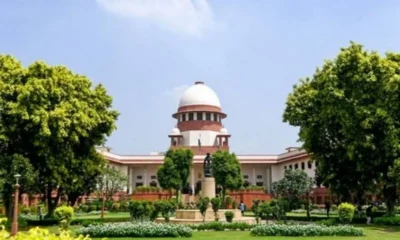
[vc_row][vc_column][vc_column_text]The Supreme Court today (Friday, March 8) sent the sensitive, decades-old Babri Masjid–Ram Janmabhoomi title suit for court-monitored, in-camera mediation which has to be completed within eight weeks.
A five-judge Constitution Bench, headed by Chief Justice of India (CJI) Ranjan Gogoi and also comprising of Justices SA Bobde, DY Chandrachud, Ashok Bhushan and S Abdul Nazeer, set up a three-member panel for conducting the mediation.
The panel of mediators consists of Justice (retired) FMI Kalifulla, Art of Living Founder Sri Sri Ravi Shankar and Madras-based senior advocate Sriram Panchu.
The court ordered that the mediation process, to begin in a week, will take place in Faizabad. It will be kept confidential and media has been barred from reporting on its proceedings.
The panel will file the first status report within four weeks and the entire process must be concluded within eight weeks.
The court said the Ayodhya dispute mediators could co-opt more on the panel if necessary and take whatever legal assistance required for them.
The Uttar Pradesh government would provide the mediators with all the necessary facilities in Faizabad. The mediation would be held in-camera.
The court proceedings in the title suit, if still required, will commence only after the mediation process concludes.[/vc_column_text][/vc_column][/vc_row][vc_row][vc_column][vc_column_text css=”.vc_custom_1552107217886{border-top-width: 10px !important;border-right-width: 10px !important;border-bottom-width: 10px !important;border-left-width: 10px !important;padding-top: 10px !important;padding-right: 10px !important;padding-bottom: 10px !important;padding-left: 10px !important;background-color: #dbdbdb !important;border-radius: 10px !important;}”]Members of the mediation panel
Justice FM Kalifulla, 68, is the son of Late Justice M Fakkir Mohamed, who started his career as an advocate in August 1975. He was also an active labour law practitioner. In 2000, Justice Kalifulla was appointed as a permanent Judge of the Madras High Court.
Justice Kalifulla was elevated as a judge of the Supreme Court on April 2, 2012. He had retired from the Supreme Court in July 2016,
Sri Sri Ravi Shankar, 62, is a spiritual guru, who has been leading a worldwide movement for a violence-free society. Sri Sri had been advocating for a constructive dialogue between the opposing parties on Ram Mandir issue.
Sriram Panchu, 69, is a senior advocate and one of the country’s foremost legal minds on mediation. Founder of The Mediation Chambers, he had set up India’s first court-annexed mediation centre in 2005, and has played a key role in making mediation a part of India’s legal system. Panchu has written two books on mediation. The top court had referred to him as an “eminent trainer” and “one of the foremost mediators in the country”.[/vc_column_text][/vc_column][/vc_row][vc_row][vc_column][vc_column_text]It may be recalled that the Constitution Bench had, on March 6, reserved its judgment on whether or not it would send the long-pending title suit for mediation. The surprise suggestion of the top court to give mediation one last chance had come during proceedings in the title suit on February 26 when Chief Justice Ranjan Gogoi and Justice SA Bobde had told counsel for the main petitioners in the case that they were thinking of invoking Section 89 of the Code of Civil Procedure to help resolve the sensitive land dispute through talks between the warring claimants.
The court has held that there was no “legal impediment” to sending the Ayodhya dispute for mediation. It cited Order 23 Rule 3 of the Civil Procedure Code for attempting to arrive at a ‘compromise decree’ in the long-pending civil dispute for the title of the disputed area where the Babri Masjid once stood before it’s demolition by kar sevaks in 1992.
According to the provision, if the parties reach an agreement, the Supreme Court can order such a settlement to be recorded and pass a decree accepting the resolution among the parties.
The Bench had pushed “negotiated compromise” as a means to heal hearts and minds. It has said the dispute was a festering wound which has touched the religious sentiments of the Hindu and Muslim communities for decades.
Justice SA Bobde, on the Bench, had put matters in perspective by observing that the court was only concerned about the present state of the Babri-Masjid-Ramjanmabhoomi case and not the past history of “Mughal invasion and conquests of Babur”.
“Primarily this is not about the 1500 sq ft of disputed land, but about religious sentiments. We know its impact on public sentiment, on body politic. We are looking at minds, hearts and healing if possible,” Justice Bobde had observed.
Most Hindu parties in the case as well as the Government of Uttar Pradesh had opposed the suggestion of sending the case for mediation.
The Hindu appellants have said their faith that Lord Ram was born in the disputed land was non-negotiable. They had even suggested that the court should issue a public notice on whether or not to send the dispute for mediation.
“The faith that Lord Ram was born there is not negotiable. But we are willing to crowd-fund a mosque somewhere else,” senior advocate CS Vaidyanathan, for Ram Lalla, the deity, had submitted.
Solicitor General Tushar Mehta for the Uttar Pradesh government had also submitted that the path of mediation was both “imprudent and inadvisable”.
The counsel for the Muslim petitioners and the Nirmohi Akhara had informed the bench that they were willing for a renewed mediation effort if the court ordered one.
Reactions
Shortly after the Supreme Court pronounced its verdict, on Friday, Justice Kalifulla told mediapersons: “I understand the Supreme Court has appointed a mediation committee headed by me. I am yet to receive the order copy. We’ll make every effort to resolve the issue amicably.”
Ravi Shankar reacted to the development through a post on Twitter which read: “Respecting everyone, turning dreams to reality, ending long-standing conflicts happily and maintaining harmony in society – we must all move together towards these goals.” The self-styled spiritual leader’s nomination to the panel of mediators has, however, not gone down too well with some of the Muslim stakeholders in the dispute owing to his earlier utterances on the title suit.
Asaduddin Owaisi, Hyderabad MP and member of the All India Muslim Personal Law board which is a party in the title suit, told reporters: “Sri Sri Ravi Shankar who has been appointed a mediator had earlier made a statement saying ‘if Muslims don’t give up their claim on Ayodhya, India will become Syria’… It would have been better if the Supreme Court had appointed a neutral person.”
Convener of the Babri Masjid Action Committee and advocate, Zafaryab Jilani welcomed the court’s order and said: “We will cooperate in the mediation process. Now, whatever we have to say, we will say it to the mediation panel, not outside.”
The BJP, for which construction of the Ram Mandir at the site where its followers demolished the Babri Masjid has been a long-pending poll promise, has reiterated its hope that a temple dedicated to the infant Lord Ram (Ram Lalla Virajman, also a petitioner in the title suit) will be built in due course at the disputed site.
Uttar Pradesh deputy chief minister Keshav Prasad Maurya said that though he does not wish to question the Supreme Court’s order, “in the past, efforts made to arrive at a solution (through mediation) had not been successful”. He added: “No devotee of Lord Ram wants construction of the Ram Mandir to be delayed.”
Union minister Uma Bharati, still an accused in the 26-year-old Babri Masjid demolition case which has been pending adjudication at the trial stage, told reporters: “I don’t want to comment on the Supreme Court order. I don’t want to comment on the mediators named by the court. But, as a Hindu, I think, a temple should be made where Lord Ram was born.”
Earlier attempts at mediation
Four earlier attempts to find a solution to the dispute through mediation had failed.
The first was in the 1990s when talks between Vishwa Hindu Parishad and Babri Masjid Action Committee broke down at a crucial stage.
The second and most significant effort for a negotiated settlement was made by the Kanchi Shankaracharya in 2003. However, it broke down after his July 1, 2003, letter to the All India Muslim Personal Law Board which said, “Kashi, Mathura and Ayodhya, all three belong to Hindus and keeping in mind the larger interest of the country and communal harmony, if not today, but at some time or other, these places have to be given to the Hindus. The Muslims have to mentally prepare themselves for this.”
The third attempt fizzled out soon after then CJI JS Khehar in March 2017 suggested that he or another SC judge would be more than willing to become the mediator to bring the warring sides to the negotiating table.
The fourth attempt, in the later half of 2017, by spiritual leader Sri Sri Ravi Shankar and Shia Wakf Board chairman Waseem Rizvi too failed to yield any result.[/vc_column_text][/vc_column][/vc_row]