English हिन्दी
Connect with us

India News

Gay sex not crime, rules SC in verdict hailed as historic; UN welcomes verdict

Published

on

Gay sex not crime, rules SC in verdict hailed as historic; UN welcomes verdict

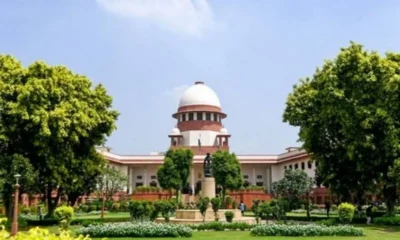
[vc_row][vc_column][vc_column_text]The Supreme Court on Thursday, September 6, 2018, decriminalised a portion of Section 377 of the Indian Penal Code (IPC), a colonial era adjunct that criminalises private consensual sexual acts between same sex adults.

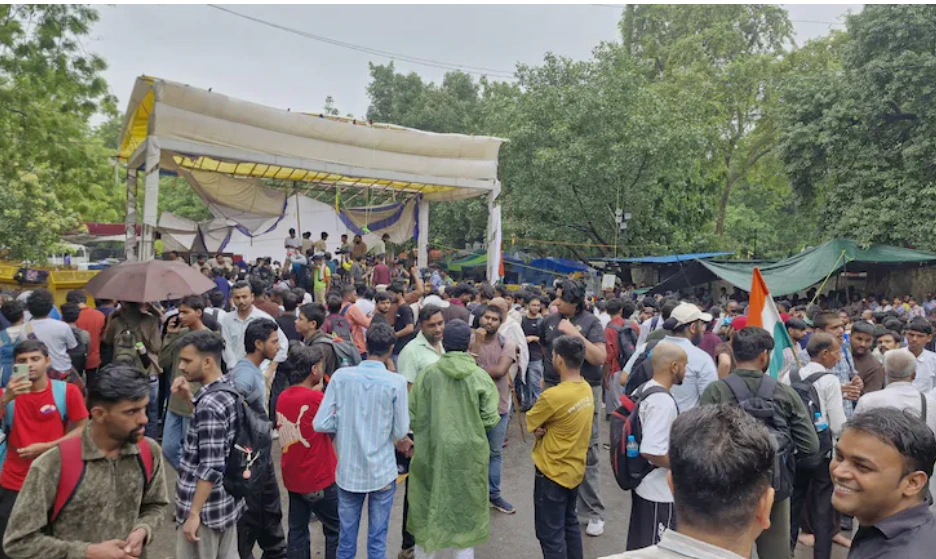
The verdict by a five-judge Constitution bench headed by Chief Justice of India Dipak Misrawas applauded by a wide section, with the United Nations also coming out with a statement hailing the judgment. Jubilant gay rights activists celebrated on the lawns of the court. Shouts of ‘Hip Hip Hurray’ echoed on the premises, reported The Hindu.

Delivering the landmark judgment, Chief Justice of India Dipak Misra said: “I am what I am. So take me as I am.”

The apexcourt overruled its own 2013 decision and said Section 377, a British-era ban on consensual gay sex, is irrational, indefensible and arbitrary.

“No one can escape from their individuality,” said Justice Misra.CJI Dipak Misra, speaking for himself and Justice A M Khanwilkar, says denial of self-expression is akin to inviting death

The judges dwelt upon various philosophical and Constitutional aspects in writing the historic judgment that called for a shift in the society and attitudes. “We have to bid adieu to prejudices and to empower all citizens,” the Chief Justice said. Homosexuality, said the judges, is not a mental disorder.

Section 377 banned “carnal intercourse against the order of nature with any man, woman or animal”, which was interpreted to refer to homosexual sex. Under the 1861 law, gay sex was punishable by up to 10 years in jail.

The Chief Justice said: “Respect for individual choice is the essence of liberty; the LGBT community possesses equal rights under the constitution. Sexual orientation is a biological phenomenon; any discrimination on these grounds is violative of fundamental rights”.

History owes an apology to LGBT persons for ostracisation, discrimination, the court said.

So far as a consensual sexual act in private is concerned, it is neither harmful nor contagious to society, said the court. The society cannot dictate sexual relationship between consenting adults as it is a private affair and denial of right to sexual orientation is akin to denial of right to privacy, said the court.

Courts must protect the dignity of an individual as the right to live with dignity is recognised as a fundamental right.

Any kind of sexual activity with animals shall remain penal offence under Section 377 of the IPC, the judgment held.

The SC noted that India is signatory of international treaties on rights of LGBT and it is obligatory to adhere to treaties[/vc_column_text][/vc_column][/vc_row][vc_row][vc_column][vc_column_text css=”.vc_custom_1536231074243{border-top-width: 10px !important;border-right-width: 10px !important;border-bottom-width: 10px !important;border-left-width: 10px !important;padding-top: 10px !important;padding-right: 10px !important;padding-bottom: 10px !important;padding-left: 10px !important;background-color: #e5e5e5 !important;border-radius: 10px !important;}”]The United Nations welcomed the judgment and said it was the first step towards ensuring full fundamental rights to LGBTI persons.

“The United Nations in India welcomes the landmark ruling by the Supreme Court of India striking down a key component of Section 377 of the Indian Penal Code which criminalized specific sexual acts between adults, a law dating back to British colonial rule that has targeted in particular lesbian, gay, bisexual, transgender and intersex (LGBTI) individuals and communities.

“Sexual orientation and gender expression form an integral part of an individual’s identity the world over, and violence, stigma and discrimination based on these attributes constitute an egregious violation of human rights. LGBTI persons across the world continue to be the targets of violent attacks and are affected by multiple and intersecting forms of discrimination based on age, gender, ethnicity, disability and social status.

“The UN in India sincerely hopes that the court’s ruling will be the first step towards guaranteeing the full range of fundamental rights to LGBTI persons. We also hope that the judgment will boost efforts to eliminate stigma and discrimination against LGBTI persons in all areas of social, economic, cultural and political activity, thereby ensuring a truly inclusive society. The focus must now be on ensuring access to justice, including remedy; effective investigations of acts of violence and discrimination; and effective access to economic, social and cultural rights.”[/vc_column_text][/vc_column][/vc_row][vc_row][vc_column][vc_column_text]The ban was challenged by five high-profile petitioners who said they were living in fear of being punished.The petitioners are, Bharatnatyam dancer Navtej Singh Johar, journalist Sunil Mehra, restaurateur Ritu Dalmia, Neemrana hotel chain co-founder Aman Nath and businesswoman Ayesha Kapur.

Activists had been fighting the ban since the 1990s, suffering several court reverses before the verdict today that sparked celebrations among lesbian, gay, bi-sexual and transgender groups across the country.

Reactions:

Congress welcomes verdict

“We join the people of India & the LGBTQIA+ community in their victory over prejudice. We welcome the progressive & decisive verdict from the Supreme Court & hope this is the beginning of a more equal & inclusive society,” tweeted the Congress’ official handle.

Congress spokesperson Randeep Singh Surjewala tweeted, “Supreme Court verdict on #Section377 is momentous. An age-old colonial law, that was an anachronism in today’s modern times, ends restoring the fundamental rights & negating discrimination based on sexual orientation. It’s an imp step forward towards a liberal, tolerant society.”

Decision vindicates my stand: Shashi Tharoor

“So pleased to learn that the Supreme Court has ruled against criminalising sexual acts in private. This decision vindicates my stand on Section 377& on exactly the same grounds of privacy, dignity &constitutional freedoms. It shames those BJP MPs who vociferously opposed me in LS,” tweeted Thiruvananthapuram MP Shashi Tharoor.

Bollywood celebrities hail judgment

Bollywood filmmaker Karan Johar tweeted, “Historical judgment!!!! So proud today! Decriminalising homosexuality and abolishing #Section377 is a huge thumbs up for humanity and equal rights! The country gets its oxygen back!”

Actor Swara Bhasker also supported the judgment. She tweeted, “Congratulations to all the activists and petitioners on #SupremeCourt judgement scrapping #Section377 Your perseverance just made #India a freer place for everyone ! #LoveIsLove #Pride #377Verdict #377Scrapped Three cheers for the #SupremeCourt.”

“Bye bye 377,” tweeted filmmaker and actor Farhan Akhtar. “Thank you #SupremeCourt #abouttime #nomorediscrimination #loveislove.”[/vc_column_text][/vc_column][/vc_row]

India News

Amit Shah counters delimitation concerns, says southern states to gain Lok Sabha seats

Amit Shah assures Parliament that southern states will gain Lok Sabha seats after delimitation, countering opposition criticism during the women’s reservation debate.

Published

on

Amit Shah

Union Home Minister Amit Shah on Thursday addressed concerns over the proposed delimitation exercise, asserting in the Lok Sabha that southern states will not lose representation but instead see an increase in their number of seats.

His remarks came during a heated debate linked to the implementation of women’s reservation, where opposition parties have raised fears that population-based delimitation could reduce the political weight of southern states.

Shah rejected these claims, calling them misleading, and said the proposed framework ensures fairness while expanding the overall strength of the Lok Sabha.

Seat count to rise with expansion of Lok Sabha

The government has indicated that the total number of Lok Sabha seats could increase significantly as part of the delimitation process. In this expanded House, the combined representation of southern states is expected to rise from 129 seats at present to around 195 seats.

Shah emphasised that no state will lose seats in absolute terms, and the exercise is designed to reflect population changes while maintaining balance across regions.

State-wise projections shared in Parliament

During his address, Shah also provided indicative figures for individual southern states, suggesting notable increases in representation. According to the projections:

  • Tamil Nadu could see its seats rise substantially
  • Kerala, Telangana, and Andhra Pradesh are also expected to gain additional seats
  • Karnataka’s representation may increase as well

These figures were presented to counter the argument that delimitation would disproportionately favour northern states.

Political debate intensifies over linkage with women’s quota

The delimitation exercise has been closely linked to the rollout of women’s reservation, which proposes one-third seats for women in Parliament and state assemblies.

Opposition leaders have questioned this linkage, arguing that tying reservation to delimitation could delay its implementation and raise federal concerns. Some leaders have also warned that the move could impact national unity if apprehensions among states are not addressed.

The government, however, maintains that the reforms are necessary to ensure equitable representation and to align the electoral system with demographic realities.

Centre dismisses ‘false narrative’ on southern states

Shah reiterated that concerns about southern states losing influence are unfounded. He said the delimitation process will increase representation across regions and described the criticism as a “false narrative” aimed at creating confusion.

The issue is expected to remain a key flashpoint as Parliament continues discussions on the women’s reservation framework and related legislative changes.

Continue Reading

India News

PM Modi assures no discrimination in women’s quota, delimitation debate intensifies in Parliament

PM Narendra Modi has assured that women’s reservation will be implemented without discrimination, amid a heated debate over delimitation in Parliament.

Published

on

PM modi

Prime Minister Narendra Modi has assured that there will be no discrimination in the implementation of women’s reservation, as Parliament witnessed a sharp debate over the proposed linkage between the quota and delimitation exercise.

During the ongoing special session, the government reiterated its commitment to ensuring fair representation while addressing concerns raised by opposition parties regarding the timing and structure of the legislation.

The proposed framework aims to reserve 33 percent of seats for women in the Lok Sabha and state assemblies. However, its implementation is tied to a fresh delimitation exercise, which is expected after the next census.

Opposition questions timing and intent

Opposition leaders have raised concerns that linking the women’s quota to delimitation could delay its implementation. They argue that the process of redrawing constituencies may push the actual rollout further into the future.

The issue has triggered a broader political confrontation, with multiple parties questioning whether the move could alter representation across states.

Some critics have also alleged that the delimitation exercise could disproportionately benefit certain regions based on population, a charge the government has rejected.

Government reiterates commitment to fair implementation

Responding to these concerns, the Centre has maintained that the reforms are necessary to ensure accurate and updated representation based on population data.

Leaders from the ruling side have repeatedly emphasized that the process will be carried out transparently and without bias. The assurance that there will be “no discrimination” is aimed at addressing fears among states and opposition parties.

The debate marks a key moment in Parliament, with both sides engaging in intense exchanges over one of the most significant electoral reforms in recent years.

Continue Reading

India News

Give all tickets to Muslim women, Amit Shah says, attacking Akhilesh Yadav on sub-quota demand

A sharp exchange between Amit Shah and Akhilesh Yadav in Parliament over sub-quota for Muslim women highlights key divisions on women’s reservation implementation.

Published

on

A heated exchange broke out in Parliament during discussions on the women’s reservation framework, with Union Home Minister Amit Shah and Samajwadi Party chief Akhilesh Yadav locking horns over the demand for a sub-quota for Muslim women.

The debate unfolded as the government pushed forward key legislative measures to implement 33% reservation for women in the Lok Sabha and state assemblies.

Akhilesh Yadav argued that the proposed reservation must ensure representation for women from marginalised communities, including Other Backward Classes (OBCs) and Muslim women. He said that without such provisions, large sections could remain excluded from political participation.

He also questioned the timing of the bill, alleging that the Centre was avoiding a caste census. According to him, a census would lead to renewed demands for caste-based reservations, which the government is reluctant to address.

Government rejects religion-based quota

Responding to the demand, Amit Shah made it clear that reservation based on religion is not permitted under the Constitution.

He stated that any proposal to provide quota to Muslims on religious grounds would be unconstitutional, firmly rejecting the idea of a separate sub-quota for Muslim women within the broader reservation framework.

The government has maintained that the existing framework already includes provisions for Scheduled Castes (SC) and Scheduled Tribes (ST) women within the overall reservation structure.

Wider political divide over implementation

The issue of sub-categorisation within the women’s quota has emerged as a major flashpoint, even as most opposition parties broadly support the idea of women’s reservation.

Samajwadi Party leaders reiterated that their support for the bill depends on inclusion of OBC and minority women, while the government continues to defend its constitutional position.

The debate is part of a broader discussion during the special Parliament session, where multiple bills linked to delimitation and implementation of the women’s quota are being taken up.

Continue Reading

Trending

© Copyright 2022 APNLIVE.com