English हिन्दी
Connect with us

India News

Gender inequality created 21 million “unwanted” girls in India: Economic Survey

Published

on

The preference for boys means there’s a gender gap of as many as 63 million girls, classified in the report as “missing.”

Indian’s desire to have a male child has created 21 million “unwanted” girls in the country between 0 and 25 years, according to the Economic Survey. Chapter Seven of the survey tabled in the Parliament on Monday deals with gender equality and showed that while the country has improved in women’s empowerment, its preference for sons over daughters has not diminished.

“In some sense, once born, the lives of women are improving but society still appears to want fewer of them to be born,” said the survey.

The preference for boys and the availability of sex-selective operations, although illegal in the country, means there’s a gender gap of as many as 63 million girls, classified in the report as “missing.” As a result, India has one of the most skewed sex ratios in the world. For every 107 males born in India, there are 100 females. According to the World Health Organization the natural sex ratio at birth is 105 males for every 100 females.

Further pointing out the behavioral pattern of Indian parents, who prefer to have children “until the desired number of sons are born”, the survey found while an average Indian family prefers to have two children, there are many families who have more than five children if the last child is not a male.

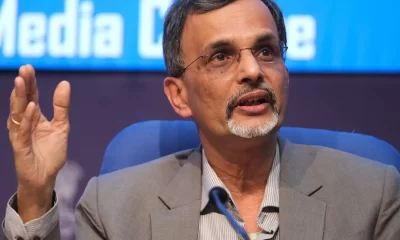
The report’s author Chief Economic Adviser Arvind Subramanian said while progress had been made in some areas, the “deeper societal son-preference” was proving hard to shift.

Some of the ingrained preference is due to the norms governing inheritance, the continued practice of paying a dowry for female children to be married and the tradition of “patrilocality” — women joining their husband’s households — and rituals which need to be performed by male children.

According to the report, 55% of couples who have a girl will try for another child and will keep trying until they have a boy. It’s referred to in the report as fertility “stopping rules.”

“What this says is that even if you didn’t have all those things, you have fertility stopping rules, where people say, ‘if I have a (male) child we stop… and if we don’t we continue’,” said Subramanian.

India News

Delhi Palam fire leaves 6 dead, massive rescue operation underway

Six people died after a fire broke out in a residential building in Delhi’s Palam. Firefighters continue rescue efforts with 30 tenders at the spot.


Published

on

Delhi's palam

A tragic fire incident in southwest Delhi’s Palam area on Wednesday morning claimed the lives of six people, triggering a large-scale emergency response.

According to officials, the blaze erupted in a residential building, prompting immediate action from fire and police authorities. Around 30 fire tenders were rushed to the spot to control the flames and carry out rescue operations.

Authorities said they received a distress call at approximately 7 am reporting the fire at a house within the building. Firefighters were deployed swiftly amid concerns that several residents could be trapped inside the structure.

A fire services official stated that initial information suggested people might still be inside, leading to an intensive search and rescue effort. Emergency teams, including police personnel, reached the congested locality to assist in evacuation and crowd management.

The firefighting operation was still ongoing at the time of reporting. The exact cause of the fire has not yet been determined, and further details are awaited as authorities continue their investigation.

Continue Reading

India News

Centre mandates 60% free seat allocation on flights, caps selection fees

Airlines must now offer 60% seats without extra charges and ensure better seating arrangements for passengers under new government rules.

Published

on

In a significant move aimed at protecting air travellers, the Union Ministry of Civil Aviation has directed airlines to ensure that at least 60 per cent of seats on every flight are offered without any additional selection fee. The decision follows widespread complaints from passengers about hidden charges, particularly for seat selection.

The directive has been issued through the Directorate General of Civil Aviation, which has introduced a series of passenger-friendly norms to enhance transparency and improve the overall flying experience.

Under the new guidelines, airlines have also been instructed to seat passengers travelling on the same PNR together, preferably in adjacent seats. This is expected to address long-standing concerns among families and group travellers, who often face inconvenience due to scattered seating arrangements.

The regulator has further emphasised the need to safeguard passenger rights in situations such as flight delays, cancellations, and denied boarding. Airlines have been asked to prominently display these rights across their websites, mobile applications, booking platforms, and airport counters to ensure better awareness.

In addition, carriers must establish clear and transparent policies regarding the carriage of sports equipment, musical instruments, and pets. The move comes in response to frequent complaints over inconsistent rules and high charges. Airlines have been directed to align such policies with safety and operational standards while ensuring they are communicated in a simple and passenger-friendly manner.

To improve accessibility, the regulator has also asked airlines to share passenger rights information in regional languages.

Continue Reading

India News

Mamata Banerjee warns BJP, EC over Bengal polls, says they will be accountable

Mamata Banerjee holds BJP and Election Commission responsible for any incidents during Bengal polls, raising concerns over officer transfers.

Published

on

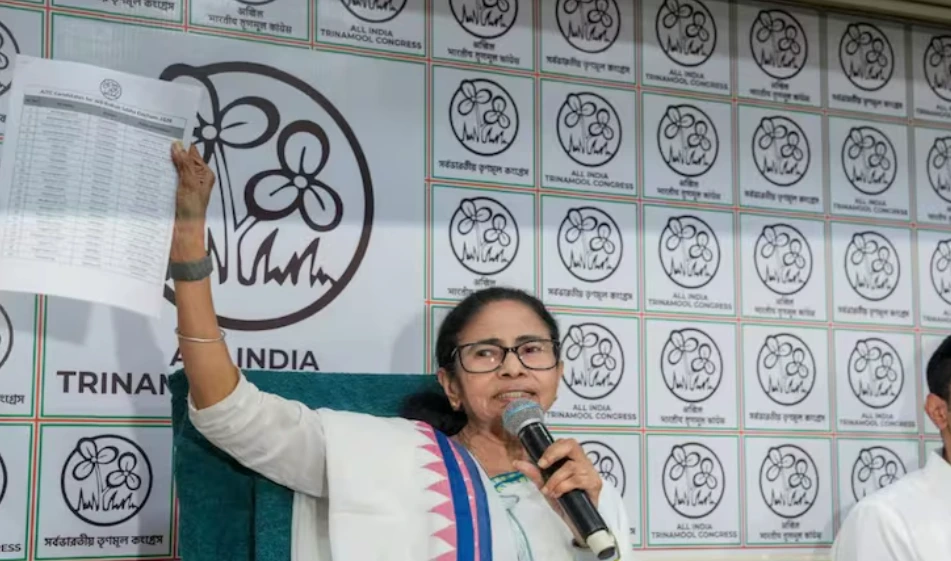
West Bengal Chief Minister Mamata Banerjee has held the Bharatiya Janata Party (BJP) and the Election Commission of India responsible for any untoward incidents in the state during the upcoming assembly elections, following the transfer of key officials.

Addressing concerns over administrative reshuffles, Banerjee said that changes involving senior bureaucrats, including the chief secretary and home secretary, could affect governance and law and order in the state during a crucial period.

The Trinamool Congress chief also announced candidates for 291 constituencies for the elections scheduled to be held in two phases on April 23 and 29.

Criticising the Election Commission, Banerjee alleged that the transfers were being carried out in a manner that benefits the BJP. She questioned the timing of the decisions and said such actions weaken the state administration at a sensitive time.

She further raised concerns about disaster management and essential services, stating that experienced officials familiar with the state’s situation have been replaced. According to her, this could impact administrative efficiency if any emergency arises before the new government is formed.

Protecting Bengal’s identity

Banerjee emphasised that the election is not merely about forming a government but about safeguarding Bengal’s identity and existence. She accused the BJP of misusing central agencies and attempting to influence the electoral process.

She urged that elections should be conducted peacefully, without external interference, and in line with democratic principles. The chief minister also expressed confidence that her party would return to power with a stronger mandate.

Appealing to voters, she called for support for the Trinamool Congress, asserting that the people of Bengal will ultimately decide the outcome and protect their democratic rights.

Continue Reading

Trending

© Copyright 2022 APNLIVE.com